
Getting Paid to Carry the Risk You Keep Avoiding
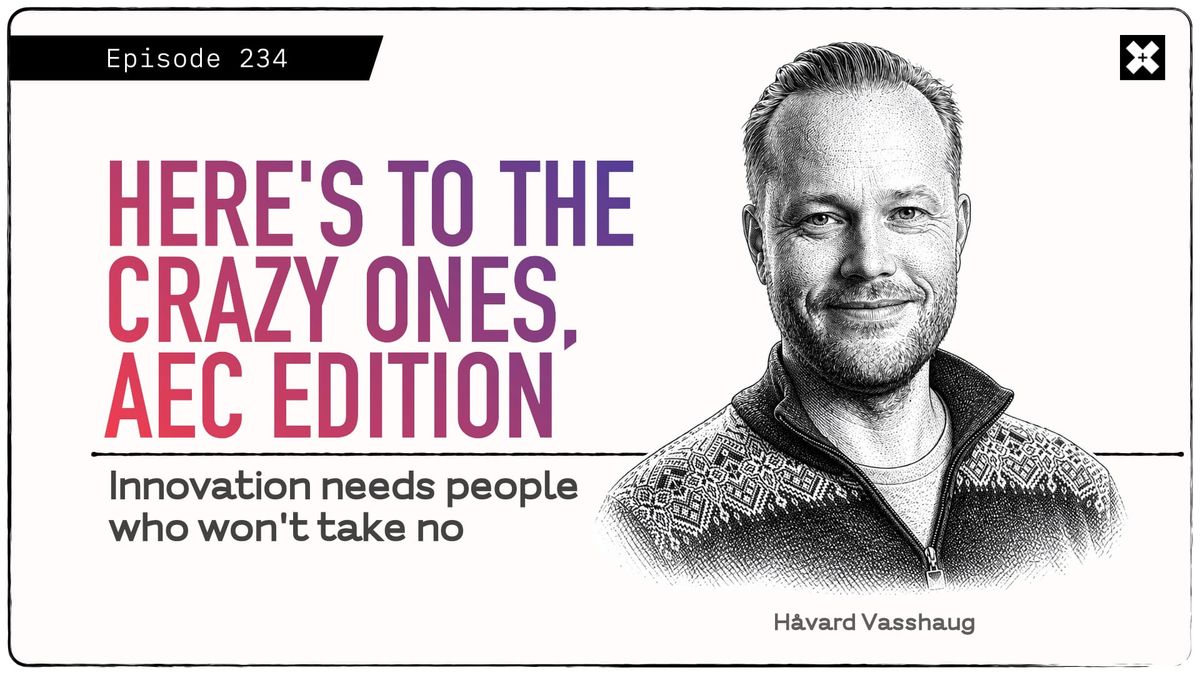
📰 The industry spent decades shedding risk. Håvard Vasshaug thinks that instinct is killing the profession's upside, and the firms taking risk back on are ending up light years ahead. The case for more crazy ones in AEC.
What if the biggest risk to your firm isn't the one you keep avoiding, but the one you keep handing to somebody else?
Summary
Håvard Vasshaug came back on the show after a couple of years, and a lot has changed. He's a structural engineer by training, and he spent 21 years in BIM. For a long stretch he was the guy with 100 Dynamo scripts, standing in the middle of a circle of contractors who all needed construction data crammed into his Revit model. He calls that version of himself The Bottleneck. That experience is basically the origin story for AnkerDB, the Norwegian software company he now runs (TRXL 234).
His core argument is simple and a little uncomfortable: it makes no sense to force construction and cost data into a design tool that was never built for it. Design authoring tools are good at parametric 3D. They are terrible at being the place where a contractor, a manufacturer, and an owner all manipulate live data. So Håvard's company pulls that data out and lets everyone in the value chain contribute to it, without needing a Revit license or a Revit expert. Along the way he makes a claim worth some introspection: the real problem on your projects isn't bad data. It's six-week-old data.
Then the conversation got spicy. We talked about risk, and how the industry has spent decades shedding it, pushing it onto the next party down the chain. Håvard sees an opportunity to do the opposite: take more of it on and get paid for it. The firms that self-disrupt, that turn who does what upside down, end up looking light years ahead of everyone else. And we landed on his hot take, borrowed from an old Apple ad. We don't have enough crazy ones in AEC, and the committees we love so much are very good at making sure we never get more.
What's Inside
- The database hiding in plain sight. Everyone knows a Revit file is a database, so why does almost nobody treat it like one, and what changes when you finally do.
- Six weeks late. Why the information problem on most projects isn't quality, and what that means for the decisions your site team makes every day.
- The risk trade nobody talks about. The industry spent decades getting rid of risk, and Håvard thinks that instinct is killing the profession's upside.
- Don't touch my file. Where the architect's protectiveness over a shared model actually comes from, and why it starts in school.
- The committee problem. What happens to the person willing to punch through a few brick walls the moment a decision needs a committee.