
Building for Four Million Architects
📰 Why does a software founder frame his entire company around helping architects build spaces where people fall in love? Mariusz Hermansdorfer's answer starts with 13 years inside a 20,000-person firm.
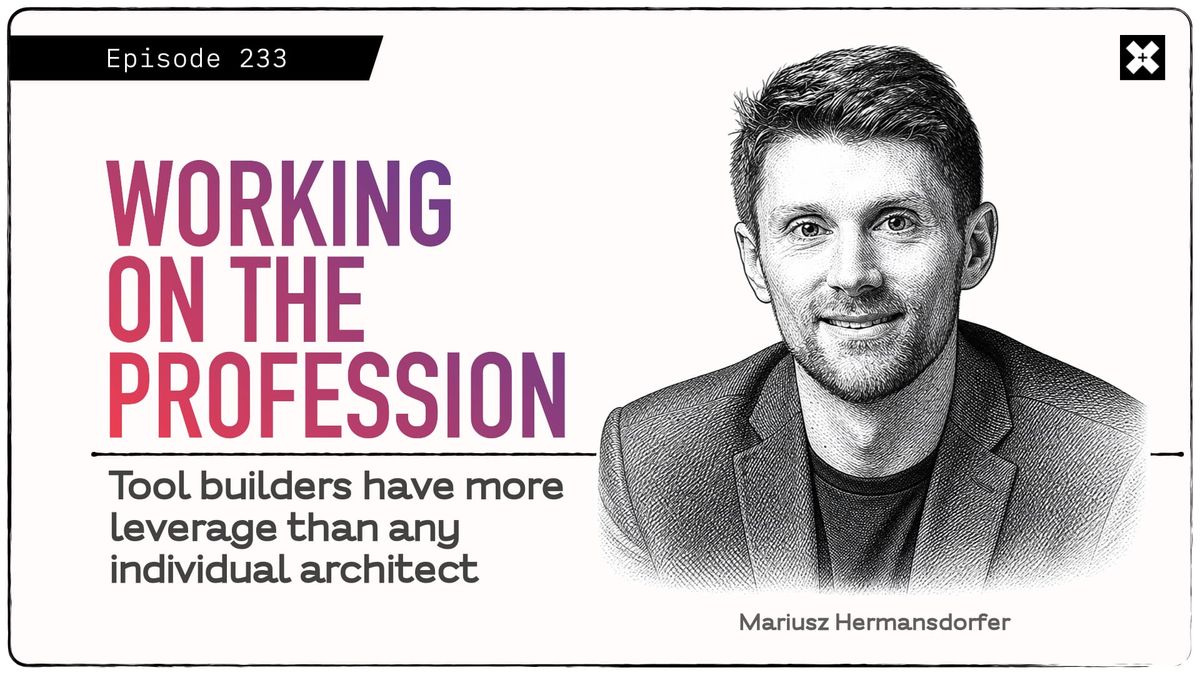
Why does a man who writes code for a living frame his entire company around helping architects build spaces for people to kiss?
Summary
In TRXL 233, I talked with Mariusz Hermansdorfer, who spent 13 years inside the Ramboll Group (most recently as head of computational design at Henning Larsen in Copenhagen) before spinning out jifto last October as the first-ever tech spinoff in both Henning Larsen's and Ramboll's history. Jifto is a personal sustainability assistant that lives inside Rhino, where designers already work. It runs wind, stormwater, microclimate, sunlight, and biodiversity studies during early design stages, with an AI companion built in.
The conversation ranged from what it takes to convince a 750-person architecture firm inside a 20,000-person engineering conglomerate to release its first-ever spinoff, to the translation problem between how designers think and how engineers deliver, to why Mariusz built his entire company around the 80% of sustainability questions that most architects have never been able to answer on their own.
What makes this conversation different from most founder stories? Read on to find out.
What's Inside
- The Translation Layer. Designers and engineers have been talking past each other for decades on sustainability, and the tools haven't helped. What does a genuine language bridge actually look like, and who bears the cost of building it?
- The 80% Bet. Jifto deliberately does less than specialist tools. Is that a limitation or a strategic advantage, and what does it mean for the majority of architects who have never run a sustainability study at all?
- The Spinout Story. Getting a 750-person firm inside a 20,000-person engineering conglomerate to release its first-ever spinoff took 13 years of relationship-building and nearly a year of dedicated conversations. What finally made it happen?
- The AI Multiplier. A team of five is shipping a product that Mariusz says wouldn't have been possible two years ago. What changes when every team member has several agents working alongside them?
- Spaces for People to Kiss. Underneath all the code and wind simulations is a surprisingly human motivation. What does a man who endowed a park for his first kiss have to do with why Mariusz writes software for architects?