
Inside /slantis' Six-Month Sprint to Claude Code, 200+ Tools, and an AI Maturity Framework
Mercedes Carriquiry and Nicolás Martínez on how /slantis actually rolled out AI across a 250-person studio, not the highlight reel version.
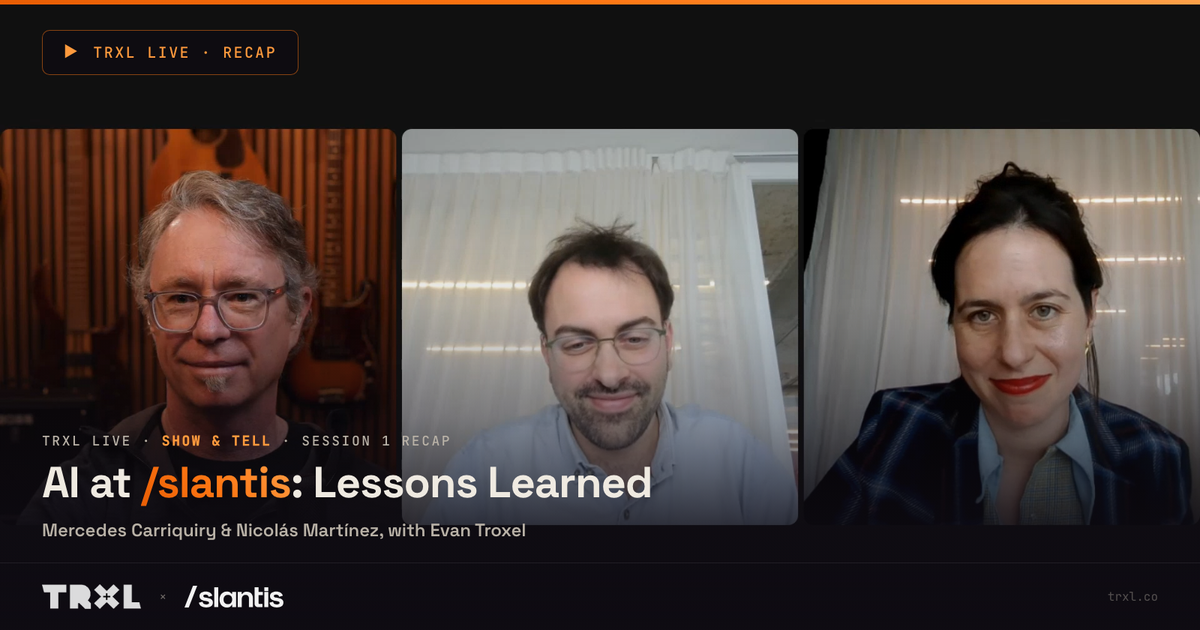
I sat down live with Mercedes Carriquiry and Nicolás Martínez from /slantis, a 250-person architecture delivery studio, for a show-and-tell walking through how AI adoption actually happened inside their company since they began in earnest in March of this year. Mercedes co-founded /slantis and now heads Applied Research. Nicolás leads the technology team.
I wanted to have this conversation because most of what I hear about AI adoption in AEC is either the (un)finished product or the people watching from the sidelines. Nobody walks you through what they've done from March to September, but /slantis did.
The starting point: March, and a "third arm"
Nicolás put a date on it: March of this year, when the technology team got Claude Code licenses. He described it as an enlightenment moment. Not a new tool added to the pile, something categorically different. His line for it: "you have a new arm to do things you didn't have before." He said he felt the way he did in architecture school, seeing for the first time everything he could build.
That energy is real and it's also a trap if you don't do anything with it. What /slantis did with it was small on purpose. The first exercise wasn't a client deliverable. It was reorganizing folders. Nicolás' point: AI adoption can be that simple to start, and starting simple is what let it compound. A month later the tech team gathered the whole studio for their weekly all-hands and showed everyone what a person with almost no development background could now build. That's the moment /slantis actually calls its first milestone, not the initial license purchase.
Leadership's runway was longer than the sprint
Mercedes was careful to separate the visible sprint from the invisible runway underneath it. /slantis' first AI project was in 2021: an internal, for-fun exploration of image-generating models tied to an outside design competition, done just to understand how the technology worked. A couple of years after that came an internal workshop process that produced /slantis' first AI-driven knowledge chat, which a better tool made obsolete about a month later. Mercedes was blunt about that pattern repeating even now: "we tend to create things and then suddenly something's replacing that, and you have to be fine with that."
Her framing of what AI adoption actually costs a firm is the line I'd put on a slide if I were speaking to firm leadership: implementing AI within a company means fundamentally changing your business model, and that's the real measure of how mature an adoption effort is, not license count.
Permission, scarcity, and who goes first
I asked how important it was for leadership to explicitly hand staff permission to use AI at work, versus staff experimenting on nights and weekends without any policy in place. Nicolás's answer was culture first, structure second: most people at /slantis were already all in, and the ones who weren't needed to see a peer succeed before they'd try it themselves.
Mercedes said they started with roughly 10 builder seats out of 250 people, deliberately scarce, and let demand build from visible wins. A month after the first licenses went out, requests for a license had doubled. "Generating scarcity is a good idea always to draw demand," she said, "and also showing the value." That's a leadership move as much as a technology one, and it's the piece firms skip when they roll out a tool to everyone on day one and wonder why nothing changes.
The unglamorous middle: governance before it gets messy
By May, /slantis had roughly 90 active seats and had moved past experimenting into what Nicolás called a real development phase. That's also when the risk showed up: everyone was becoming a software developer, and nobody was thinking about how to version, distribute, or govern what they were building. So the technology team stood up an applied research group and a tooling framework: what platforms to build on, what counts as worth scaling versus a personal tool someone's allowed to throw away, and who owns the accountability for both.
Mercedes said at their current pace, /slantis is shipping roughly 1.14 new Revit buttons a day, as a company. Before March, three or four people at the firm could actually write software. A month after Claude Code rolled out, they had ten new internal tools that didn't exist before.
That volume created its own problem. With that many people building, nobody could keep track of what already existed. Their fix was a harvest skill that captures anything built in Claude Code into a searchable tool portfolio, plus a tool-finder skill that answers "is there already something for this?" against both their internal catalog and outside tools on the market. Mercedes said the irony out loud: use AI to implement AI. It's a recursive loop, and it's the only way discovery scales past a dozen people.
Usage isn't the win. Value is.
I pushed on this directly: session counts and license numbers measure use, not success. Mercedes's answer reframed the whole conversation. /slantis tracks AI impact across five dimensions (firm strategy, firm operations, culture and adoption, knowledge management, and design and delivery) because the industry's incentives currently point at automating the business side of a firm, not the design and delivery work that actually generates revenue. Right now, she said, /slantis' biggest measured impact is in firm operations, culture and adoption, and design delivery, but not yet at the level of the business model itself. That's still ahead.
The most interesting data point from the session: 55% of all Claude sessions at /slantis come from just 10 people. That's expected for a heavy-builder cohort using Claude Code all day. What genuinely surprised Nicolás was watching a much lighter user, someone not building tools at all, just running their daily job through Claude's interface, become one of the platform's heaviest users by session count. That's the signal that adoption is spreading past the builders, into the people who just need to get work done.
The AI maturity framework
Out of all of this, /slantis built a framework they plan to open source: five stages of maturity, from limited to leading, mapped against the same five practice dimensions. What matters isn't just your score in one dimension, Mercedes said, it's the spread across all five, because moving the whole business forward beats getting one department to leading status while the rest stays flat. And she was insistent about honesty in self-assessment: don't invent reasons you're scoring higher than you are, because the only reason to use the tool is to actually know where you stand.
She was equally clear that /slantis isn't AI-first yet, even though three months ago they thought they'd be there by now. "We're not yet AI first. We want to be AI first," she said. That kind of honesty, in public, about a company that's clearly ahead of most of its peers, is rare and worth noting on its own.
Where to see it
The framework is still being built as /slantis works through it themselves, with plans to make it publicly available so other firms can start from something instead of a blank page. Check /slantis at slantis.com for updates. Watch the full conversation here.
This was the first of two live sessions with /slantis. The second, a hands-on show and tell with the team walking through actual tools they've built, streams October 7. Thanks to Mercedes and Nicolás for doing this one in public.