
241: From Autocomplete to Agent: Where AEC Actually Is
A conversation with industry vendors and practitioners about why AI tools in AEC often deliver value only on deterministic, repetitive tasks, the hype versus reality of autocomplete, copilot and agents, and the critical role of the AI harness.
Every company in this arc has AI in their marketing. So I asked all of them the same question: in a real firm today, what can it actually do, and what can't it?
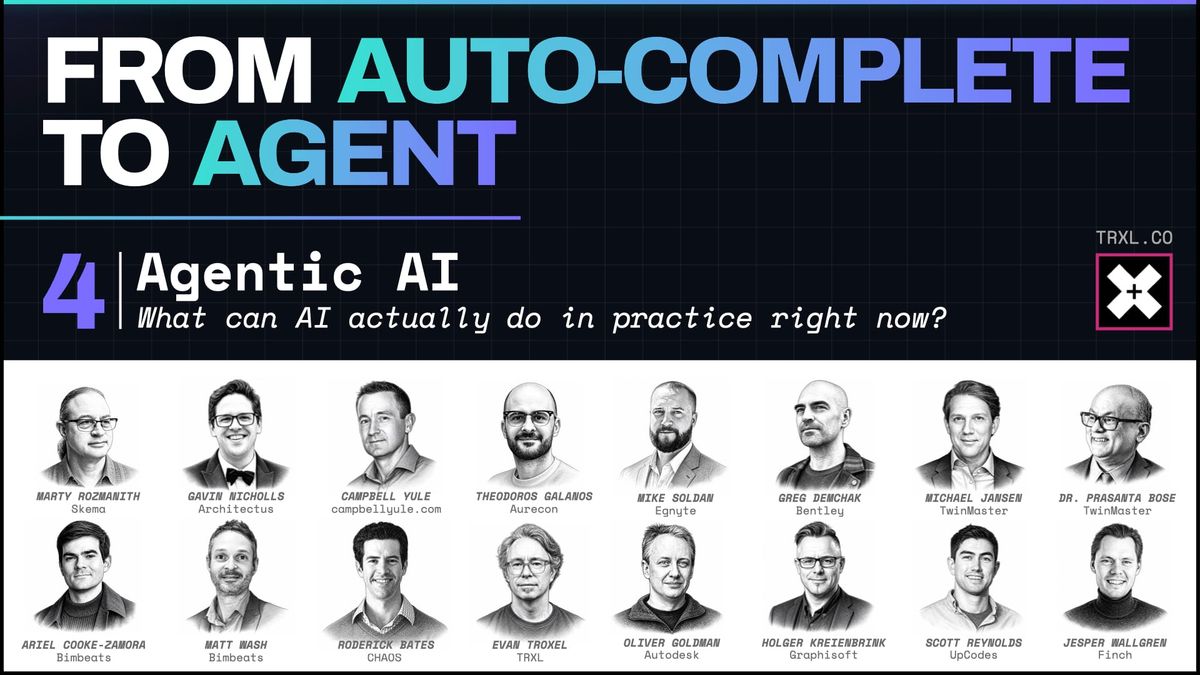
Michael Jansen and Prasanta Bose at TwinMaster open with why firms resist adopting new tools at all, and Roderick Bates at Chaos separates real capability from social-media hype using a story about his son and a magnet-fishing YouTube video. Holger Kreienbrink at Graphisoft wants AI on the tedious tasks, not the creative ones. Marty Rozmanith at Skema says 90 to 95 percent of what they do is deterministic math, not AI at all. Ariel Cooke-Zamora and Matt Wash at Bimbeats can actually measure adoption inside a firm instead of guessing at it. And Oliver Goldman at Autodesk admits he isn't sure autocomplete, copilot, and agent mean anything different beyond marketing, before Greg Demchak at Bentley and Theodoros Galanos at Aurecon lay out what a harness actually is and why it might be 90 percent of the real work.
This episode is especially relevant for firm leaders and technology decision-makers who are tired of vendor claims that expire the moment they're spoken, and who want a straight answer to what these tools do in a real firm this week, not the demo.
Original episode page: https://trxl.co/241


Graitec provides AEC software, training, and expert support to help architects, engineers, and construction teams design, build, and manage projects more effectively.

AVAIL's content management system (CMS) helps architecture and engineering teams find, manage, and reuse their Revit, AutoCAD, Civil 3D, and other technical content in one place.
Watch This on YouTube:
Episode Links:
The Series
- The Next AEC Tech Stack — Series hub · Arc 2: Agentic AI — Fifteen conversations across three arcs. This is Arc 2, episode 1 of 3 — it opens the Agentic AI arc.
- Previous episode: TRXL 240 — I've Got to Get My Project Out on Friday (Arc 1, episode 3, closed Arc 1)
Voices in This Episode
- Michael Jansen — Chief Business Officer, TwinMaster — LinkedIn · TwinMaster
- Dr. Prasanta Bose — CEO & CTO, TwinMaster — LinkedIn · TwinMaster
- Roderick Bates — Senior Director, Product Operations, Chaos — LinkedIn · Chaos · Veras
- Holger Kreienbrink — Director, Product Intelligence & Partnerships, Graphisoft — LinkedIn · Graphisoft
- Marty Rozmanith — CTO & Co-Founder, Skema — LinkedIn · Skema
- Mike Soldan — SVP, Global Technology Solutions, Egnyte — LinkedIn · Egnyte
- Scott Reynolds — CEO & Co-Founder, UpCodes — LinkedIn · UpCodes
- Oliver Goldman — VP, Software Architecture, AEC Solutions, Autodesk — Autodesk
- Greg Demchak — VP, Emerging Technologies, Bentley Systems — LinkedIn · Bentley
- Ariel Cooke-Zamora — Product Operations Lead, Bimbeats — LinkedIn · Bimbeats
- Matt Wash — CEO, Bimbeats — LinkedIn · Bimbeats
- Jesper Wallgren — CPO & Co-Founder, Finch — LinkedIn · Finch
- Campbell Yule — LinkedIn · Website — the practitioner reality check across the series.
- Gavin Nicholls — Digital / National Computation Lead, Architectus — LinkedIn · Aussie BIM Guru on YouTube · Architectus
- Theodoros Galanos — Generative AI Leader, Aurecon — LinkedIn · Aurecon
- Randall Stevens — CEO & Founder, AVAIL — LinkedIn · AVAIL
Why Firms Resist Adopting This Stuff
- TwinMaster on inertia and risk aversion — TwinMaster — Prasanta Bose on why enterprises have deep inertia against change, and Michael Jansen on why an industry that builds assets standing for decades is naturally risk-averse until the evidence is undeniable.
- Chaos on the gap between demos and reality — Chaos — Roderick Bates on Comfy UI and the disconnect between viral YouTube demos and what firms can actually get to work reliably.
- Graphisoft on where AI belongs today — Graphisoft — Holger Kreienbrink wants AI on tedious, repetitive tasks (dimensioning, cleanup, checking) and is skeptical it belongs in the creative part of design yet.
What "Agentic" Actually Means Today
- Skema on deterministic math, not magic — Skema — Marty Rozmanith says 90 to 95 percent of what Skema does is discrete deterministic solving; the AI's job is translating intent into which of hundreds of parameters to tune.
- Autodesk on autocomplete vs. copilot vs. agent — Autodesk — Oliver Goldman admits he isn't sure the terms mean much beyond branding, and that the real question is which modes of AI apply where across the product portfolio.
- The agent harness concept — Greg Demchak (Bentley) and Theodoros Galanos (Aurecon) on the idea that the model is the easy 10% and the harness — validation, integration, monitoring — is the other 90%.
Adoption, Trust, and Cost
- Egnyte on native AI vs. bolt-on chatbots — Egnyte — Mike Soldan on why Egnyte built AI directly into its content governance pipeline instead of wrapping a chatbot around existing infrastructure.
- Bimbeats on measuring adoption instead of guessing — Bimbeats — Ariel Cooke-Zamora and Matt Wash can see which programs a firm's employees actually use and how much time they spend in them — hard data on AI adoption instead of a vendor's word for it.
- AVAIL on the cost of shipping too early — AVAIL — Randall Stevens on watching AI features ship since 2017 and how a bad first impression can take years to undo, drawn from his own experience with ArchVision's RPC content.
Tools and Companies Mentioned
- Comfy UI — Roderick Bates' example of a powerful but brittle open-source visualization tool.
- Giraffe, Arcol, Snaptrude, and TestFit — the modeling-side tools Campbell Yule names.
- Lovable — the AI app-builder tool Holger Kreienbrink points to as an example of a shiny demo without real depth.
Series Partners
Arc 2 exists because these companies agreed to be asked hard questions about their own AI, with no script and no approval on the final cut.
- Autodesk · AVAIL · Bentley Systems · Bimbeats · Chaos · Egnyte · Finch · Graphisoft · Skema · TwinMaster · UpCodes
Every voice in this episode is on trxl.co/guests with their own bio.