
248: Whose Data Is It, Anyway?
Who owns your data once it lives in someone else's platform? AVAIL, Autodesk, Bentley, UpCodes, dRofus, Pirros, Egnyte, Speckle, Skema, Bimbeats, Finch, Graphisoft, TestFit, and Campbell Yule on ownership, the cost of leaving, liability, and what AI-ready means. The series finale.
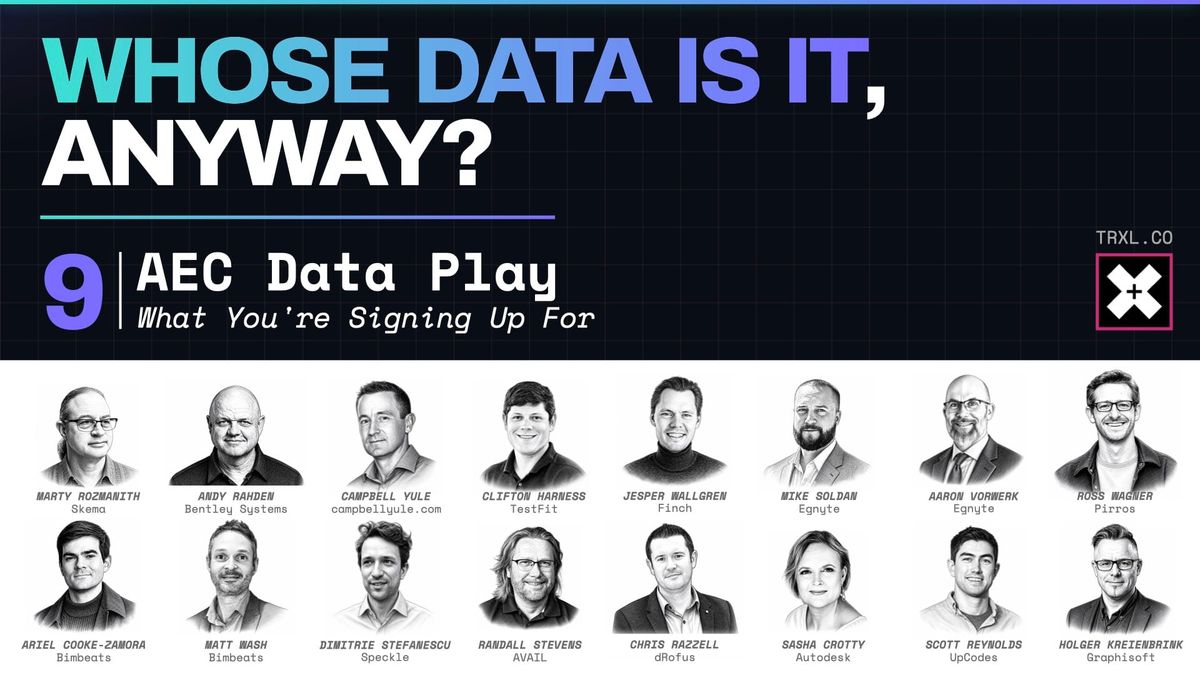
Last episode ended on a question: who owns your data once it lives in someone else's platform, and what happens when an AI starts reading it? In the series finale I put it to the vendors. Randall Stevens at AVAIL, Sasha Crotty at Autodesk, Andy Rahden at Bentley, Scott Reynolds at UpCodes, Chris Razzell at dRofus, Ross Wagner at Pirros, Marty Rozmanith at Skema, and Aaron Vorwerk at Egnyte each say what a firm keeps, what it rents, and what walks out the door when it leaves. Aaron, Mike Soldan at Egnyte, Andy, and Campbell Yule take on who is liable when something goes wrong. Dimitrie Stefanescu at Speckle, Matt Wash and Ariel Cooke-Zamora at Bimbeats, Holger Kreienbrink at Graphisoft, Jesper Wallgren at Finch, and Clifton Harness at TestFit weigh in on what AI-ready means, and whether to wait until the data is clean.
This episode is especially relevant for principals, CIOs, and BIM managers who sign the software contract or have been told to get ready for AI, and who haven't yet asked what the firm keeps, what it pays for, and what it can take with it when it leaves.
Original episode page: https://trxl.co/248

Watch This on YouTube:
| Arc 3 presenting sponsor | |
 |
Speckle makes design data actually usable across projects, so your team can trust it, own it, act on it, and make better decisions faster. |
| This series brought to you by | |
 |
Graitec provides AEC software, training, and expert support to help architects, engineers, and construction teams design, build, and manage projects more effectively. |
| With support from | |
 |
AVAIL's content management system (CMS) helps architecture and engineering teams find, manage, and reuse their Revit, AutoCAD, Civil 3D, and other technical content in one place. |
Episode Links:
The Series
- The Next AEC Tech Stack — Series hub · Arc 3: The AEC Data Play — Arc 3, episode 3 of 3, and the series finale. Arc 3 is presented by Speckle.
Previous episodes in the series:
- TRXL 238 — Half Your Day Isn't Design
- TRXL 239 — You're Not Going Home Early
- TRXL 240 — I've Got to Get My Project Out on Friday
- TRXL 241 — From Autocomplete to Agent, Where AEC Actually Is
- TRXL 242 — Designing for 100 Years… in 100 Seconds?
- TRXL 244 — Who Signs When the AI Is Wrong?
- TRXL 246 — Someone Already Figured This Out
- TRXL 247 — It's on the Server Somewhere
Voices in This Episode
- Randall Stevens — CEO and Founder, AVAIL — LinkedIn · AVAIL, From Project Knowledge to Capital Resources
- Sasha Crotty — VP, AEC Data, Autodesk — LinkedIn · Autodesk
- Marty Rozmanith — CTO & Co-Founder, Skema — LinkedIn · Skema
- Andy Rahden — Chief Revenue Officer, Bentley Systems — LinkedIn · Bentley
- Scott Reynolds — CEO & Co-Founder, UpCodes — LinkedIn · UpCodes
- Chris Razzell — Managing Director & Chief Revenue Officer, dRofus — LinkedIn · dRofus
- Ross Wagner, Assoc. AIA — Head of Industry & Product Strategy, Pirros — LinkedIn · Pirros
- Aaron Vorwerk — AEC Practice Leader, Architects + Owners, Egnyte — LinkedIn · Egnyte
- Mike Soldan — SVP, Global Technology Solutions, Egnyte — LinkedIn · Egnyte
- Dimitrie Stefanescu — CEO & Co-Founder, Speckle — LinkedIn · Speckle
- Matt Wash — CEO, Bimbeats — LinkedIn · Bimbeats
- Ariel Cooke-Zamora — Product Operations Lead, Bimbeats — LinkedIn · Bimbeats
- Jesper Wallgren — CPO & Co-Founder, Finch — LinkedIn · Finch
- Holger Kreienbrink — Director, Product Intelligence & Partnerships, Graphisoft — LinkedIn · Graphisoft
- Clifton Harness — CEO & Co-Founder, TestFit — LinkedIn · TestFit
- Campbell Yule — LinkedIn · Website
Also thanked in the close, though not heard in this episode:
- Gavin Nicholls — Digital / National Computation Lead, Architectus — LinkedIn · Aussie BIM Guru on YouTube
- Theodoros Galanos — Generative AI Leader — LinkedIn
Who Owns It, and What Leaves With You
- AVAIL on the index model — AVAIL — Randall Stevens on why AVAIL doesn't take possession of a firm's content, what a customer can export, and where the line sits between your work product and value a platform adds.
- Autodesk on ownership and pricing — Autodesk AEC Data · Data Model APIs included with subscriptions, plus flexible ways to scale — Sasha Crotty on why the relationships between data are the hard part to export, and how API pricing is being set. The linked Autodesk Platform Services post is the company's own account of the AEC Data Model API pricing she describes.
- Bentley on consent — Bentley — Andy Rahden on the data agreement registry, why customer data isn't used to train AI without explicit consent, and what to rule out in a vendor agreement.
- UpCodes on renting intelligence — UpCodes — Scott Reynolds on what a firm rents (the checking layers and code data) and what stays its own (decisions, projects, and knowledge).
- dRofus on who owns a shared project's data — dRofus — Chris Razzell on why data in a collaborative project belongs to the building owner, and how dRofus keeps one client's data from another's.
- Pirros on security — Pirros — Ross Wagner on SOC 2 Type 2, firm-specific workspaces, and why detail libraries stay out of any model trained across the industry.
- Egnyte on data it never takes — Egnyte — Aaron Vorwerk on why Egnyte studies patterns rather than a customer's files, and what a firm loses (the machinery, not the work) if it leaves.
- Skema on where pricing is heading — Skema — Marty Rozmanith's comments from the last episode on the move from license-based to transaction-based pricing.
- Campbell Yule on cloud lock-in — Website — Why transfer costs, not file formats, are the lock-in problem now that files live in the cloud.
- AEC Magazine — AEC Magazine — Martyn Day's publication. His warning about platforms embedding between a firm and its downstream work is how the episode opens.
- Palantir — Palantir for construction — The example Martyn Day gave of a platform that gets very hard to remove once it's embedded, and the comparison I put to Randall Stevens.
Liability, Security, and Handover
- Dodge Construction Network and Egnyte report — Architects and contractors underestimate cyberattack risk (Building Design + Construction) — Coverage of the study behind Aaron Vorwerk's figure that 59% of AEC firms had a cyber threat in the last two years. Dodge and Egnyte published the report, Data Resilience in Design and Construction.
- Egnyte AI readiness — Egnyte — Mike Soldan on classifying content by metadata instead of perfecting folder structure, retention policies, and why he expects breaches from firms that put margin ahead of governance.
- The architect's instruments of service — AIA Contract Documents — The standard owner-architect agreement I describe on the show: the architect owns its instruments of service and the owner gets a license to use them on that one project.
- Bentley on provenance — Bentley — Andy Rahden on audit trails as an insurance policy, using a highway utility clash and a change order as the example.
What AI-Ready Means
- Speckle on getting out of Revit files — Speckle — Dimitrie Stefanescu on moving data out of Revit and into a neutral database, going to the source instead of reading data back out of PDFs, and the hidden-geometry problem.
- Bimbeats on Elastic and measuring workflows — Bimbeats · Elastic — Matt Wash on structuring data in Elastic so the database and the models can keep improving without rework. Ariel Cooke-Zamora on why understanding your own workflows is how you evaluate a new tool.
- Graphisoft on agents that enrich a model — Graphisoft — Holger Kreienbrink on agents that check a model and suggest what's missing while the design is underway.
- Finch on structuring as you learn — Finch — Jesper Wallgren on why structuring your own drawings teaches you something, even if AI will eventually do it.
- TestFit on intent — TestFit — Clifton Harness on why drawings and models are derivatives of a building's intent, and what context an AI needs to avoid hallucinating.
- IFC — buildingSMART, Industry Foundation Classes — The open format I describe before Campbell Yule's segment, and his point that it has never carried a whole project.
Where the Data Pays Off
- Bimbeats on crashes — Bimbeats — Ariel Cooke-Zamora and Matt Wash on pulling crash timestamps, machine metrics, and journal logs into one summary, and two crashes from the same week with two different fixes.
- BricsCAD — Bricsys BricsCAD — The concurrent-license option Matt Wash's example firm moved to from named AutoCAD users, taking its spend from about $90,000 a year to $15,000.
- Revizto — Revizto — The coordination platform in Matt Wash's crash example, where a user had four models open and tried a Revizto export.
- UpCodes on checking against historical projects — UpCodes — Scott Reynolds on testing a review against past projects to see what it catches that you didn't.
Previous TRXL Episode Mentioned
- TRXL 237 with Phil Read — TRXL 237 — The Interns Will Have Interns, with Phil Read — The conversation Chris Razzell refers to when he talks about the sawtooth diagram and keeping a human in the loop.
Series Partners
These companies took part in The Next AEC Tech Stack.
- Speckle (Arc 3 presenting sponsor)
- Graitec (foundation partner)
- AVAIL (supporting sponsor)
- Autodesk
- Bentley
- Bimbeats
- Chaos
- dRofus
- Egnyte
- Finch
- Graphisoft
- Pirros
- Skema
- TestFit
- TwinMaster
- UpCodes
Every voice in this episode is on trxl.co/guests with their own bio.