
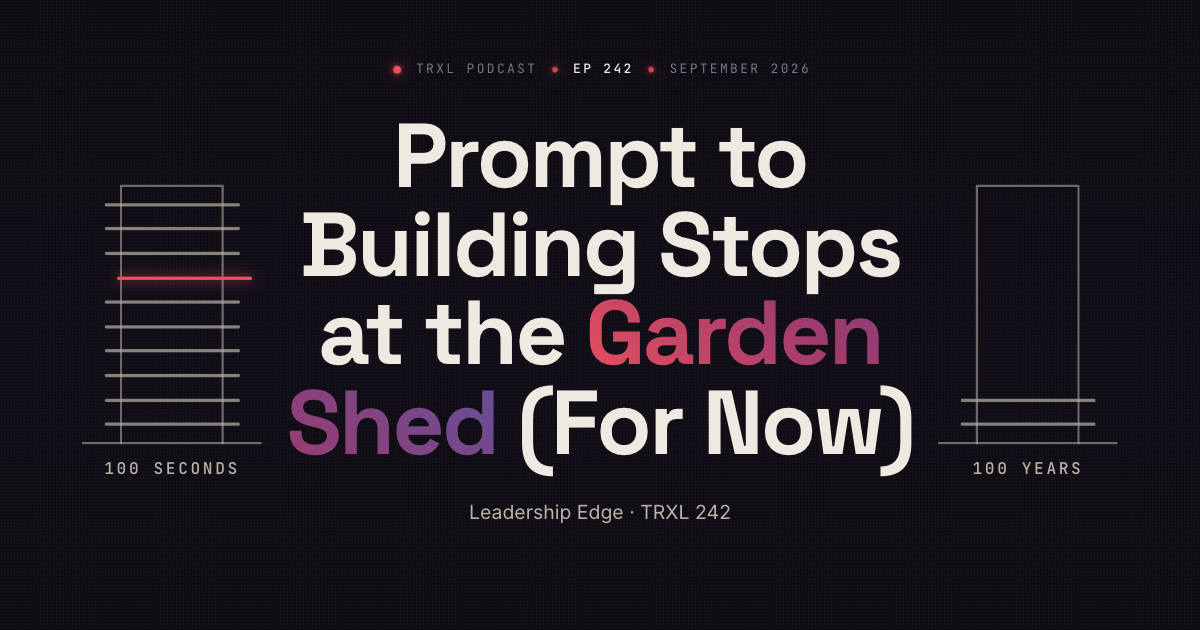
Prompt to Building Stops at the Garden Shed (For Now)
📰 Nobody has taken prompt-to-building past a garden shed, said one guest. Autodesk, Bentley, Skema, Finch and more on where agents work today and where a design decision still needs time to incubate and iterate.
If an agent can draw your fifty façade balconies in Revit in half a second, who has to figure out how to fix it when it gets one wrong? Again, this leads to more questions than answers.
Summary
For this episode of The Next AEC Tech Stack (TRXL 242), I put two questions to the same partners you heard in the last episode. First, when a vendor says AI, do they mean autocomplete, a copilot, or something that acts on its own (agent), and does the difference matter to you? Second, further out, can you describe a building in plain English and get something useful back?
I heard from Oliver Goldman at Autodesk, Greg Demchak at Bentley, Matt Wash and Ariel Cooke-Zamora at Bimbeats, Marty Rozmanith at Skema, Scott Reynolds at UpCodes, Prasanta Bose and Michael Jansen at TwinMaster, Mike Soldan at Egnyte, Roderick Bates at Chaos, Holger Kreienbrink at Graphisoft, and Jesper Wallgren at Finch, plus practitioners Gavin Nicholls, Campbell Yule, and Theodoros Galanos. The labels got less airtime than I expected. Oliver said he isn't sure copilots, agents, and assistants mean much beyond branding. The better answers were about what an agent is allowed to touch and who checks its work.
The prompt-to-building answers split along a line I recognize from my years running digital practice inside a large firm: geometry is getting close, and design is a different problem. Jesper gave the episode its title with one sentence, and several other guests landed near it from different directions.
| This series brought to you by | |
 |
Graitec provides AEC software, training, and expert support to help architects, engineers, and construction teams design, build, and manage projects more effectively. |
| With support from | |
 |
AVAIL's content management system (CMS) helps architecture and engineering teams find, manage, and reuse their Revit, AutoCAD, Civil 3D, and other technical content in one place. |
If someone forwarded this to you, sign up free and the rest of the series lands in your inbox as it publishes. TRXL+ members also get the ad-free feed, the full back catalog, and all the content that goes back behind the paywall when we return to our regular schedule following this series.
What's Inside
- The pen problem. Autodesk started Revit's MCP server read-only, so what changes once you and an agent can both edit the same model?
- Scripts the AI writes and runs. One guest said the smartest thing an agent can do is choose something deterministic, which raises a question about who reads that script later.
- Stacked versus coordinated agents. Two guests disagreed about how multi-agent systems should be built, and a third ran an experiment that got stuck in a loop.
- Same engine, new interface. Bentley made a bet that doesn't involve rebuilding anything, and I wanted to know what that changes on a Monday morning.
- A hundred years in a hundred seconds. Guests took on prompt-to-building from four angles, and I gave a read of my own that I'm less sure about now.