
242: Designing for 100 Years… in 100 Seconds?
A conversation with Oliver Goldman, Greg Demchak, Matt Wash, Marty Rozmanith, and other experts about AI agents versus copilots, trust frameworks, and the challenges of prompting a building in AEC.
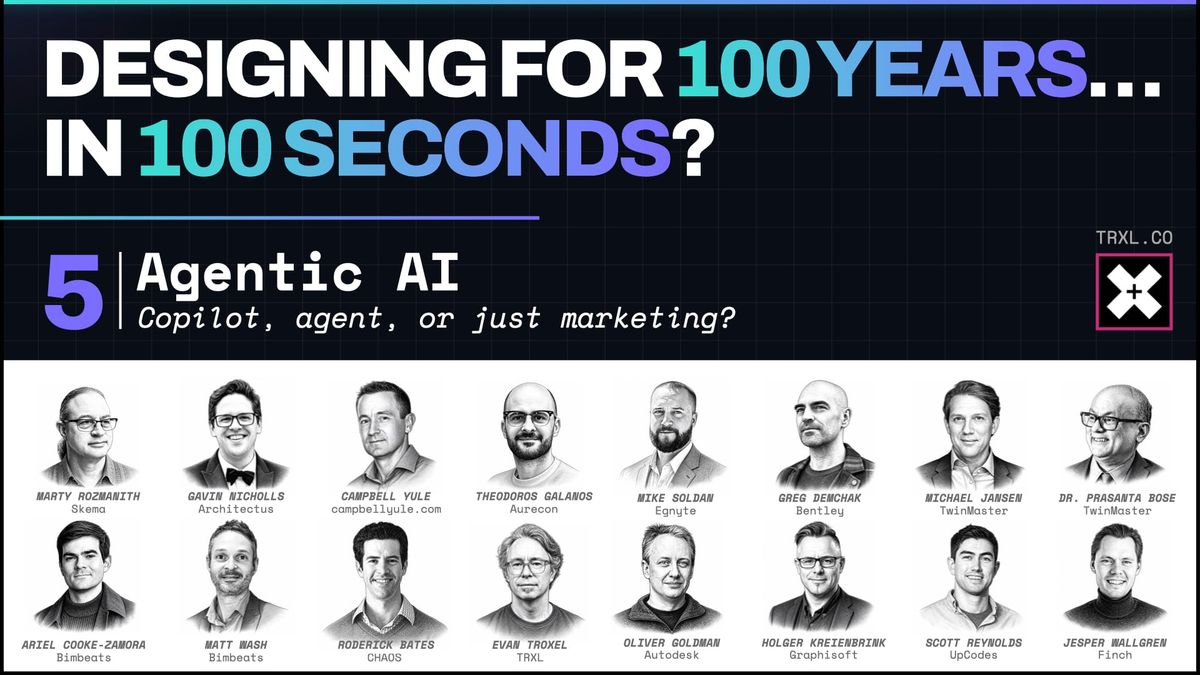
I asked the same people you heard last episode two questions back to back. When a vendor says AI, do they mean autocomplete, a copilot, or something that acts on its own, and does the distinction matter to you? And further out, can you describe a building in plain English and get something real back?
Oliver Goldman at Autodesk isn't sure the three terms mean much beyond branding, and explains why Revit's MCP server started read-only when both you and the agent hold the pen. Greg Demchak at Bentley describes an agent driving a headless MicroStation, and argues for a new interface on top of a proven geometry engine instead of a rewrite. Matt Wash at Bimbeats shows an agent flagging a model with 50 hours of work from one person and no second reviewer, while Ariel Cooke-Zamora explains why his crash-report agent ended up as a Python script. Marty Rozmanith at Skema says the AI writes deterministic scripts and then runs them, and calls Revit a data entry tool. Scott Reynolds at UpCodes says stacking agents in a line is a software architecture mistake. Jesper Wallgren at Finch gave this episode its title. Mike Soldan (Egnyte), Prasanta Bose and Michael Jansen (TwinMaster), Roderick Bates (Chaos), Holger Kreienbrink (Graphisoft), Gavin Nicholls, Campbell Yule, and Theodoros Galanos (Aurecon) weigh in on where the prompt-to-building idea holds up and where it breaks.
This episode is especially relevant for firm leaders and design technologists who are being sold "agentic" this quarter and need a way to tell what ships today from what is still a demo, and for anyone wondering how far a prompt gets you toward a building.
Original episode page: https://trxl.co/242

| This series brought to you by | |
 |
Graitec provides AEC software, training, and expert support to help architects, engineers, and construction teams design, build, and manage projects more effectively. |
| With support from | |
 |
AVAIL's content management system (CMS) helps architecture and engineering teams find, manage, and reuse their Revit, AutoCAD, Civil 3D, and other technical content in one place. |
Watch This on YouTube:
Episode Links:
The Series
- The Next AEC Tech Stack — Series hub · Arc 2: Agentic AI — Arc 2, episode 2 of 3.
Previous episodes in the series:
- TRXL 238 — Half Your Day Isn't Design
- TRXL 239 — You're Not Going Home Early
- TRXL 240 — I've Got to Get My Project Out on Friday
- TRXL 241 — From Autocomplete to Agent, Where AEC Actually Is
Voices in This Episode
- Oliver Goldman — VP, Software Architecture, AEC Solutions, Autodesk — Autodesk
- Greg Demchak — VP, Emerging Technologies, Bentley Systems — LinkedIn · Bentley
- Prasanta Bose — CEO & CTO, TwinMaster — LinkedIn · TwinMaster
- Michael Jansen — Chief Business Officer, TwinMaster — LinkedIn · TwinMaster
- Mike Soldan — SVP, Global Technology Solutions, Egnyte — LinkedIn · Egnyte
- Matt Wash — CEO, Bimbeats — LinkedIn · Bimbeats
- Ariel Cooke-Zamora — Product Operations Lead, Bimbeats — LinkedIn · Bimbeats
- Marty Rozmanith — CTO & Co-Founder, Skema — LinkedIn · Skema
- Scott Reynolds — CEO & Co-Founder, UpCodes — LinkedIn · UpCodes
- Jesper Wallgren — CPO & Co-Founder, Finch — LinkedIn · Finch
- Roderick Bates — Senior Director, Product Operations, Chaos — LinkedIn · Chaos
- Holger Kreienbrink — Director, Product Intelligence & Partnerships, Graphisoft — LinkedIn · Graphisoft
- Gavin Nicholls — National Computation Lead, Architectus — LinkedIn · Aussie BIM Guru on YouTube · Architectus
- Campbell Yule — LinkedIn · Website
- Theodoros Galanos — Generative AI Leader, Aurecon — LinkedIn · Aurecon
Copilot, Agent, or Marketing
- Autodesk on the vocabulary — Autodesk — Oliver Goldman isn't sure copilots, agents, and assistants mean much beyond branding, and describes Autodesk Assistant moving from a help feature to a standalone experience that works across products.
- Bentley on where each one shows up — Bentley — Greg Demchak separates a copilot that annotates a drawing from an agent that calls a headless MicroStation or STAAD through MCP and feeds the results to whatever interface fits.
- TwinMaster on all three at once — TwinMaster — Prasanta Bose answers autocomplete, copilot, and agent as parts of one system, with Arch-e as the orchestrator over specialized agents.
- Egnyte on definitions getting blurry — Egnyte — Mike Soldan on skill files, planning frameworks, and why a year of arguing over what counts as an agent has mostly stopped. Includes his agent-chain examples for RFP intake and contract review.
- Skema on deterministic scripts — Skema — Marty Rozmanith on why the AI works best when it writes a deterministic script and runs it, and what delegating to an agent does and doesn't change about responsibility.
Agents Working on Firm Data
- Bimbeats on agents that read how a firm works — Bimbeats — Matt Wash on an agent that flagged a model with 50 hours from one person and no second reviewer, a burnout view for people and culture teams, and the Bluebeam Legacy to Studio report. Ariel Cooke-Zamora on a crash trigger that sends journal, model health, and hardware data to an LLM for a summary.
Guardrails and Trust
- UpCodes on independent agents and citations — UpCodes — Scott Reynolds on why linear, stacked agents are the wrong software architecture, and why every answer needs a traceable citation.
- TwinMaster on coordination instead of stacking — TwinMaster — Prasanta Bose and Michael Jansen on agents that cooperate and can bid against each other, and on why assistants bolted onto existing tools aren't the same thing.
- Campbell Yule on live feedback and compounding error — Campbell Yule — Why constant agent feedback mid-design burned tokens and told him nothing, and how a 1 percent error per step compounds.
- Gavin Nicholls on documenting code for AI — Architectus — Why comments and a roadmap of skills matter more now that an AI reads the code base.
Prompt to Building
- Autodesk on language and geometry models — Autodesk Forma — Oliver Goldman on training models that understand both language and geometry, the Building Layout Explorer in Site Design, and bringing the language interface into Autodesk Assistant.
- Bentley Labs — Bentley — Greg Demchak on the small group of creative technologists behind the embodied carbon color-coding demo and the superblock simulation built in a week with the city of Basel.
- Finch on where prompting stops — Finch — Jesper Wallgren on combining its own floor plan models, image tools, and an agent for refinement, and on the line that became this episode's title.
- Graphisoft on why not to prompt a building — Graphisoft — Holger Kreienbrink on GDL, an Archicad MCP server coming soon, and why creativity has to come from the person.
- Chaos on AI inside familiar tools — Chaos — Roderick Bates on adoption inside the tools firms already use, firms writing their own software, and using AI as a sparring partner.
Tools and Companies Mentioned
- Autodesk University — where Autodesk announced the standalone Autodesk Assistant and demonstrated the Building Layout Explorer, as Evan notes in the episode.
- Elastic — the search engine behind Bimbeats' data. Matt Wash's agents reach it through the Elastic MCP.
- Bluebeam — the Legacy versus Studio markup story in Matt Wash's segment.
- EC3 — the embodied carbon calculator in Greg Demchak's color-coded concrete demo.
- MicroStation and STAAD — the desktop engines Greg Demchak describes agents running headless.
- Enscape — Roderick Bates' example of what an interface with no buttons would mean for users.
- SketchUp — mentioned by Roderick Bates as adding an MCP server.
- TestFit and Spacio — the layout tools Evan names alongside Forma.
- Cursor — one of the tools Roderick Bates says firms use to build features on demand.
- Grasshopper and Dynamo — the visual scripting tools Marty Rozmanith and Ariel Cooke-Zamora compare agent workflows to.
- OpenAI GPT-6 Astra — the model Evan mentions generating 3D geometry and pushing it into Blender.
Series Partners
These companies took part in Arc 2 and agreed to be asked hard questions about their own AI.
- Autodesk · AVAIL · Bentley Systems · Bimbeats · Chaos · Egnyte · Finch · Graphisoft · Skema · TwinMaster · UpCodes
Every voice in this episode is on trxl.co/guests with their own bio.