

239: You're Not Going Home Early
A conversation with Gavin Nicholls, Carl Christensen, and nine other people building and using BIM 2.0 tools about the real cost of switching platforms, sunk-cost bias, and why adoption stalls even when the tool is better.
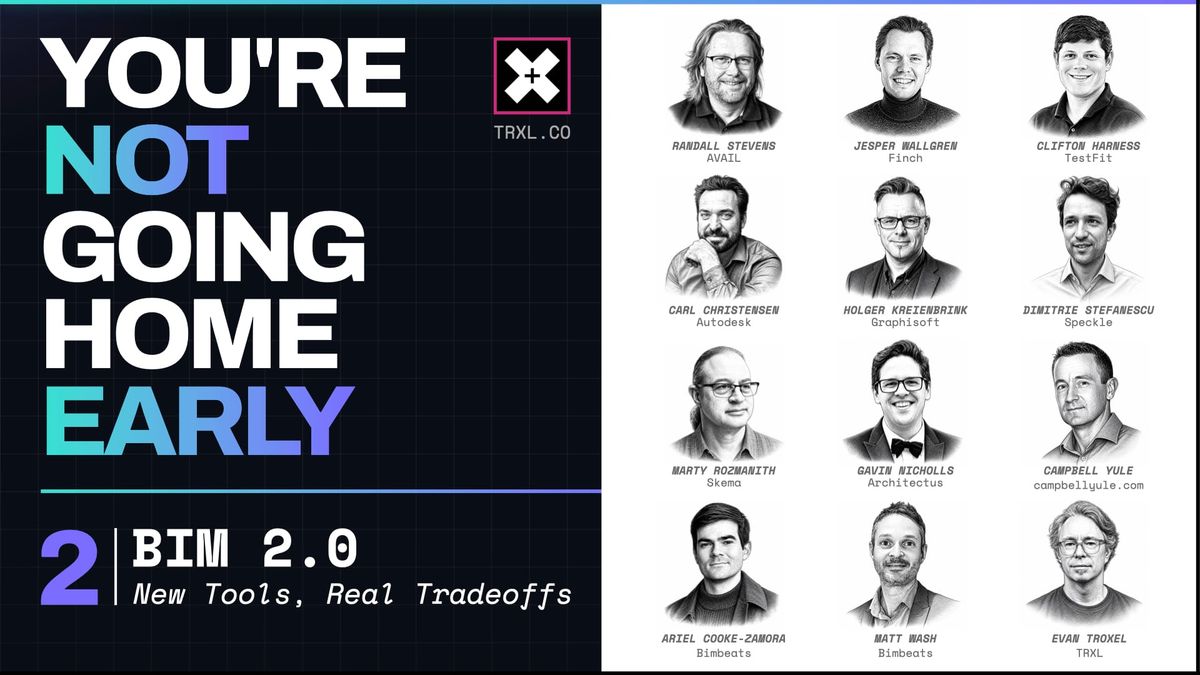
Episode one ended with the pitch: new tools give architects their day back. Episode two asks the harder question. If a firm stops running one platform and starts running ten, what happens to twenty years of muscle memory while that shakes out?
I put some version of that question to eleven voices building and using the BIM 2.0 stack. Gavin Nicholls calls the sunk cost a serious blocker and describes his own Revit add-in work as "polishing the prison bars from the other side." Carl Christensen at Autodesk has to answer for why the company that built the industry's center of gravity is choosing to hold customers' hands through the transition instead of moving faster. Matt Wash and Ariel Cooke-Zamora at Bimbeats bring real adoption data — a firm's AutoCAD-to-Civil 3D migration climbed from thirty to seventy percent, then flatlined, and the people who were going to switch already have. Campbell Yule lays out the Catch-22 underneath the whole BIM 2.0 pitch: a new tool only earns the years of trust Revit already has by getting used inside Revit first, not by replacing it. Clifton Harness at TestFit calls Revit "a masterpiece" and then argues that's exactly the problem — it's a parametric propagation engine, not a design tool, and adoption "costs everything" because firms almost never budget for retraining. And Randall Stevens, Jesper Wallgren, Holger Kreienbrink, Marty Rozmanith and Dimitrie Stefanescu all answer from inside the products they're building, sometimes conceding more than a pitch deck would allow.
This one is for BIM managers, firm leaders and anyone who has to defend a software line item — the people who feel the switching cost in their calendar, not just their budget.
Original episode page: https://trxl.co/239


Graitec provides AEC software, training, and expert support to help architects, engineers, and construction teams design, build, and manage projects more effectively.

AVAIL's content management system (CMS) helps architecture and engineering teams find, manage, and reuse their Revit, AutoCAD, Civil 3D, and other technical content in one place.
Watch This on YouTube:
Episode Links:
Some links on this page help fund our work, and we may earn a commission from purchases at no extra cost to you.
The Series
- The Next AEC Tech Stack — Series hub · Arc 1: BIM 2.0
- Nine episodes across three arcs. This is Arc 1, episode 2 of 3.
- Previous episode: TRXL 238 — Half Your Day Isn't Design (Arc 1, episode 1)
Voices in This Episode
- Randall Stevens — CEO & Founder, AVAIL — LinkedIn · AVAIL
- Carl Christensen — VP, Product, Autodesk — LinkedIn · Autodesk
- Matt Wash — CEO, Bimbeats — LinkedIn · Bimbeats
- Ariel Cooke-Zamora — Product Operations Lead, Bimbeats — LinkedIn · Bimbeats
- Campbell Yule — LinkedIn · Website — the practitioner reality check in an episode otherwise full of founders and vendors.
- Jesper Wallgren — CPO & Co-Founder, Finch — LinkedIn · Finch
- Holger Kreienbrink — Director, Product Intelligence & Partnerships, Graphisoft — LinkedIn · Graphisoft
- Marty Rozmanith — CTO & Co-Founder, Skema — LinkedIn · Skema
- Dimitrie Stefanescu — CEO & Co-Founder, Speckle — LinkedIn · Speckle
- Clifton Harness — CEO & Co-Founder, TestFit — LinkedIn · TestFit
- Gavin Nicholls — Digital / National Computation Lead, Architectus — LinkedIn · Aussie BIM Guru on YouTube · Architectus
What Switching Actually Costs
- Bimbeats' adoption data — Bimbeats
- Matt and Ariel's clearest evidence in the series: a firm's AutoCAD-to-Civil 3D adoption climbed from thirty to seventy percent over eighteen months, then flatlined. The people who were going to switch already have.
- Campbell Yule's Catch-22 — LinkedIn
- A new BIM 2.0 tool can't replace Revit or Archicad outright — it has to fit inside that world first to generate the revenue and traction that would eventually let it escape.
- TestFit on why Revit isn't the problem — TestFit
- Clifton Harness calls Revit "a masterpiece" — a parametric propagation engine whose real value is keeping contract documents in sync — and argues that's exactly why it isn't a design tool. His read on adoption: it "costs everything," because firms almost never budget to actually retrain people.
Tools and Companies Mentioned
- Autodesk Civil 3D — the tool at the center of Bimbeats' adoption-plateau data.
- SketchUp — Campbell Yule's example of the one tool BIM 2.0 challengers might actually be able to displace.
- Qonic — Campbell's example of the one BIM 2.0 player tackling developed design from the rich-3D-model end rather than documentation first.
- Snaptrude — Campbell's example of a tool already latching into automatic-generation systems.
- Arcol — Gavin's most-used BIM 2.0 tool day to day; he walks through what carries over from Revit and what he had to unlearn.
- Giraffe — one of Gavin's firm's three core BIM 2.0 tools; he calls it "a faux Rhino in the web."
- Hypar — the third of Gavin's firm's three core tools, alongside Arcol and Giraffe.
Series Partners
Arc 1 exists because these companies agreed to answer hard questions on the record, without approval over how the answers get used.
Every voice in this episode is on trxl.co/guests with their own bio.