

238: Half Your Day Isn't Design
A conversation with industry leaders about how BIM 2.0 tools consume half of architects’ day, the hidden “technology tax,” and strategies to reclaim design time and control software costs.
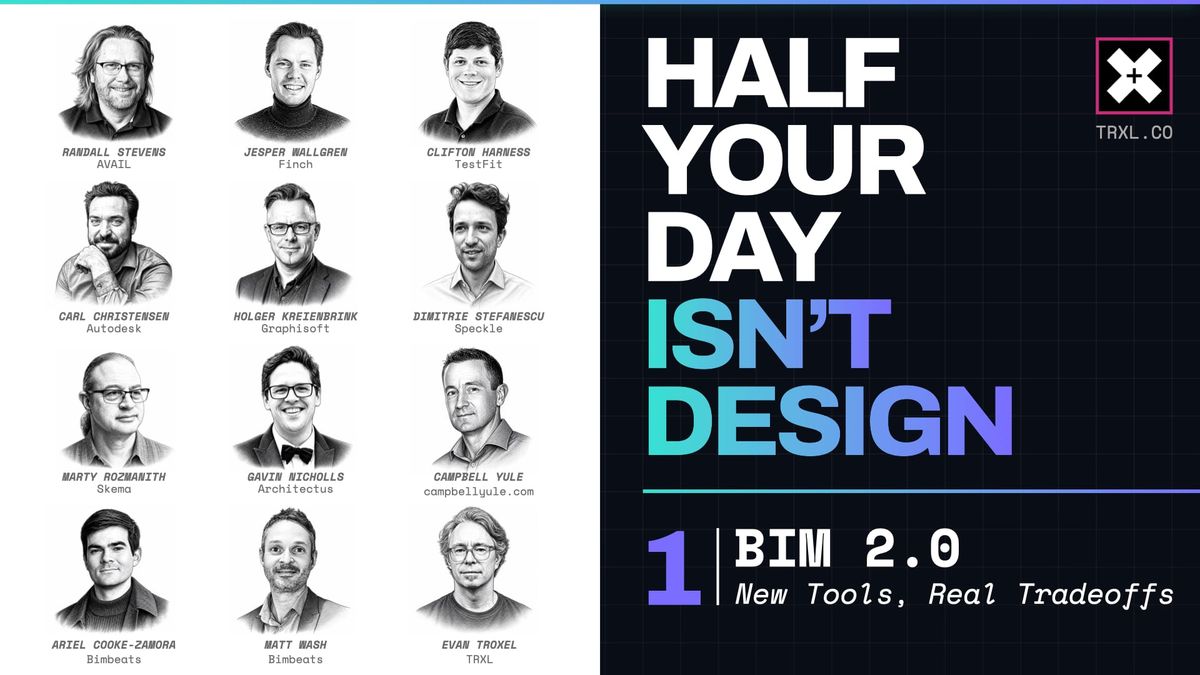
The first episode of The Next AEC Tech Stack opens on the number nobody wants to say out loud. Randall Stevens of AVAIL puts the mundane overhead of an architect's day at somewhere near fifty percent, and he admits it's hard to measure because it disappears in seconds and minutes at a time. Looking for a file. Marking up the same PDF three people already marked up. Waiting on a license.
Across this episode I put one question to ten people building and using the BIM 2.0 tools: does this let architects design, or does it move the technology tax to a different line item? Matt Wash and Ariel Cooke-Zamora bring project data showing where a documentation crunch actually went. Campbell Yule argues the real progress is much narrower than the marketing suggests. Jesper Wallgren, Holger Kreienbrink, Marty Rozmanith, Dimitrie Stefanescu and Clifton Harness answer from inside the products, sometimes conceding more than you'd expect, and Gavin Nicholls prices out what adoption actually costs a firm with a fixed tech budget. It closes with everyone answering the same three questions about the firm of 2030.
This one is for practitioners, BIM managers and firm leaders who have watched a new tool arrive and quietly add work.
Original episode page: https://trxl.co/238


Graitec provides AEC software, training, and expert support to help architects, engineers, and construction teams design, build, and manage projects more effectively.

AVAIL's content management system (CMS) helps architecture and engineering teams find, manage, and reuse their Revit, AutoCAD, Civil 3D, and other technical content in one place.
Watch This on YouTube:
Episode Links:
Some links on this page help fund our work, and we may earn a commission from purchases at no extra cost to you.
The Series
- The Next AEC Tech Stack — Series hub · Arc 1: BIM 2.0
- Nine episodes across three arcs. This is Arc 1, episode 1 of 3.
Voices in This Episode
- Randall Stevens — CEO & Founder, AVAIL — LinkedIn · AVAIL
- Matt Wash — CEO, Bimbeats — LinkedIn · Bimbeats
- Ariel Cooke-Zamora — Product Operations Lead, Bimbeats — LinkedIn · Bimbeats
- Campbell Yule — LinkedIn · Website — the practitioner reality check in an episode otherwise full of founders.
- Jesper Wallgren — CPO & Co-Founder, Finch — LinkedIn · Finch
- Holger Kreienbrink — Director, Product Intelligence & Partnerships, Graphisoft — LinkedIn · Graphisoft
- Marty Rozmanith — CTO & Co-Founder, Skema — LinkedIn · Skema
- Dimitrie Stefanescu — CEO & Co-Founder, Speckle — LinkedIn · Speckle
- Clifton Harness — CEO & Co-Founder, TestFit — LinkedIn · TestFit
- Gavin Nicholls — Digital / National Computation Lead, Architectus — LinkedIn · Aussie BIM Guru on YouTube · Architectus
Where the Day Actually Goes
- Bluebeam Studio — Bluebeam Studio
- Matt's worked example. Several people marking up the same sheet under their own filename in the last week before a documentation milestone, because nobody was in Studio.
- Autodesk Revit — Revit
- Marty's framing is worth the whole segment: Revit was always a cardboard model, a placeholder arrangement you figure out and then document.
- Rhino — Rhino3D
- Jesper's gap: free-form modeling on one side, documentation tools on the other, and workarounds, brute force and spreadsheets in between.
- Archicad — Archicad
- Holger's answer is more candid than most vendors would give. You can design in Archicad, but every option is modeled by hand and the only real simulation is shadow.
Tools and Companies Mentioned
- Qonic — Campbell's example of the one tool going at developed design from the detail end.
- Snaptrude — approaching the same territory from the conceptual end.
- Giraffe — Gavin's example of a product that landed, and of the support burden that comes with it.
- Hypar — one of the names Randall lists as actually working the execution end of the problem.
Series Partners
Arc 1 exists because these companies agreed to answer hard questions on the record, without approval over how the answers get used.
About Two of the Voices:
Dimitrie Stefanescu is the CEO and co-founder of Speckle, the open-source data platform that connects design and construction software so teams can use their model data outside the tool that made it. He trained as an architect in Bucharest and Rotterdam, worked as a project architect at Bogdan & Van Broeck, taught computational design in Berlin and Stuttgart, and did a stint at Arup as a senior programmer before landing at UCL's Bartlett in 2015 as a Marie Curie Fellow. He and Matteo Cominetti spun Speckle out into a company in 2020; it now runs inside firms like Arup, Jacobs, Mott MacDonald and Foster + Partners. He describes himself as a recovering architect, which is about right for someone who has spent a decade arguing that the lock-in was never the authoring tool, it was the file.
Clifton Harness is the CEO and co-founder of TestFit, the Dallas real estate feasibility platform that generates and prices site plans in seconds. He trained as an architect at the University of Texas at Austin, added business and real estate certificates from the McCombs School of Business, and then went to work at a Dallas multifamily developer, where he spent his days drawing apartment units and counting parking stalls. He and his college roommate Ryan Griege started automating that on nights and weekends in 2015, and TestFit now runs more than 1,500 deals a week. He is one of the few people in AEC software willing to say out loud that the binding constraint on American buildings isn't gravity or zoning, it's finance.
Every other voice in this episode is on trxl.co/guests with their own bio.