
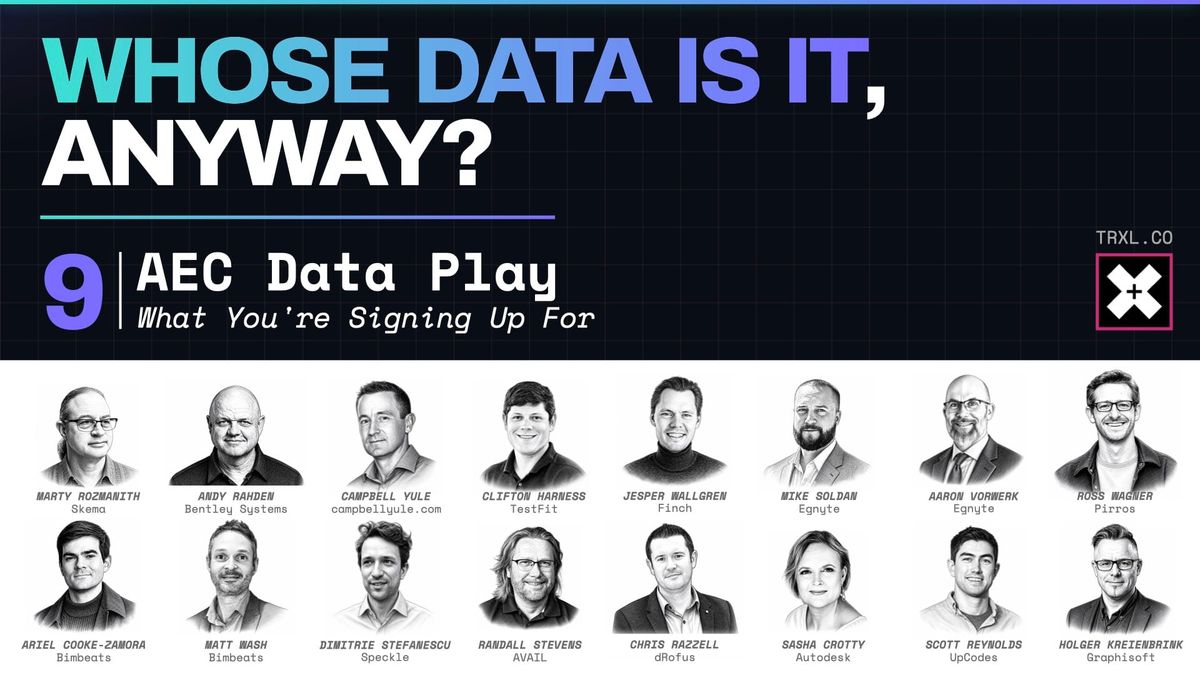
My Favorite Moments from Episode 248 "Whose Data Is It, Anyway?"
💬 28 lines worth keeping from TRXL 248. Sixteen voices on lock-in, what a platform keeps when you leave, and what AI-ready asks of a firm.
| Arc 3 presenting sponsor | |
 |
Speckle makes design data actually usable across projects, so your team can trust it, own it, act on it, and make better decisions faster. |
Every episode of this series, I go back through the full conversation and pull the lines I don't want you to miss. Here are 28 of them from Episode 248, “Whose Data Is It, Anyway?” Each one has who said it and a timestamp if you want to hear it in context.
On lock-in and what it costs to leave
 | “The question is, are you being extorted? Things cost money. The real question is, is there a fair exchange? And as long as the value's there, we look at it as whatever dollar you're paying us, I want you to be getting 10X that in value. That should be the ratio of the relationship.” Randall Stevens, AVAIL · ▶ 0:00:04 |
 | “The argument about vendor lock-in has taken a different turn now that your files are in the cloud. … Certain vendors are taking the view that if you want to take [your data] out, then there's transfer costs involved. And that's holding people to ransom a little bit. … That's got nothing to do with the file format.” Campbell Yule · ▶ 0:35:50 |
 | “I don't think people are quite aware of the future scenario that they're being lined up for. … The time to think about it is right now.” Marty Rozmanith, Skema · ▶ 0:19:20 |
| “I have no long-term rights to [your data]. If you're going to put it into my platform, you ought to be able to get it back. This is why APIs start to become important.” Randall Stevens, AVAIL · ▶ 0:02:55 |
 | “Your data is your data, full stop. … We're a partner, not the data owner, and that distinction matters.” Andy Rahden, Bentley Systems · ▶ 0:20:47 |
On what a platform keeps, and what you can carry out
 | “What is challenging to pull out of the system is the relationships [between things], because that's the system. The system is this bigger piece, and it establishes connections between the data.” Sasha Crotty, Autodesk · ▶ 0:10:52 |
| “You can change formats on a regular basis. AI can change formats for you in a couple of days. What is really important is that you know where your data is and how it's connected between different pieces.” Sasha Crotty, Autodesk · ▶ 0:17:44 |
 | “You could argue that the data is more important than the physical asset at the point of handover, because over its life, that will be very expensive information to not have.” Aaron Vorwerk, Egnyte · ▶ 0:50:10 |
| “The BIM model is the final result of the intent, but there's no capture of what the intent was.” Campbell Yule · ▶ 1:30:37 |
On trust, privacy, and AI that tells you what you want to hear
 | “You can rent or you can buy intelligence and tools, but what those systems like UpCodes doesn't have is your knowledge, and that stays unique to you. So your data, your knowledge, your decisions, all of that is private. Models don't get trained on that, which is critical.” Scott Reynolds, UpCodes · ▶ 0:22:54 |
 | “In this industry, data's incredibly confidential. And so we need to make sure that we have the right systems in place and the governance is in place to scale that effectively.” Ross Wagner, Pirros · ▶ 0:31:02 |
| “It's not about just deploying generative AI. … It's about trust, permissions, well-classified understanding of data. It's about taking this mess and making it something that's safely usable with trustworthy results.” Aaron Vorwerk, Egnyte · ▶ 0:54:14 |
| “AI's programmed to answer you. It's not programmed to be truthful about it. It's programmed to give you an answer, to make you happy by giving you an answer.” Aaron Vorwerk, Egnyte · ▶ 0:57:23 |
| “If a technology partner tells you that they're AI-ready, but can't show you a complete historical record of every model version, every change, every human approval, that really becomes more of a marketing communication versus being actually AI-ready.” Andy Rahden, Bentley Systems · ▶ 0:52:44 |
On getting data ready for AI
 | “The number of hours spent on folder structures is insane. We could've changed the world instead of every firm chasing that. … Folder structure is starting to matter less because the classification and understanding of the piece of content individually is what actually matters.” Mike Soldan, Egnyte · ▶ 0:44:25 |
 | “You don't need to wait for that data to become a PDF and then reverse engineer data out of a PDF. … If you can get to the source, get to the source. Don't wait for the decision to be taken. Don't wait for the PDF to be exported out. Go straight to where the data and the design lives.” Dimitrie Stefanescu, Speckle · ▶ 1:17:50 |
| “The most acceleration and the most ROI that we can provide with AI is on the day-to-day menial tasks. … In order to be AI-ready, you don't need much.” Dimitrie Stefanescu, Speckle · ▶ 1:04:48 |
 | “As long as we have the data structured correctly, we don't need to worry about developing the technology of the database. We don't need to worry about developing the technology of the LLMs because they're just going to get better and better and better.” Matt Wash, Bimbeats · ▶ 1:06:21 |
 | “There's some manual work to structure your data well, but I also think that probably in the future, the AI will structure the data very well itself.” Jesper Wallgren, Finch · ▶ 1:13:09 |
 | “There has to be agents that either automatically enrich the data or check it and give it to you, and you make the decisions what kind of data should be added.” Holger Kreienbrink, Graphisoft · ▶ 1:15:10 |
 | “What is needed is the right way to create AEC context information at the point of attack so that a human can be successful. We never did that, so now we will do it for agents to be successful.” Clifton Harness, TestFit · ▶ 1:33:35 |
 | “Tool fatigue is absolutely real. … So you're not going for the next shiny thing. You're going for the thing that can deliberately target a workflow that is costing you time.” Ariel Cooke-Zamora, Bimbeats · ▶ 1:07:37 |
On what to do now
| “We need to start documenting institutional knowledge. … The standards, precedents, judgment calls on your team, they rely on this every single day. So AI can't amplify what's still locked in people's file cabinets or heads.” Andy Rahden, Bentley Systems · ▶ 1:34:22 |
| “I like to use the word play, because you should be playing with all of these new capabilities as much as you can stomach. I don't think you should have your head in the sand about what change might be afoot.” Randall Stevens, AVAIL · ▶ 1:37:00 |
| “This is a train that has left the building. It's not disappearing. Even if you've been in the space for 30 years, you're not going to avoid it unless you retire first.” Mike Soldan, Egnyte · ▶ 1:35:24 |
 | “Arm yourself with knowledge. AI is here. It's disrupting things already. You don't necessarily have to be an AI expert, but you do have to be AI savvy.” Chris Razzell, dRofus · ▶ 1:43:07 |
| “This is a ship that's moving. There are other firms that are jumping on it. If we don't do this because of our own internal potential egos, then you will fall behind.” Ross Wagner, Pirros · ▶ 1:45:16 |
| “The firms that don't change their workflows as new tools evolve are the ones that are going to be overtaken by the nimble new firms that are starting today and embracing these new tools.” Ariel Cooke-Zamora, Bimbeats · ▶ 1:41:44 |
| This series brought to you by | |
 |
Graitec provides AEC software, training, and expert support to help architects, engineers, and construction teams design, build, and manage projects more effectively. |
| With support from | |
 |
AVAIL's content management system (CMS) helps architecture and engineering teams find, manage, and reuse their Revit, AutoCAD, Civil 3D, and other technical content in one place. |
That's the whole episode's worth of highlights. Full conversation's at trxl.co/248 if any of these made you want the rest.