
233: 'Spaces For People To Kiss', with Mariusz Hermansdorfer
A conversation with Mariusz Hermansdorfer about turning an internal sustainability tool into the jifto plugin, the challenges of spinning out from a large firm, and making early‑stage environmental analysis accessible to all architects.
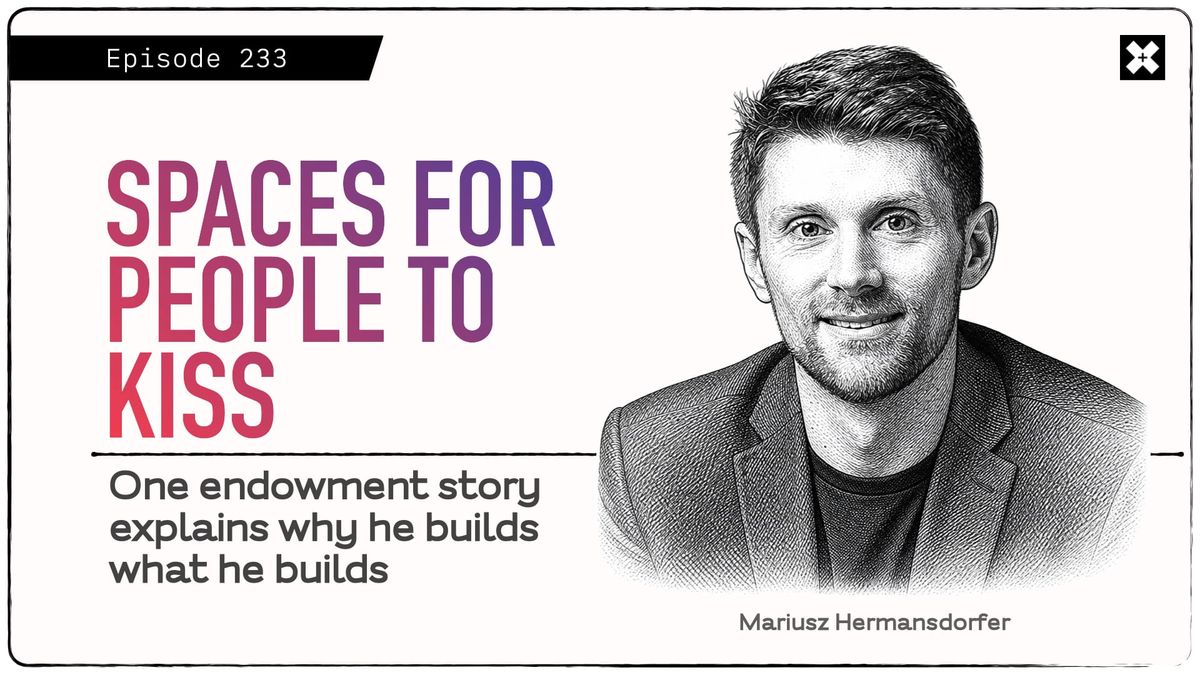
Mariusz Hermansdorfer joins the podcast to talk about turning an internal tool into a product for the whole profession. We explore how he spun Jifto out of Henning Larsen as the firm's first ever tech spin-off, why letting go of corporate control was the thing that made it possible, and how a Rhino plugin can put wind, stormwater, and microclimate analysis in the hands of architects who never had a specialist team to call.
This episode is especially relevant for firm leaders and computational designers who are sitting on tools they've built in-house and wondering whether they could, or should, take them to market. If you've ever felt the gap between how designers think and how engineers deliver, or wondered what it really takes to spin a product out of a practice, this one's for you.
Original episode page: https://trxl.co/233

Watch This on YouTube:
Episode Links:
Some links on this page help fund our work, and we may earn a commission from purchases at no extra cost to you.
Connect with the Guest
- Mariusz Hermansdorfer
jifto
- jifto
- Website
- jifto is the product at the center of this episode, a personal sustainability assistant built as a Rhino plugin that runs wind, stormwater, microclimate, sunlight, cut-and-fill, and biodiversity studies in the early design stages. It's the first tech spin-off from Henning Larsen, operating under the entity Nflection.
Where jifto Came From
- Henning Larsen — Website. The ~750-person architecture firm where Mariusz led computational design and ran an in-house industrial PhD program. jifto grew out of the internal sustainability tools his team built there.
- Ramboll — Website. The global engineering group Henning Larsen is part of. jifto is the first spin-off in Ramboll's history, which usually grows through acquisition.
Tools and Platforms
- Rhino (McNeel) — Website. jifto is built as a Rhino plugin because that's where designers already work in the early stages.
- Motif — Website. Mariusz references a conversation with Jens at Motif about organizing architects "by architects, for architects."
- Claude Code — Website. Evan brings up its "insights" command as an example of software that watches how you work and suggests improvements.
- Model Context Protocol (MCP) — Website. A possible route for jifto to plug into tools beyond Rhino, like SketchUp or Blender.
Ideas and References
- Carl Steinitz — A Framework for Geodesign — Book | Carl Steinitz at Harvard GSD. Geodesign as a method for getting stakeholders to agree on what they can, and stop wasting time on what they can't.
- Steve Jobs — "Connecting the dots" — Stanford 2005 commencement. The lens Mariusz uses to explain how an engineering student became a software CEO.
- Pareto principle (80/20 rule) — Wikipedia. jifto deliberately targets the 80% of sustainability questions rather than specialist edge cases.
- Clarke's three laws ("indistinguishable from magic") — Wikipedia. Mariusz riffs on advanced engineering being indistinguishable from magic.
Previous TRXL Episodes Mentioned
- TRXL 181: Densities of Information — Show notes. Evan's earlier conversation with Matt Jezyk of Motif, the company Mariusz references.
About Mariusz Hermansdorfer:
Mariusz Hermansdorfer is the founder and CEO of Nflection, the first tech spin-out from Henning Larsen, and the maker of jifto, a sustainability assistant built as a Rhino plugin. He's an architect-engineer by training who spent 13 years inside the Ramboll group, most recently leading computational design at Henning Larsen in Copenhagen, where he also earned an industrial PhD splitting his time between practice and academia. His instinct for this work goes back two decades, to when he was an engineering student who built a software pipeline to generate multiple dams while his classmates each designed one by hand. That same instinct, taking the mundane out of the work so people can focus on what matters, is what pushed him from building internal tools for one office to spinning out a product aimed at the roughly four million architects who never had access to a specialist sustainability team.