
237: 'The Interns Will Have Interns', with Phil Read
A conversation with Phil Read about treating AI as an intern, preserving human judgment through sawtooth decision points, and the need to teach delegation early in architectural practice.
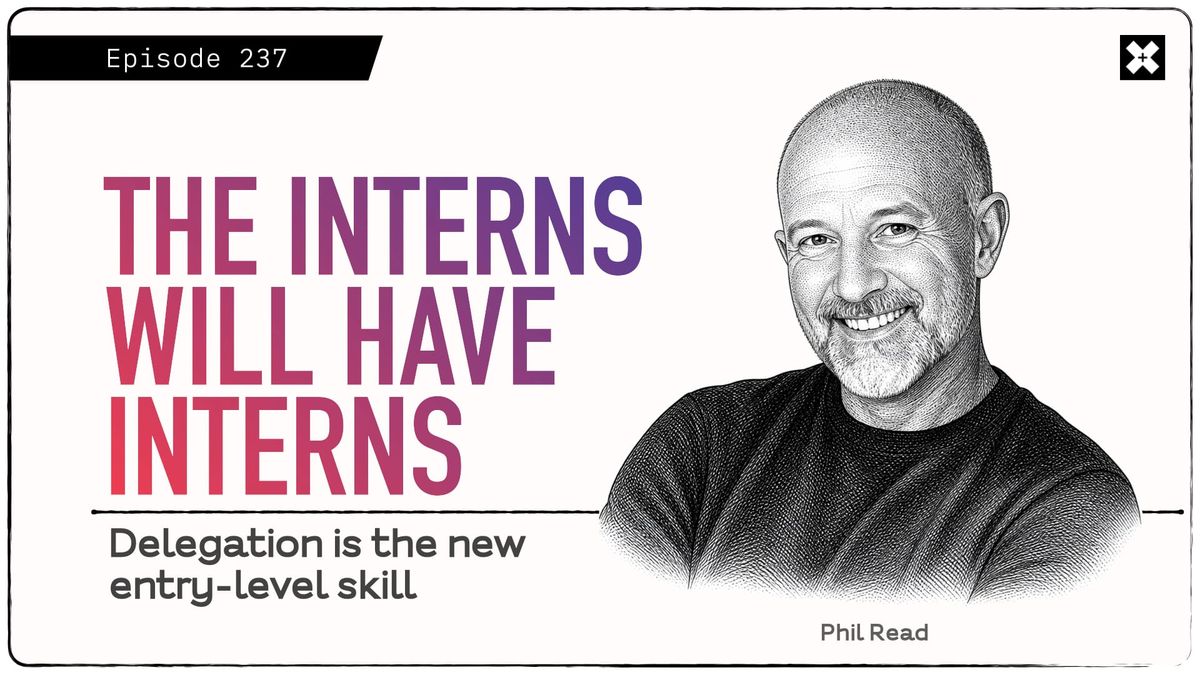
Phil Read joins the podcast to talk about where human judgment belongs in an AI-assisted design process. We explore his case for the infamous sawtooth diagram (the thing BIM was supposed to eliminate) as the place where experience gets injected. We get into AI as an intern rather than an oracle, why firms are using it to study materials and lighting instead of generating building form, and why automated documentation is fast but not yet predictable. We close on AEC Acoustics, the 50-person event Phil runs in North Florida, and why it's built the way it is.
This episode is especially relevant for firm leaders, technology directors, and educators watching entry-level work get absorbed by software. If the reps were how people used to build judgment, the open question is what replaces them, and Phil makes the case that the answer is teaching delegation far earlier than anyone teaches it now.
Original episode page: https://trxl.co/237

Watch This on YouTube:
Episode Links:
Some links on this page help fund our work, and we may earn a commission from purchases at no extra cost to you.
Connect with the Guest
- Phil Read
- X
- Read | Thomas
- Mastering Autodesk Revit Architecture — the book series Phil co-authored with James Vandezande and Eddy Krygiel that taught a generation of architects Revit.
The Sawtooth, and Where Judgment Goes
- The MacLeamy Curve
- The MacLeamy curve, by Daniel Davis
- Patrick MacLeamy
- The "sawtooth" Phil and Evan open on is the jagged traditional-process line in Patrick MacLeamy's 2004 effort/effect diagram, the one the industry spent twenty years trying to smooth out.
- Phil Bernstein
- Phil Read jokes "don't tell Bernstein" about rehabilitating the sawtooth, because Bernstein has spent years arguing the diagram was misread and oversold.
AI in Practice, Not in Demos
- Veras (EvolveLAB)
- Veras
- The AI visualization add-in Phil's Sydney clients were using, and the tool he credits for making material and finish studies predictable rather than merely interesting.
- Glyph (EvolveLAB)
- Glyph
- The documentation automation plugin behind the 2,000-patient-room example. Phil's verdict is that it's fast but not yet predictable.
- Nano Banana (Google)
- Gemini image models
- Phil points to Veras implementing Nano Banana around March 2026 as the moment material iteration went from interesting to reliable.
- Grok (xAI)
- Grok
- Phil's on-demand training experiment, where Grok walked him through building a parametric Revit component accurately but couldn't show him where to click.
- Enscape and V-Ray (Chaos)
- Chaos — 10% off your first year of Enscape, V-Ray, or Corona
- Phil's point about both is that they only render what's in the design file, and the interesting thing about AI rendering is that it renders past the file into speculation. Chaos owns Enscape, V-Ray, and Corona, so one link covers all three. The discount applies to the first annual commercial license, up to three seats, and it's applied automatically.
- TestFit
- TestFit
- Evan connects Phil's speculative-pursuit workflow to what Clifton Harness is building at TestFit, where the value is in killing bad deals fast rather than perfecting good ones.
Tools Mentioned
AEC Acoustics
- AEC Acoustics
- Website
- Leadership sessions
- Registration form
- Phil's event, running September 27 through October 2, 2026. Capped at 50 people, $999 early bird including lodging and meals, and this year the leadership and technical tracks come together. The name is an homage to unplugged sets, not architectural acoustics.
- Lake Swan Camp
- Lake Swan Camp
- The venue in Melrose, Florida. Two spring-fed lakes, motel-style rooms and cabins, and deliberately not a big-box conference hotel.
- Ichetucknee Springs State Park
- Ichetucknee Springs State Park
- The Monday offsite paddle that opens the week.
- Randy Benn
- The leadership facilitator Phil brings in, an attorney and executive coach whose "take a beat" framing is the through-line of the leadership track.
- Mark Schmieding, FAIA
- Phil credits him with the rule that shaped the room, that nobody should ever have to turn around to see who's speaking.
- Harlan Brumm (Autodesk)
- The Revit product leader whose "we need more of this," delivered while rocking on his heels on a lodge deck, is Phil's favorite review of the event.
- Kerry Thompson (KTA Ltd)
- 2026 AEC Acoustics roundtables
- Source of the line Phil keeps returning to, that the prompt is poetry rather than engineering.
Buildings and Books That Came Up
- Humanize, by Thomas Heatherwick
- Amazon
- Heatherwick Studio
- Evan brings it in to argue that buildings get better with more time spent on them, not less, which cuts against every efficiency case being made for AI right now.
- City Museum, St. Louis
- City Museum
- Phil's example of an evolved building, a former International Shoe factory that became an artist-built playground rather than opening finished on a single day and never changing again.
- Florence Cathedral and Brunelleschi's dome
- Florence Cathedral
- The church fathers set out a dome larger than anyone knew how to build and decided God would show them how. Phil's point is that you'd be sued for that today.
- Discovery Place
- Discovery Place
- Phil's foil for City Museum, the kind of interactive museum where kids run around manic rather than encountering real artifacts.
About Phil Read:
Phil Read is the CEO and co-founder of Read | Thomas, a global BIM/VDC consulting group that works with designers, builders, manufacturers, and owners, and that advises AEC technology startups on getting to market. He was one of the people who pushed Revit into the profession in its earliest days, and he co-authored the Mastering Autodesk Revit Architecture series that taught a generation of architects how to use it. In 2020 he started what has since become AEC Acoustics, an annual event at a camp in North Florida built around smaller, quieter conversations about leadership and technical practice for people in a high-stress, low-control industry. He spends much of the year on the road with firms in the United States and Australia, which gives him an unusually direct view of what AI is being used for in practice rather than in demos. When he isn't traveling, he's usually in Charlotte driving a 1960s Triumph TR3A or at a restored 70s beach cottage on Holden Beach, North Carolina.