

Where to Start When Your AI Readiness Score Comes Back Uneven
Almost nobody scores evenly across the nine dimensions, and the shape of the gap is the useful part. Kenton Grant and I walk three readiness scenarios and what to do first in each. Watch the replay, score your firm, and get ready for our AU 2026 workshop.
Almost nobody scores evenly across all nine dimensions of the assessment. Some part of the firm is way out ahead and some part is dragging, and the shape of that gap tells you more than any total ever could.
This week Kenton Grant and I went live with the second of two sessions leading up to our workshop at Autodesk University 2026. Session 1 laid out the Digital Practice OS: three pillars, nine dimensions, scored 1 → 5. This one was about what you do once the scores come back.
Kenton walked through three scenarios we expect to see a lot of. None of them are grades. They're patterns, and each pattern points somewhere different.
Scenario 1: high alignment, low capability
Leadership wants it. The staff is enthusiastic, or at least not fighting it. Nobody is pushing back. But the tools are messy and siloed, the data is inaccurate or hard to find, and the skills aren't there yet.
This is the firm that mandates AI from the top without any of the framework underneath to actually do it. No training budget. No time carved out. Just a directive and a hope.
You need top-down and bottom-up at the same time. A mandate without literacy is just pressure. And literacy isn't the whole story either, because trust sits right next to it. If a department doesn't believe the data is accurate, they won't use it no matter how good the tool is. That's a culture problem wearing a technology costume.
Scenario 2: high capability, low alignment
Kenton thinks this one shows up the most, and I agree. You have super users. Designers, design technologists, maybe some IT staff who are already deep in it, playing with Midjourney and Claude on the weekend and dragging what they learn back into the office on Monday.
What you don't have is direction from above. Leadership hasn't worked out its risk tolerance, or hasn't said it out loud. There are real questions about whether this is responsible, and those questions haven't been answered so much as avoided.
The result is a firm with a lot of energy at the front end and a wall behind it. Pilots go great. Scaling anything past the pilot runs into the same friction every single time.
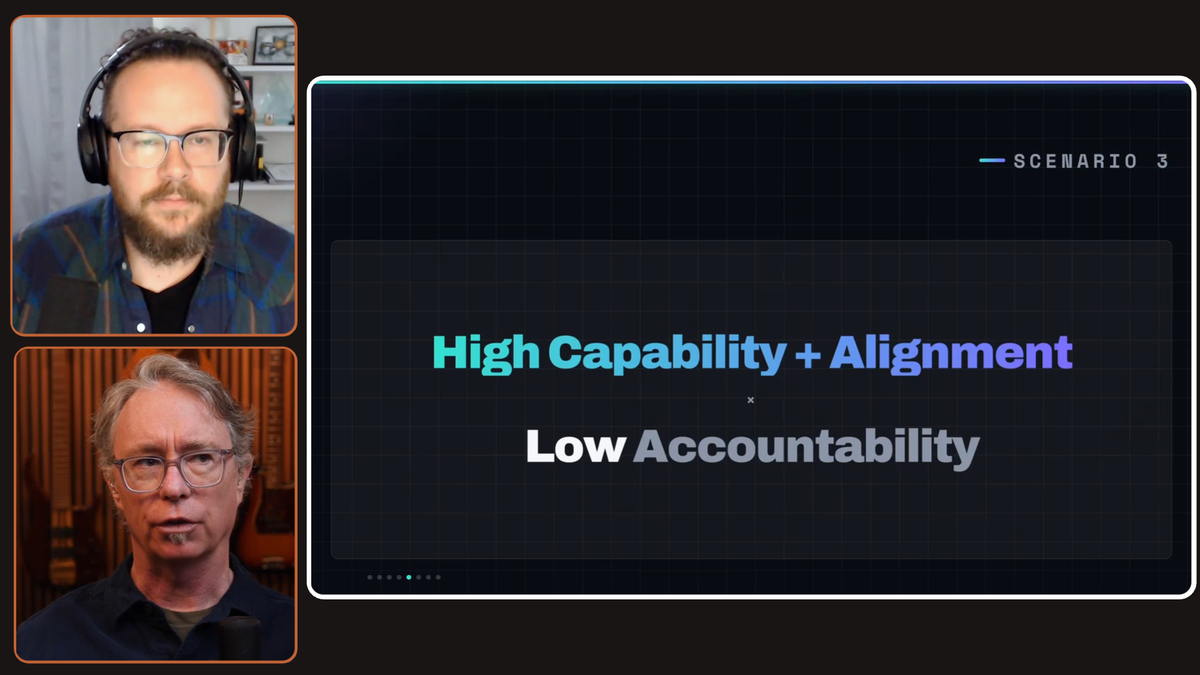
Scenario 3: capability and alignment, but no accountability
The tools are there. Leadership is on board. Maybe there's even an AI policy and a stated risk tolerance. What's missing is any structure for knowing whether it's working: no innovation metrics, no feedback loops, no line connecting any of this back to project goals or business strategy.
This is the one people push aside, and it's the one that ends the funding. "We bought the tool, we trained the team, everybody's on board, we used it on a pilot." Great. What were the results, and who did you tell? Without that, an executive has no reason to approve the next round of training that pulls people off billable work.
Architects are comfortable with open-ended exploration. We trust that we'll arrive at a solution even when the page is blank. The part that feels foreign is setting a target and measuring against it. Treat it like a hypothesis instead. Write it down, test it on a real project, and change it when the evidence says to. Being wrong is how you rule things out.
Culture runs through all three
Culture came up in every scenario even though we didn't plan it that way.
I told a story on the stream about pinning work up on the wall as a young designer and having a principal wander by and tell me I had "the fun part of the job." You do get the fun part. You also get the part where everyone tears it down, and you need a thick skin to make it to the next pin-up.
The other one is Bjarke Ingels talking about the ski slope on top of a waste-to-energy plant in Copenhagen. It's the only mountain in Denmark and it's a fake one. That is an absurd idea, and the only reason it exists is that the office was a place where an absurd idea didn't get killed in the first five minutes.
Same thing applies here. If people can't experiment in public, fail in public, and float a weird idea about a new workflow in public, none of the rest of this matters.
It's a flywheel, and you have to keep turning it
There's always more to do. I know. But if you actually want to change what your firm is capable of, there is no version of this that's a checkbox.
You apply something, you surface what happened, you apply it again. Nine months or two years later you look back and you can see the distance you covered, and half your original ideas were wrong and that's fine. What got you there was the turning, not the ideas.
If you're not willing to keep checking the pulse inside the office, don't start. A leader who hands this off and stops asking about it has already decided how it ends.
Take the honest snapshot to your board
If you're an executive, this assessment is something you can hand to your board and say: this is who we actually are right now.
Every boardroom is dealing with this at some level. What most of them are getting is the aspirational version, the firm as it would like to be described. A board that's detached from the daily work doesn't have the visibility needed and therefore can't make good decisions. Give them the real snapshot and the conversation changes fast, usually toward the thing nobody wants to fund: capability, training, upskilling, new ways of working, time pulled away from projects that are already demanding all of it. Buying software is the easy part.
Come do the exercises with us at AU
The AU session is a workshop, not a lecture. Three exercises across 90 minutes, and we'll be calling on the room. The self-assessment is exercise one, which is why we've been handing it out early. Show up with your scores and you're starting from a real position instead of a cold one.
The most useful thing in a room like that is usually not us. It's hearing someone else describe the exact problem you thought was unique to your firm. I've had that happen more times than I can count, and it's the reason to be in the room.
What to do next
Watch the replay of Session 2. All three scenario examples and more.
Access the assessment and score your firm across the nine dimensions. If you already filled it out, go back in with the same email address and update your answers rather than submitting a second time. Better yet, send it to a few people in different roles and compare where you disagree.
Watch Session 1. The full Digital Practice OS framework and the thinking behind each of the nine dimensions. My written version is here.
Bookmark our AU 2026 session. "Build Your Firm's AI Adoption Plan in 90 Minutes" (AS1719), Thursday, September 17 at 4:30pm in Las Vegas. There's no class registration this year, so bookmarking gets it on your calendar but doesn't hold a seat. Get to the room early.
Questions go in the comments on the YouTube video. Kenton and I are watching that thread, and what shows up there will shape what we do in the class.
If you're a firm leader, a BIM or design technologist, or the person trying to get AI off the ground where you work, this series is for you. Come do the work with us.