Everything Arc 3 partners need to promote their episode on their own: quotes, drafts, and graphics.
What this is
Your partnership for the series includes a perpetual, worldwide, royalty-free license to reuse your own segments, clips, and transcript excerpts for your own marketing, sales, investor relations, and internal comms, across any channel. This page is everything you need to post on your own without waiting on me: your episode dates, your pull-quotes, ready-to-post LinkedIn drafts, and the series graphics.
Producer retains sole editorial discretion over the cut. Nothing on this page requires my review to post, it's built from segments already cleared for you.
One ask: post on your episode's Thursday and tag Evan Troxel and TRXL Podcast.
Once your episode is live I'll send a timestamped link straight to your segment, so you don't have to hunt for it.
Episode dates and direct links
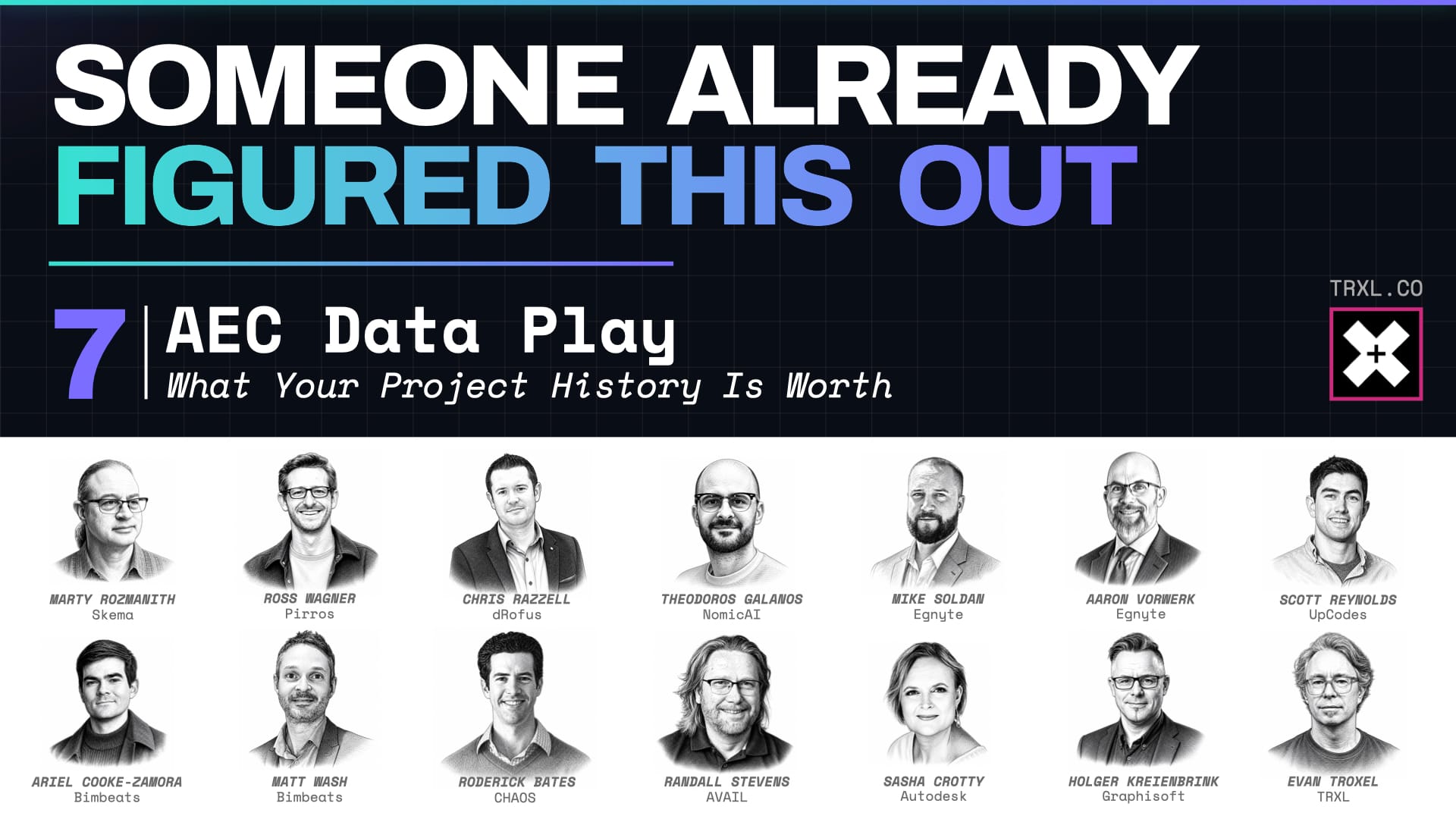
TRXL 246, "Someone Already Figured This Out," Thursday October 15, 2026, trxl.co/246
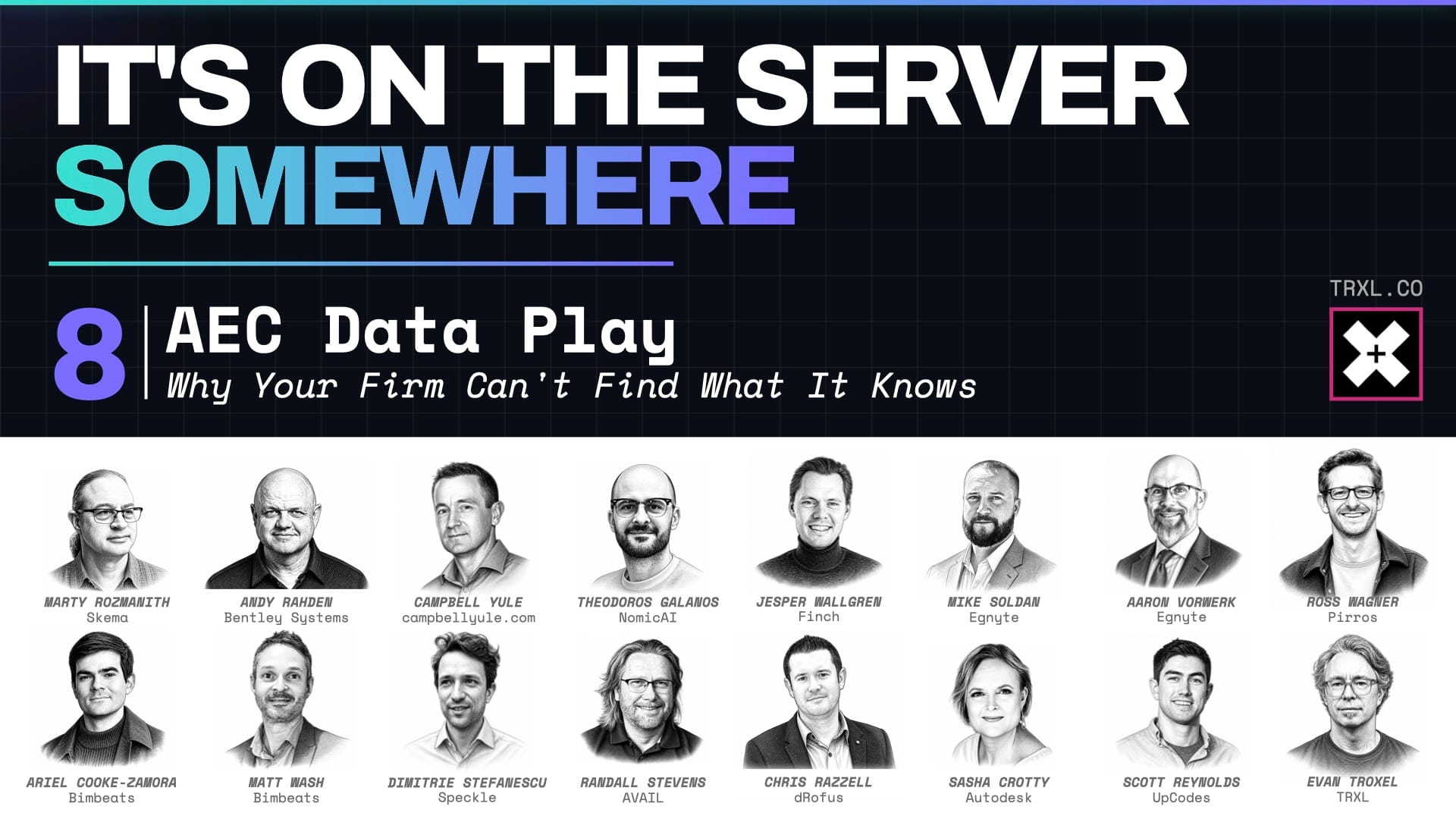
TRXL 247, "It's on the Server Somewhere," Thursday October 22, 2026, trxl.co/247
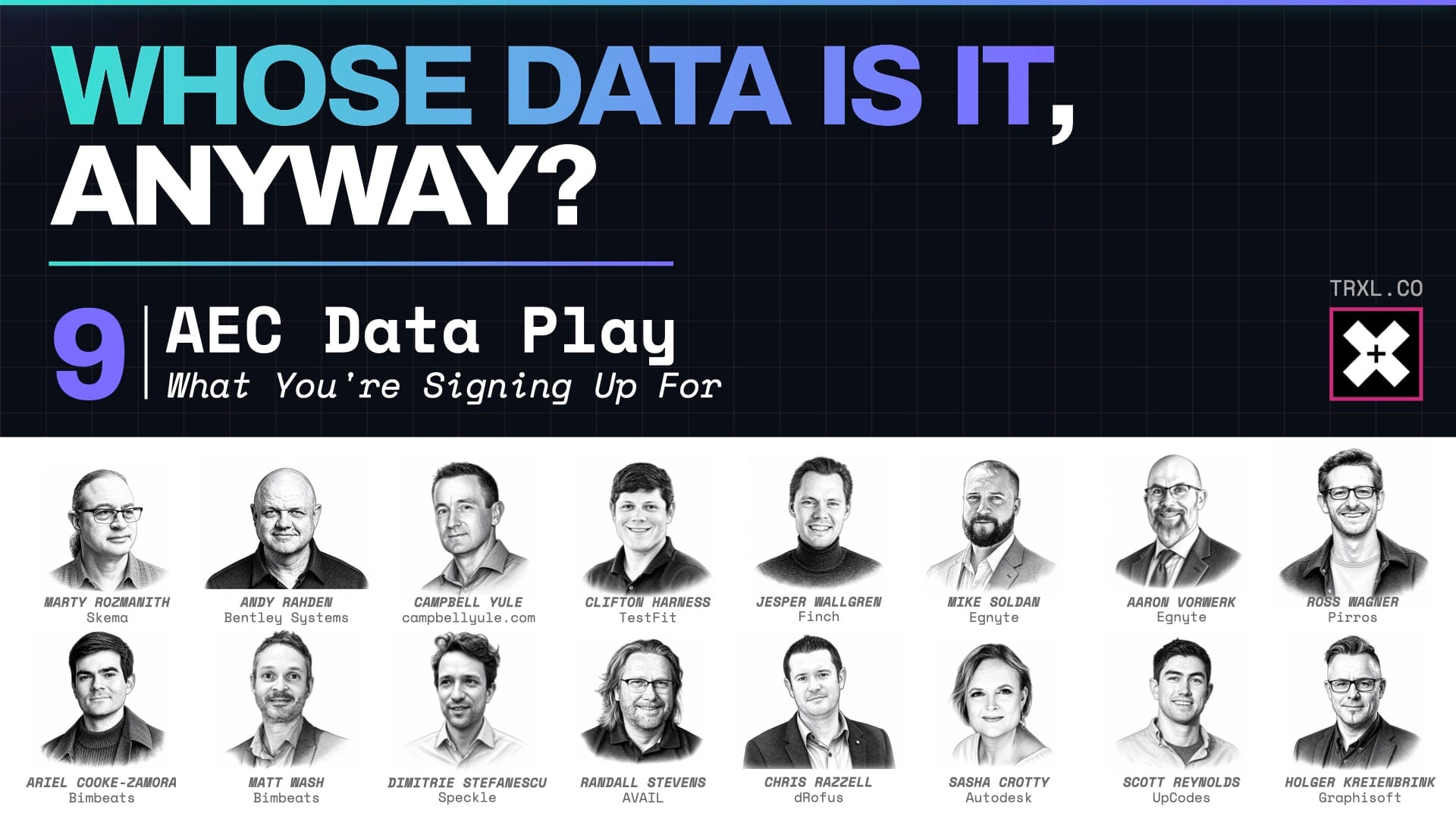
TRXL 248, "Whose Data Is It, Anyway?" Thursday October 29, 2026, trxl.co/248
“How do we think about the information first, and that the model is just one more derived representation of that data. And that's hard. That's hard for our tools. That's hard for our customers.”
“What is challenging to pull out of the system is the relationships, because that's the system. The system is this bigger piece, and it establishes connections between the data.”
“You can change formats on a regular basis. AI can change formats for you in a couple of days. What is really important is that you know where your data is and how it's connected between different pieces.”
“There's definitely value that hasn't been captured post-delivery of those projects … what you really want is a capital resource. It's an economic and financial term.”
“You could take all 27,000 of those details, and I could give them to you, and I just throw them out on the floor. You'd go, they're worthless. The same details with now an organizational interface and metadata around them allows you to get to the one out of the 27,000 that you need is where most of the value is.”
“Windows file folders were never designed to hold and capture anything except storing the file and then putting a name on a folder that gave you some small amount of contextual information to be able to know what's in that folder, and then it stops.”
“The question is, are you being extorted? Things cost money. The question is, is there a fair exchange? And as long as the value's there, we look at it as whatever dollar you're paying us, I want you to be getting 10X that in value. That should be the ratio of the relationship.”
“I have no long-term rights to your data. If you're going to put it into my platform, you ought to be able to get it back. This is why APIs start to become important.”
“I like to use the word play, because you should be playing with all of these new capabilities as much as you can stomach. I don't think you should have your head in the sand about what change might be afoot.”
Bentley Systems — Andy Rahden, Chief Revenue Officer
“You don't need everyone speaking the exact same language, but you need enough shared meaning for your data to move across different disciplines and life cycles.”
“Where it breaks is when you try to force a monolithic standard across every single discipline. That's when you get resistance, and that's when you start getting workarounds.”
“If a technology partner tells you that they're AI-ready, but can't show you a complete historical record of every model version, every change, every human approval, that really becomes more of a marketing communication versus being actually AI-ready.”
“We need to start documenting institutional knowledge. … The standards, precedents, judgment calls on your team, they rely on this every single day. So AI can't amplify what's still locked in people's file cabinets or heads.”
“The firms not doing anything with the data are just missing out on a valuable learning resource. It's sitting on a mountain of books that you're not reading.”
“The weekly time sheet. … There's the fictitious one that you do on a Friday afternoon when you're trying to remember what you've done versus, well, what did I actually do?”
“I would caution any firm who is procrastinating or not starting until they know exactly how to structure it. I would say just go ahead and start structuring it because the answer is going to reveal itself as you're working and asking questions to your own data.”
“These systems, they're going to hallucinate, and it's up to firms to, one, structure their data, and then two, define the skills that they're going to give the agents to interpret that data.”
“So you can go from the very simple, ‘Hey, you've just helped me do my timesheet,’ to now organizationally, how do we deliver our projects based on actual time rather than the fictitious timesheet?”
“As long as we have the data structured correctly, we don't need to worry about developing the technology of the database. We don't need to worry about developing the technology of the LLMs because they're just going to get better and better and better.”
“Tool fatigue is absolutely real. … So you're not going for the next shiny thing. You're going for the thing that can deliberately target a workflow that is costing you time.”
“The firms that don't change their workflows as new tools evolve are the ones that are going to be overtaken by the nimble new firms that are starting today and embracing these new tools.”
“I can control my house. I've got all my kids' key information, medical records, whatever it might be on my phone. But then, of course, you step into the work environment working on a building project, and it's not that easy.”
“Almost like the old school library you'd have had within a corner of the architectural studio. A more modern phrase might be the democratized organizational intelligence layer.”
“There is this false bill of goods maybe that was sold to everyone when it comes to BIM, and I think everyone visualized everyone in the project's going to be working in this collaborative space. One big file that's got absolutely everything in it.”
“Arm yourself with knowledge. AI is here. It's disrupting things already. You don't necessarily have to be an AI expert, but you do have to be AI savvy.”
“We get the cart in front of the horse and we think we're just going to put this tool into place and it can leverage all of our historic knowledge when we really don't have historic knowledge. We have a pile of stuff that's not well understood.”
“For 15 years, ever since we've had digital capture of most of this stuff, everyone's been saying, that's your goldmine. That's your IP. … The issue has been being able to turn it into usable structured content and be able to do something with it.”
“Comparisons are easy. Why that was changed is a very different animal and is not represented in the contract deliverables at all. It's in the emails, it's in the Slack threads, the Teams chats, the digital whiteboards, beautiful places where things go to die.”
“Up to 80% of the data on that project, not data outside of that project, but data on that project, doesn't sit in those tools or systems. And so there's so much communication happening, so much other stuff that doesn't live in a project delivery platform, and that's where the decisions are made. That's where the why sits.”
“Governance has to come first. In our space, there's some folks that are pretty laissez-faire about this, that I think there will be bites. I would bet my house there's going to be some major breaches in the next 12 to 18 months because of this stuff.”
“Security through obfuscation. … It felt safe, but once that content's indexed and AI can find it contextually, it's going to surface it up really fast. So this issue of messy data just becomes an even bigger problem.”
“You could argue that the data is more important than the physical asset at the point of handover, because over its life, that will be very expensive information to not have.”
“It's not about just deploying generative AI. … It's about trust, permissions, well-classified understanding of data. It's about taking this mess and making it something that's safely usable with trustworthy results.”
“AI's programmed to answer you. It's not programmed to be truthful about it. It's programmed to give you an answer, to make you happy by giving you an answer.”
“The number of hours spent on folder structures is insane. We could've changed the world instead of every firm chasing that. … Folder structure is starting to matter less because the classification and understanding of the piece of content individually is what actually matters.”
“This is a train that has left the building. It's not disappearing. Even if you've been in the space for 30 years, you're not going to avoid it unless you retire first.”
Pirros — Ross Wagner, Head of Industry & Product Strategy
“If someone's retired at this point, you can still tap into their work and allow the team to learn from that work to understand how that work came together.”
“Standards are great, but it's basically a mandate of what the firm wants you to use, and it's like a database. Whatever you put in is whatever you get out, and it's hard to maintain any database.”
“You allow the team to critically think about what they want to bring into the next project and build upon that. … Let the people choose what they want. Why are we having some IT or maybe BIM professional decide for you?”
“There's always one person at a firm that knows everything. They know where all the skeletons are in the closet. … But how do you capture that? That's tricky.”
“There's such a lack of mentorship sometimes at a firm that's moving so fast that you just have to slow down and teach people and show what good looks like.”
“In this industry, data's incredibly confidential. And so we need to make sure that we have the right systems in place and the governance is in place to scale that effectively.”
“This is a ship that's moving. There are other firms that are jumping on it. If we don't do this because of our own internal potential egos, then you will fall behind.”
“Only 20% of all the stuff that I've ever learned in the technology side of this is still relevant. … Lawyers, their case backlog almost never goes invalid.”
“A lawyer that's been practicing for 50 years is that much more valuable than a lawyer that's been practicing for two years. And I'm thinking, well, it should be that way for architects, but with architects, there was no real way of capturing things and reusing them like lawyers could.”
“Everything's a prototype, right? And people say, well, the site's different every time. No. When you really look at it, there's lots of things that can be reused over and over again.”
“There's a lot of people out there who say, ‘Well, our BIM's not good enough, and we really need to clean up our data so that we're ready for AI.’ The AI doesn't care. Your data is whatever your data is. It's a cluttered garage.”
“If a lawyer has 50 years of cases that they've got in some case management system where they can say, ‘I want every case in the last 20 years when somebody got hit on a bike,’ and it's at their fingertips. Architects, they don't have anything like that. Other than maybe some photographs somewhere.”
“How are you going to convince a client that you're going to build their 21st hospital better than the previous 20 hospitals that you've built if you don't have access to the data of those previous 20 hospitals?”
“Is your portfolio of designs that you have becoming a true asset, and can you leverage it? A lot of people are asking themselves that question. And then they realize that in order for that to be a productive asset, they need to open old clunky files, and that data is stale and it's wrong.”
“Garbage in, garbage out. You need to be careful around this. And to a certain extent, that stands true. But there's added nuance today. An AI agent can whiz through your inconsistencies in naming or in misclassification of parameters, and can fix those things in an instant.”
“You don't need to wait for that data to become a PDF and then reverse engineer data out of a PDF. … If you can get to the source, get to the source. Don't wait for the decision to be taken. Don't wait for the PDF to be exported out. Go straight to where the data and the design lives.”
“The most acceleration and the most ROI that we can provide with AI is on the day-to-day menial tasks. … In order to be AI-ready, you don't need much.”
“It's all public information, but what most people don't realize about Google Maps is the complexity behind that very easy interface. … It's the same for us. It's spending years and years and years building the infrastructure that can digest all this code.”
“It doesn't have to be perfect. It just needs to be written down. We just need to document the decision, have the discussion, do the back and forths so we can come back in the future, we can reference it, or we can learn from it.”
“You can rent or you can buy intelligence and tools, but what those systems like UpCodes doesn't have is your knowledge, and that stays unique to you. So your data, your knowledge, your decisions, all of that is private. Models don't get trained on that, which is critical.”
Edit the bracketed line for your own voice. Plain text, no markdown, paste directly. Click each to expand.
Put the episode link in your first comment, not in the post. LinkedIn suppresses posts that send people off the platform, so these are written to be posted as-is with the link added underneath as a comment.
Draft 1 — episode-day announcement
[Company] is part of The Next AEC Tech Stack, a nine-episode series from TRXL on what's actually changing in the tools AEC firms use every day. Our episode, "[episode title]," is live now.
Link's in the first comment.
Draft 2 — quote card
"[your pull-quote]"
[Spokesperson name], [title] at [Company], on TRXL's The Next AEC Tech Stack. Full episode linked in the first comment.
Draft 3 — series-level, any week
Proud to back The Next AEC Tech Stack from TRXL, a three-arc series on the technology rebuilding how AEC firms work. Nine episodes, sixteen companies, real questions, no vendor script.