Everything Arc 2 partners need to promote their episode on their own: quotes, drafts, and graphics.
What this is
Your partnership for the series includes a perpetual, worldwide, royalty-free license to reuse your own segments, clips, and transcript excerpts for your own marketing, sales, investor relations, and internal comms, across any channel. This page is everything you need to post on your own without waiting on us: your episode dates, your pull-quote, ready-to-post LinkedIn drafts, and the series graphics.
Producer retains sole editorial discretion over the cut. Nothing on this page requires our review to post, it's built from segments already cleared for you.
One ask: post on your episode's Thursday and tag Evan Troxel and TRXL Podcast.
Once your episode is live we'll send a timestamped link straight to your segment, so you don't have to hunt for it.
Episode dates and direct links
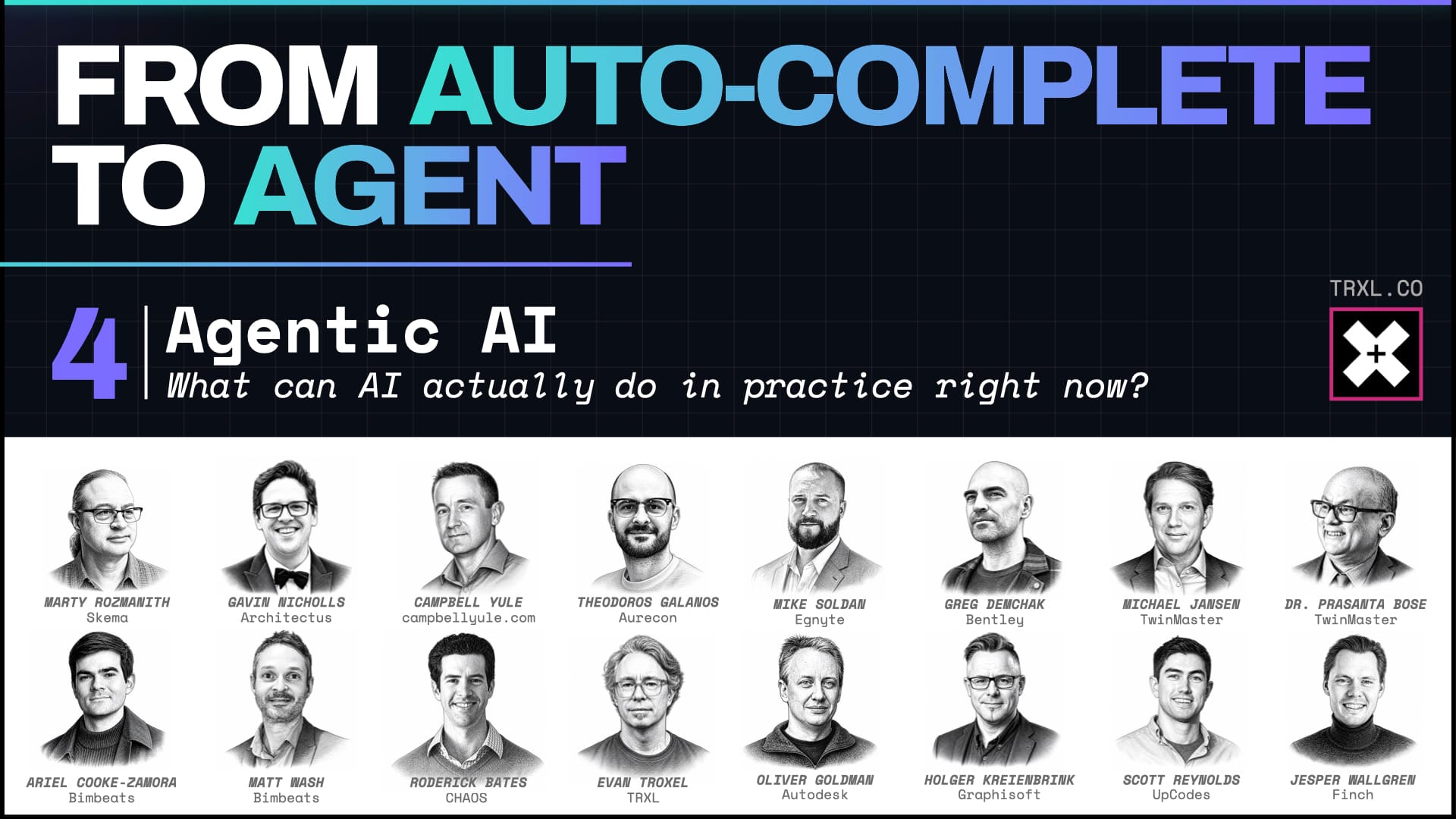
TRXL 241, "From Autocomplete to Agent: Where AEC Actually Is," Thursday September 17, 2026, trxl.co/241
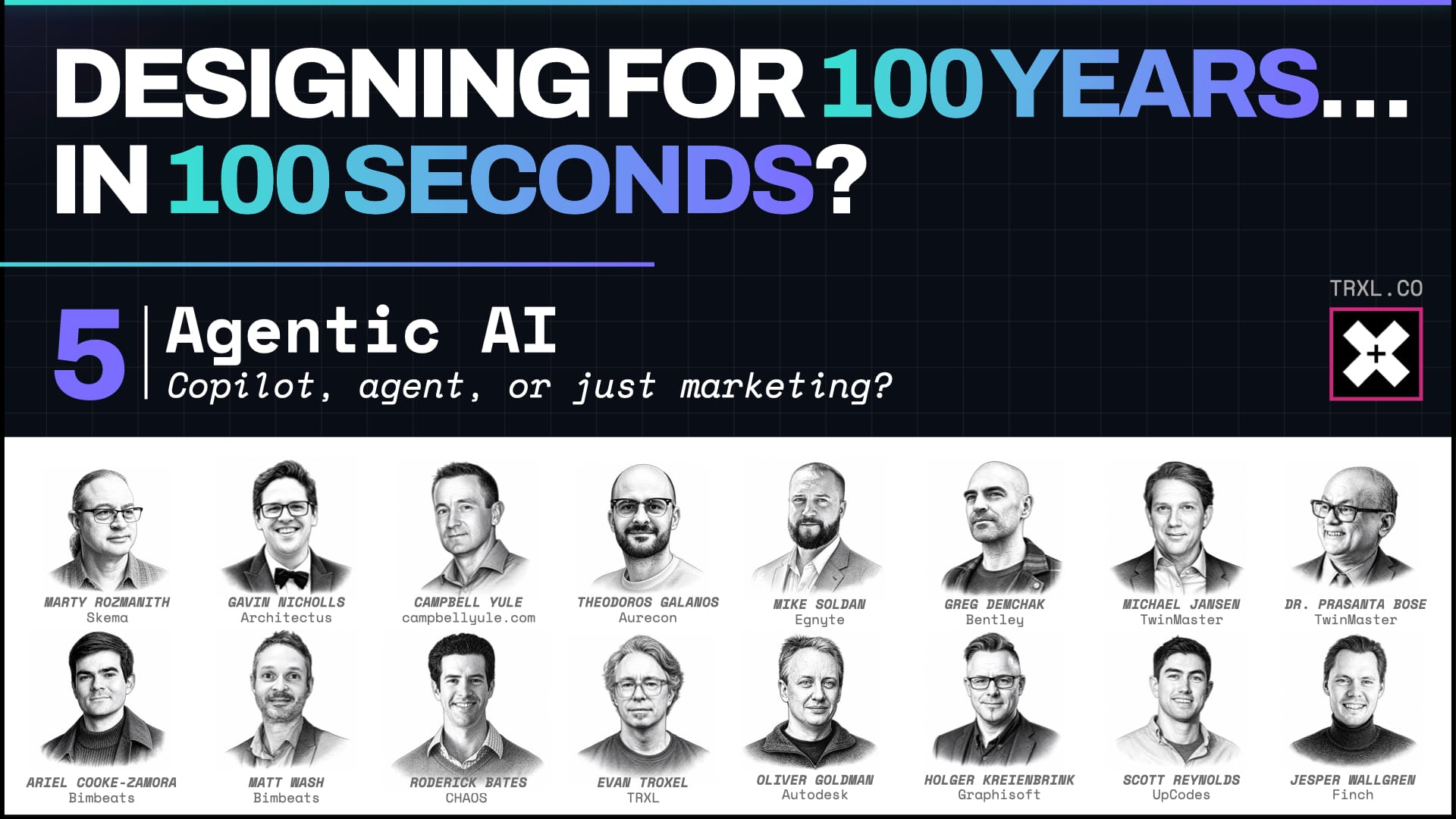
TRXL 242, "Designing for 100 Years… in 100 Seconds?" Thursday September 24, 2026, trxl.co/242
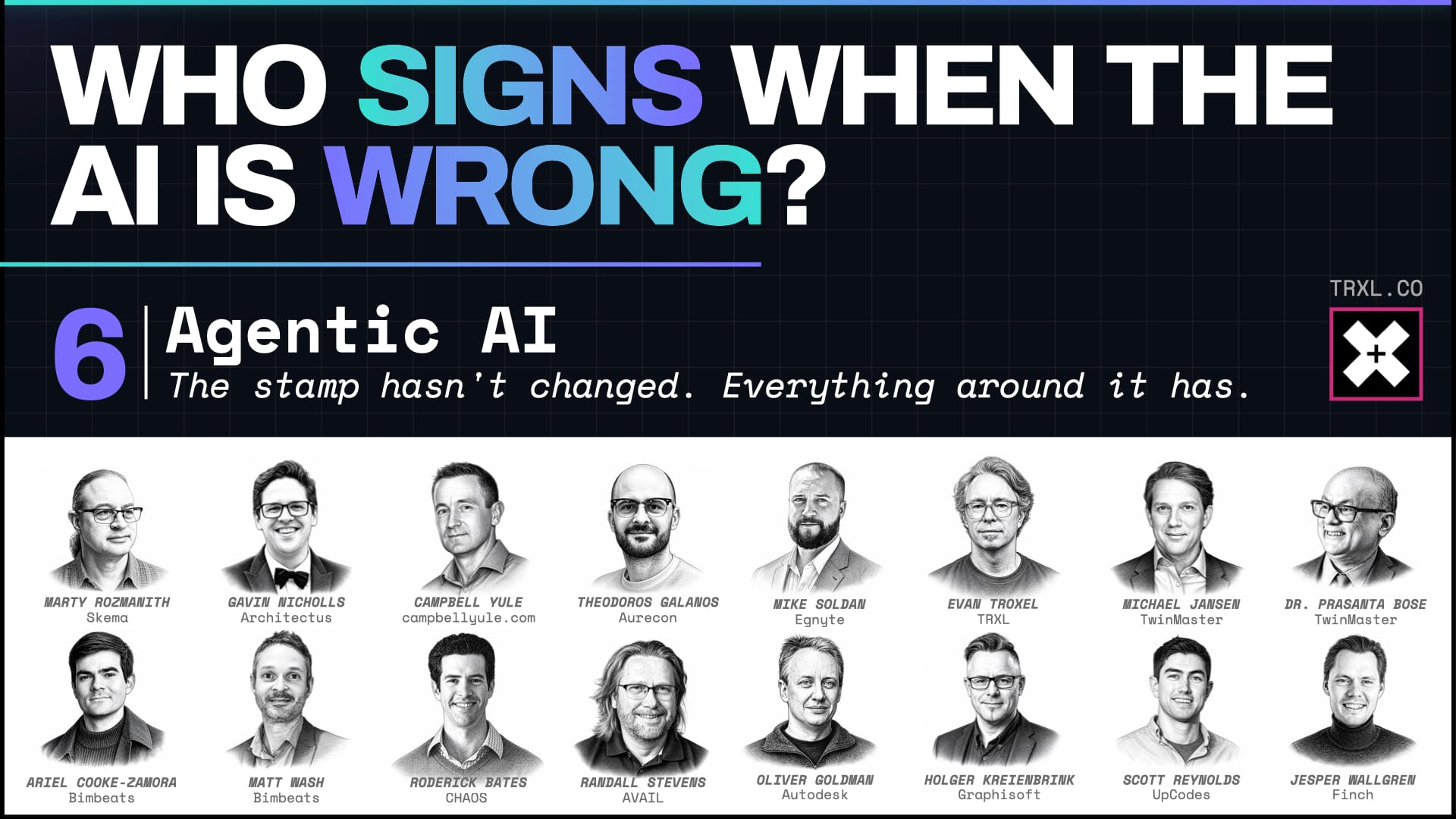
TRXL 244, "Who Signs When the AI Is Wrong?," Thursday October 8, 2026, trxl.co/244
Sourced from raw-interview timecodes, not the final cut — the timestamp/deep-link to your segment lands here once your episode airs. Check back Thursdays for that update.
Autodesk — Oliver Goldman, VP, Software Architecture, AEC Solutions
“What you're seeing in the rollout is less about the order in which the ideas occurred to us and more about the depth and the complexity of the work that needs to be done to bring those experiences to market.”
“Ultimately, I'm responsible for the products that I deliver. I'm accountable for those, and it doesn't matter what tools I use or how good they are or they aren't, I still carry that accountability.”
“Building Layout Explorer is a generative AI model. It actually uses a large language model under the covers. The user interface doesn't have you chatting with it.”
“Part of the MCP server vision that we have is not that you'll ignore Autodesk Assistant, but that you'll use Autodesk Assistant in combination with some of your own agents… Maybe you built an agent that's trained on your data or your ways of working.”
“You could literally spend all your day just watching the stream of announcements and trying to download the latest models and never get anything else done. But at the other extreme, you run the risk of… just ignoring it entirely and not getting any benefit from it… and then the world's going to move on and you're going to miss out.”
“We've been using AI and machine learning for the better part of five, six years for use cases like image classification... to find things like defects, exposed rebar, rust, cracks in the road. This is something we had in the market before the whole LLM explosion took place.”
“There's no agent that's actually signing off on the structural analytics or the final documentation. What the agent does is basically radically accelerate your time to that deliverable. It's still the human in the loop to check and verify all that.”
Greg Demchak
“Do you want to put your work on autopilot and be able to totally trust it, or do you want to be involved in it? And if you want to be involved in it, then you've got to be involved in it.”
Greg Demchak
“You do try to remove some bias in these systems by creating multiple agents, multiple personalities that will cross-check, test, criticize, try and tear down your argument — you create a counterpoint, so you don't get into this sycophant type loop.”
Greg Demchak
“Show me this complete building model, isolate all the concrete, and colour code the concrete based on the quantity of embodied carbon... That is something you can do today.”
“The model context protocol is really just a way for AI to understand the APIs that already exist in the software. These APIs have a long history of being used and they're quite trustworthy.”
Greg Demchak
“The more information you embed into the geometry itself, the better results you're going to get... So it's not making as many assumptions.”
Greg Demchak
“It's kind of like a real intern — you're letting an intern come into your office and mess with your BIM model... there is a period of time over which you build trust in the system.”
Greg Demchak
“You'll be able to call an agent that runs into this structural package that maybe runs an energy simulation over here, and then produces a rendering with a diffusion model over here, and then brings it all back together.”
“It's easy to draw a parallel to visual scripting in Grasshopper, where each step is a node. But now some of these nodes are essentially magic — I input something, some magic happens, out comes the output.”
“At the end of the day, it's going to be someone's professional stamp on the piece of paper… it's going to be the person with the stamp that's going to be held liable.”
“That's caused an awareness that the tech is moving faster than the laws we have in place… My answer was about a stamp on a piece of paper. That's an ancient methodology for validating who's in charge.”
“If you had asked me this question a few years ago, I was all in on people honing in on a niche… I think things are moving so quickly now that the opposite might be true… that you need people that are generalists, and you need to have someone who is completely comfortable throwing out the way they've done things for the last five years.”
“If you're training it on the knowledge of your people, I think that's where it will change. You will still employ the same people, but their interaction with how they get experience and knowledge will be different.”
“Right now, AI is the drug, and everybody's being given this drug, and everybody's lapping it up and really getting addicted to it. And at some point, there's obviously going to be a cost to that.”
“Before, when they saw it was a Python script, they knew it was a hacky Python script… Now, this application looks like it was professionally coded and would look like it spent hundreds of hours of effort. That's the bit I think is tricky.”
“A lot of projects are going to pencil out that didn't pencil out in the past, and I'm hoping for a boom in construction because of that.”
Ariel Cooke-Zamora
“Everybody wants something that's quick and easy and get instant gratification or instant reward, and essentially that's what the agents have allowed us to do with the Bimbeats data.”
“Revit crashes. I lose an hour of work. I smash my head against the wall, and I open Revit again, and I keep working. And IT probably had no idea that this even happened.”
“Just building a building, I don't care whether you're licensed or not, it's still hard to do. It is a complex process that incorporates a number of different disciplines, a number of different procurement streams that you might have, a lot of time, a lot of effort.”
“There's no doubt that there's going to be people losing their jobs because of AI. Full stop… AI doesn't care. It may seem very human, but it does not care.”
“They know that when we say we're not going to train on their data, we're not going to train on their data. Whereas smaller scale startup… they might just find out that, 'Oh yeah, actually, we were training on the data. I'm sorry.' And sue us. We're not worth anything.”
“We saw one of our competitors basically offering free AI visualization… 'Wow, how are they doing this?' Well, it turns out they were just burning investor money.”
“At one point people complained that everyone who used Enscape had a similar-looking output. Now they're telling me they really like the way Enscape treated light and materials. Eventually you stay around long enough and people appreciate the aspects that were once a liability.”
“The AI easy button, back when everything was free, is no longer there. Before, you just couldn't model that much, so you didn't render that much. Now you just don't want to pay that much, so you don't want to render that much.”
“The number of people really willing to put in the effort to do these types of things has always been small. The people that could do a great hand sketch at a firm have always been in the minority.”
Roderick Bates
“They're more willing to get feedback from AI than they are from people. If AI tells you it's ugly, you're like — oh, okay. Whereas if someone told you that, it really would hurt.”
Roderick Bates
“If you could almost ingest all of the work of, say, Frank Lloyd Wright, and then you could show him your project and just have him critique you, it'd just be brutal.”
“They deploy Claude across the entire firm and all of a sudden they're getting hundred, hundred-fifty thousand dollar token bills in a month, going: wow, this math is starting to not math.”
“It's not even really hallucination anymore… The bigger risk is my reference content is five years old instead of two years old than it is to hallucinate something and totally fabricate something.”
“It's a low-margin business, so every mistake, every little thing is just eating another point away at your four percent. There's a bit of the devil you know: I'm going to do four percent again.”
“An atomic agent… is something that you can write a task for that can get something done at a certain level. And then you have to orchestrate them, and that's how you drive the bigger process.”
“What we're really doing here is business process analysis, the same thing that humans have done to try to make businesses more efficient for 50 years. You just have better tools to do it that are more automated.”
“I heard one firm that had written a document that checked a thousand things in the Revit model, and there were so many things going wrong, you just stop listening.”
“At the end of the day, you are the architect, it's your building. Finch is just a tool. It's a great tool, but at the end of the day, it's your building.”
Jesper Wallgren
“Prompt architecture, for me, that sounds like the person that goes to the architect. They speak. They say, 'I want the building with this, and that,' and then the architect goes to work and turn[s] that into drawings.”
“Where we want to see AI is on the tedious tasks — placing dimension lines, cleaning up plan files, placing labels, doing the checks. This is what no one wants to do.”
“I see AI as a very well-equipped and educated draftsperson — I tell this draftsperson I want the design like this, and then it will do it. That's the North Star.”
“Token spending will be huge if we are not cautious. It becomes a second licence cost, and it can be even more expensive than the licence cost if you overuse it.”
“Everyone is expecting that AI will reduce costs. Maybe it will not. It will make us more efficient, but still we need to pay a price for that efficiency.”
“Never have I seen so much progress in the whole BIM industry as in the last two years. For the last twenty years everything was just evolution — and now there is a lot of disruption.”
“Deterministic things — scripts, Grasshopper, Revit journal files, Dynamo — you put in the same inputs, you get the same outputs every time. Versus AI, which is probabilistic.”
“The AI itself writes a script, which is deterministic, and then runs it — because if you ask it to do it again, it will produce the same result. It's the combination of using AI to interpret your goal, driving deterministic things, that yields the greatest results.”
“I call that democratizing technology… When technology gets in the way and imposes a tax, we should eliminate it and reduce that friction so that tax isn't there anymore.”
“You actually need to know a lot more about putting a building together in order to draw a building in Revit than you had to in order to draw it in AutoCAD… So if there's a lowering of the bar now, maybe it's about time.”
“What we don't want is an AI to be a black box, where you feed it twenty years of firm history and it starts spitting out designs and you don't know why.”
“In copilot, the human in the loop is ever-present. In agentic, the human only reviews the end thing when the AI says I've completed the goal. That doesn't absolve you of responsibility for it.”
“What the agentic stuff opens up is for you to make custom tooling that in the past would have been way too expensive or unapproachable — that for your firm's workflow might be very, very useful.”
“Revit is — and people might bristle when I say this — a data entry tool. People sit in front of it for eight hours and put in walls, doors, windows and staircases.”
“It's actually forcing that question back upon us because I think we lost sight of what it actually is. It became about production. So when production's free, just like renderings became free…”
“Autodesk has to have an AI story. They're a publicly traded software company, so they had to do something. Whether that something is useful remains to be seen.”
Marty Rozmanith
“Building APIs on systems that are file-based and architected thirty years ago probably isn't a good strategy.”
Marty Rozmanith
“It's not paying to be a Luddite and say, 'Well, nobody's using AI,' or, 'We're not going to use it,' because it can save you a hell of a lot of time.”
“How is [the traceability aspect of AI] impacting the apprenticeship profession that is architecture, and how does that change how that same profession either values or doesn't value their time?”
“A lot of things you see in the market today are single-purpose — AI for drawing, AI for energy consumption. Arch-e works across the entire lifecycle, across disciplines, across KPIs, and across software platforms.”
Michael Jansen
“Ninety-five percent of the tools calling themselves AI tools are actually LLM wrappers — a bit of code wrapped around an existing LLM. Otherwise we're just going to go from thirty algorithmic tools to thirty AI tools, and it's no better.”
“You have to get out of this thinking of living and dying by the fee… A fee is time-bound. Job's over, your fee is gone, next job. That's the business model.”
“When you talk to your lawyer or your doctor, you divulge a tremendous amount of private information. Thanks to privilege and the Hippocratic Oath, they're not supposed to divulge it. Same thing with your AI service provider if you're in AEC.”
Michael Jansen
“I don't fault AEC professionals for their risk aversion. I understand it. It's really the job of the vendor to prove it.”
“A lot of the assistance you're seeing added on to Revit and Trimble and other tools like this—these are not agentic systems. They count doors and windows… It's not really agentic behavior. Arch-e is a multi-agent system that is fundamentally different.”
Edit the bracketed line for your own voice. Plain text, no markdown, paste directly. Click each to expand.
Put the episode link in your first comment, not in the post. LinkedIn suppresses posts that send people off the platform, so these are written to be posted as-is with the link added underneath as a comment.
Draft 1 — episode-day announcement
[Company] is part of The Next AEC Tech Stack, a nine-episode series from TRXL on what's actually changing in the tools AEC firms use every day. Our episode, "[episode title]," is live now.
Link's in the first comment.
Draft 2 — quote card
"[your pull-quote]"
[Spokesperson name], [title] at [Company], on TRXL's The Next AEC Tech Stack. Full episode linked in the first comment.
Draft 3 — series-level, any week
Proud to back The Next AEC Tech Stack from TRXL, a three-arc series on the technology rebuilding how AEC firms work. Nine episodes, sixteen companies, real questions, no vendor script.
Series link in the first comment.
Graphics
Episode Thumbnails
Episode 4 — From Autocomplete to Agent: Where AEC Actually Is
Episode 5 — Designing for 100 Years… in 100 Seconds?