
The Technology Tax Nobody Can Agree On
📰 I asked nine AEC tech companies if their software actually frees architects to design, or just moves the tax to a different line item. The answers surprised me.
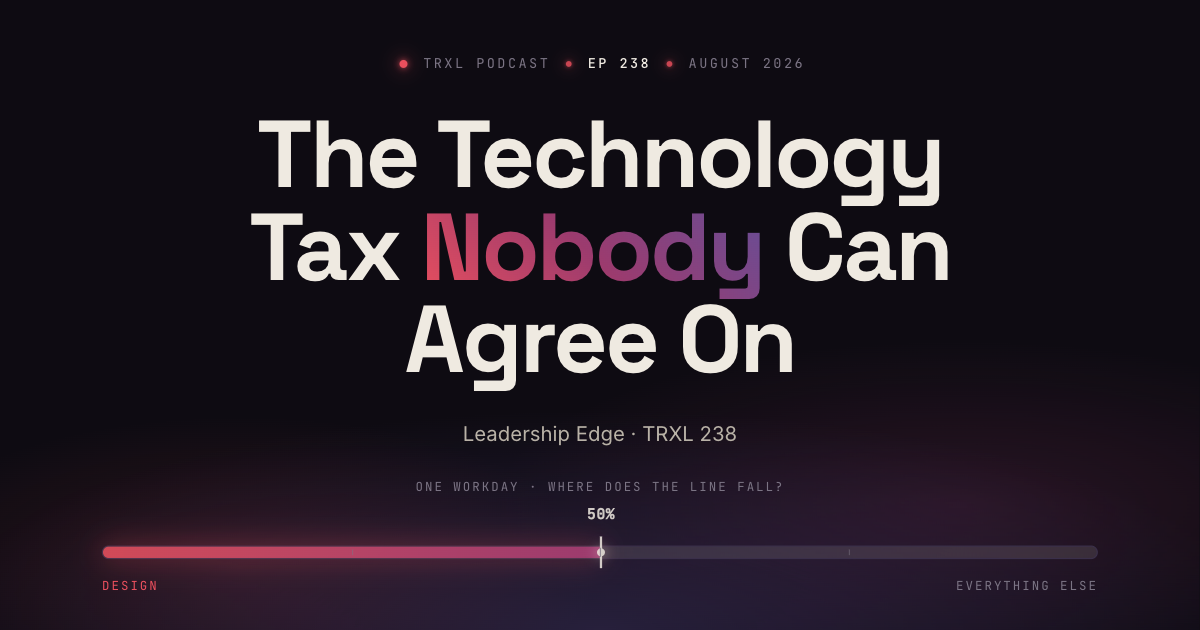
If your software promises to free you up to design, where does the other half of your day actually go?
Summary
This is episode one of nine in a limited series I built for this fall called The Next AEC Tech Stack (TRXL 238). I went to the companies building what comes after the tools we use now and asked every one of them the same question, on camera, with no script and no approval over the final cut: does your tool actually free designers to design, or does it just move the technology tax to a different line item?
This first episode is arc one, BIM 2.0. I put that question to Randall Stevens (AVAIL), Matt Wash and Ariel Cooke-Zamora (Bimbeats), Gavin Nicholls, Campbell Yule, Jesper Wallgren (Finch), Holger Kreienbrink (Graphisoft), Marty Rozmanith (Skema), Dimitrie Stefanescu (Speckle), and Clifton Harness (TestFit). Nobody got a soft question, and nobody flinched.
What came back wasn't one answer. It was a set of different definitions of what "design" even is, and a running argument about who's actually eating the time that gets freed up when a tool works as advertised.

Graitec provides AEC software, training, and expert support to help architects, engineers, and construction teams design, build, and manage projects more effectively.

AVAIL's content management system (CMS) helps architecture and engineering teams find, manage, and reuse their Revit, AutoCAD, Civil 3D, and other technical content in one place.
If someone forwarded this to you, sign up free and the remaining eight land in your inbox. TRXL+ members also get the ad-free feed, the full back catalog, and all the content that goes back behind the paywall when we return to our regular schedule following this series.
What's Inside
- The 50 percent problem. Randall Stevens estimates half of a practitioner's day disappears into friction that has nothing to do with design, so who's actually built to reclaim that time, and who's just repackaging it.
- The duplication nobody notices. A documentation crunch at a real firm revealed the same markup happening three times over by three different people, and what it took to actually see that.
- Reinventing the wheel, on purpose. Dimitrie Stefanescu calls out a narcissistic streak inside architecture itself, one that rewarded the wrong kind of cleverness for years.
- Cardboard, not replicas. Marty Rozmanith explains why Skema isn't trying to be a one-to-one model of a building, and what that has to do with how Revit was actually meant to work.
- The finance nobody teaches in school. Clifton Harness argues the real constraint on American buildings was never gravity or zoning, and what that means for what design is actually for.