
The Boring Stuff Is Where the Leverage Actually Lives
📰 Explore the hidden value in AEC automation beyond visible outputs. Discover how capturing operational knowledge and leveraging tools like Model Context Protocols (MCP) can enhance efficiency, preserve expertise, and turn data into a competitive advantage for your firm.

What if the most valuable automation project for your firm right now has nothing to do with the model?
Summary
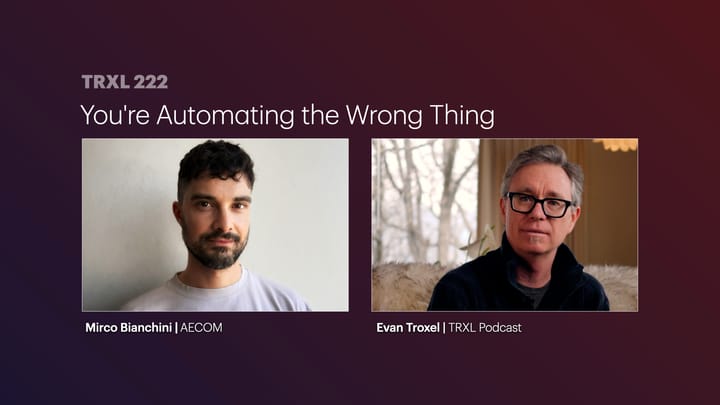
TRXL 222 is a conversation with Mirco Bianchini, Technical Digital Product Manager at AECOM. Mirco started as an architect in Italy, discovered Grasshopper in its early days, and has spent more than 15 years going progressively deeper into the technology side of engineering. From computational design and fabrication, through backend development and product management, to leading a data science and developer team at one of the largest engineering firms in the world.
Mirco's key insight might surprise you, which is his framing of where the real automation opportunity in AEC actually sits. Firms are spending enormous energy automating the visible, measurable outputs: the model, the drawings, the rendered images. That is the work that's easy to present to leadership. But underneath it, the operational layer is still largely untouched. Email threads that can't be searched. Project knowledge that retires with the engineers who hold it. Data trapped in team silos that never flows where it needs to go.
Mirco's argument: that's where the real work needs to happen. And with large language models and tools like Model Context Protocols (MCP), the path to actually fixing it is more accessible than it has ever been.
What's Inside
- The Wrong Target. Why the most visible automation work in AEC may not be the most valuable, and what that distinction means for where to point your team's energy.
- MCPs in Practice. What Model Context Protocols actually are, how they work without requiring a developer, and what they make newly possible for everyday AEC workflows.
- The Second Brain. How firms can begin capturing the unstructured knowledge that currently lives in senior engineers' heads, and why AI tools are finally suited to this particular problem.
- Who Builds the Tools Now. LLMs are changing who inside a firm can create automations, and that shift carries real consequences for both internal development teams and external software startups.
- The IP Conversation We're Not Having. Why the fear of sharing technology is often misplaced, where actual firm IP lives, and why treating tools as trade secrets may be slowing the whole industry down.