
240: I've Got to Get My Project Out on Friday
A conversation with Roderick Bates, Campbell Yule, Jesper Wallgren, Gavin Nicholls, Dimitrie Stefanescu, and Carl Christensen about where AI‑generated design should stop, how to liberate data, and what truly survives the BIM 2.0 handoff.
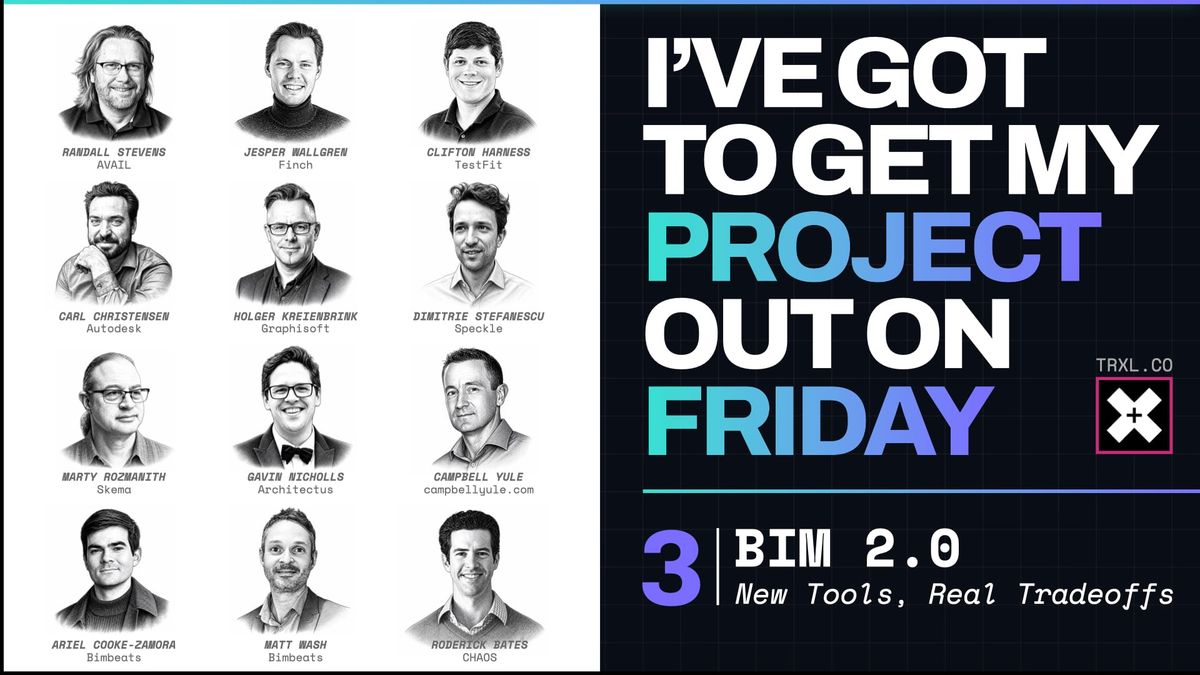
Two questions close out the BIM 2.0 arc. When a tool generates a design for you, where does its output stop and your judgment start? And what does interoperability actually deliver once you strip away the vendor promises?
Roderick Bates at Chaos draws the clearest line anybody in this series draws about what a generative tool should not be allowed to do: his team won't let AI touch geometry or materials without the designer's direct input, because that's "the bridge too far." Campbell Yule pushes back on the whole premise of AI-assisted design: a model that satisfies every constraint is a starting point, not architecture. Jesper Wallgren at Finch says the architect's role is shifting from craftsman to curator, and that quality — not quantity — becomes the competitive edge once AI can produce endless options. Gavin Nicholls walks through the build-versus-buy calculus at his firm and lands on an analogy that makes sense: even Excel is lock-in, we just don't think about it that way.
Then the episode turns to interoperability, and Dimitrie Stefanescu at Speckle gives me the line I'd put on the poster for this whole arc: let's liberate our data. He and Marty Rozmanith at Skema both argue the old goal (perfect file translation between platforms) was never the real point. Carl Christensen at Autodesk has to answer for what actually survives the trip between Forma and Revit, and Holger Kreienbrink at Graphisoft previews an upcoming open collaboration platform meant to make that handoff invisible. Randall Stevens closes the loop on where AI-generated imagery is heading, and Clifton Harness at TestFit makes the case for a constellation of people over any single tool.
Three episodes, and the people in them agreed on almost nothing except that the tools are changing faster than the contracts are. This one is for anyone who has ever had to ship a project on a deadline that didn't move while the tools underneath them did.
Original episode page: https://trxl.co/240


Graitec provides AEC software, training, and expert support to help architects, engineers, and construction teams design, build, and manage projects more effectively.

AVAIL's content management system (CMS) helps architecture and engineering teams find, manage, and reuse their Revit, AutoCAD, Civil 3D, and other technical content in one place.
Watch This on YouTube:
Episode Links:
Some links on this page help fund our work, and we may earn a commission from purchases at no extra cost to you.
The Series
- The Next AEC Tech Stack — Series hub · Arc 1: BIM 2.0
- Nine episodes across three arcs. This is Arc 1, episode 3 of 3 — closes out the arc.
- Previous episode: TRXL 239 — You're Not Going Home Early (Arc 1, episode 2)
Voices in This Episode
- Randall Stevens — CEO & Founder, AVAIL — LinkedIn · AVAIL
- Carl Christensen — VP, Product, Autodesk — LinkedIn · Autodesk
- Matt Wash — CEO, Bimbeats — LinkedIn · Bimbeats
- Campbell Yule — LinkedIn · Website — the practitioner reality check across all three Arc 1 episodes.
- Roderick Bates — Senior Director, Product Operations, Chaos — LinkedIn · Chaos · Veras
- Jesper Wallgren — CPO & Co-Founder, Finch — LinkedIn · Finch
- Gavin Nicholls — Digital / National Computation Lead, Architectus — LinkedIn · Aussie BIM Guru on YouTube · Architectus
- Holger Kreienbrink — Director, Product Intelligence & Partnerships, Graphisoft — LinkedIn · Graphisoft
- Marty Rozmanith — CTO & Co-Founder, Skema — LinkedIn · Skema
- Dimitrie Stefanescu — CEO & Co-Founder, Speckle — LinkedIn · Speckle
- Clifton Harness — CEO & Co-Founder, TestFit — LinkedIn · TestFit
Where AI's Judgment Stops and Yours Starts
- Chaos on the bridge too far — Chaos · Veras
- Roderick Bates draws the clearest line in the series: Chaos won't let AI change geometry or materials without the designer's direct input.
- Campbell Yule on constraint satisfaction — LinkedIn
- A model that satisfies every planning and site constraint is a starting point, not architecture.
- Finch on craftsman to curator — Finch
- Jesper Wallgren: once quantity stops being the competitive edge, quality becomes it instead.
The Interoperability Lie
- Speckle: "let's liberate our data" — Speckle
- Dimitrie Stefanescu's framing for the whole segment.
- Skema on full-fidelity sync — Skema
- Marty Rozmanith describes Skema's push/subscribe model as 100% full fidelity — no placeholder geometry.
- Autodesk on what survives the handoff — Autodesk · Forma
- Carl Christensen on what carries from Forma into Revit.
- Graphisoft's Open Collaboration Platform — Graphisoft
- Holger Kreienbrink previews a Nemetschek collaboration backbone built with Autodesk.
Tools and Companies Mentioned
- Qonic — Campbell Yule's example of a BIM 2.0 platform built natively on IFC.
- Snaptrude — Campbell's example of a tool latching into automatic-generation systems.
- Arcol — Gavin Nicholls' most-used BIM 2.0 tool day to day.
- Giraffe — one of Gavin's firm's three core BIM 2.0 tools.
- Hypar — the third of Gavin's firm's three core tools, alongside Arcol and Giraffe.
- Rhino / Grasshopper — referenced by Gavin and Marty.
- The Innovator's Dilemma by Clayton Christensen — the book Holger Kreienbrink cites.
Series Partners
Arc 1 exists because these companies agreed to answer hard questions on the record, without approval over how the answers get used.
Every voice in this episode is on trxl.co/guests with their own bio.