

220: ‘Lightweight Architectural Structures’, with Joshua Schultz

A conversation with Joshua Schultz about lightweight architectural structures, exploring structural efficiency, innovative design practices, and the barriers preventing their mainstream adoption in architecture.
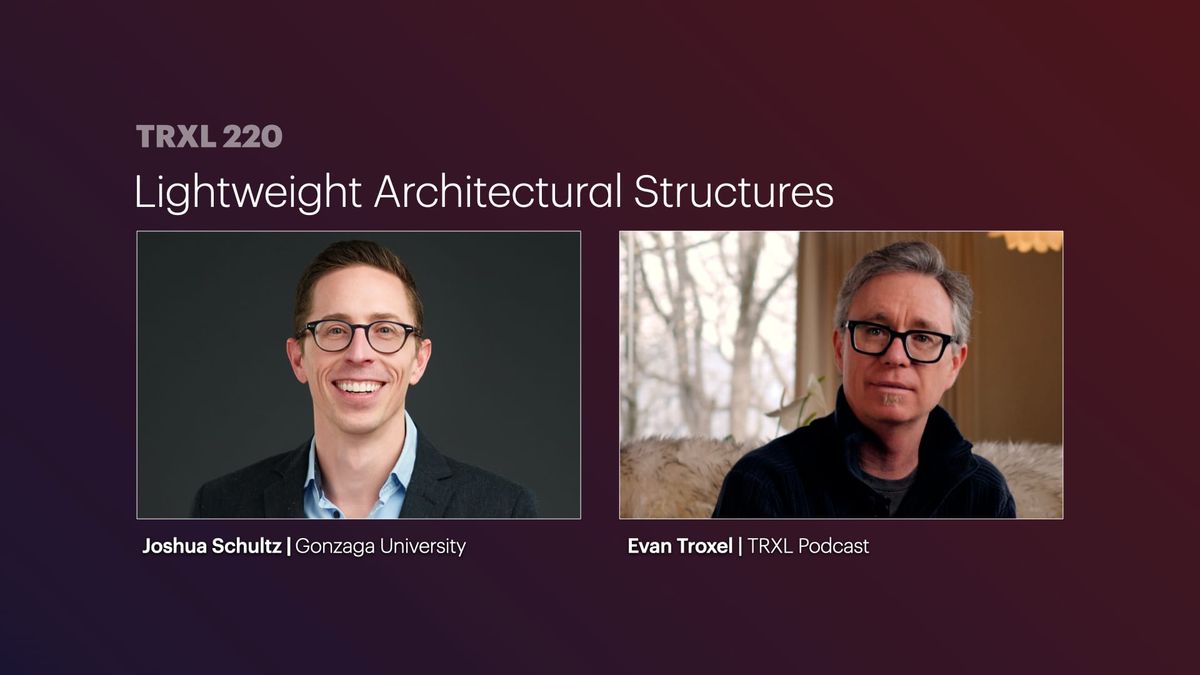
220: ‘Lightweight Architectural Structures’, with Joshua Schultz

Joshua Schultz joins the podcast to talk about lightweight structures, including cable nets and glass design, as well as insights from his upcoming book, “Structural Design of Lightweight Structures,” co-authored with Christian Stutzki, highlighting the future of architectural design.

Original episode page: https://trxl.co/220


Icons of podcast platforms where you can find TRXL
Listen wherever you get your podcasts.

Watch This Episode on YouTube:


Some links on this page help fund our work, and we may earn a commission from purchases at no extra cost to you.

Connect with the Guest

Books and Philosophies

  • Frei Otto – Tensile Structures, Volume 1 & 2

Lightweight & Membrane Structures

  • Institute for Lightweight Structures (ILEK), Stuttgart
    • ILEK Website
    • A global leader in research on lightweight, membrane, and adaptive structures.

Computational Design & Analysis Tools

  • Rhino + Grasshopper
  • Karamba3D
    • Karamba3D Official Site
    • Structural analysis tool for Grasshopper, commonly used in lightweight and parametric workflows.
  • Kangaroo Physics
    • Grasshopper Plugin
    • Interactive physics engine for form-finding, especially relevant to membranes and tensile systems.

About Joshua Schultz:

Joshua Schultz, PhD, PE, LEED AP is a licensed professional engineer with nearly two decades of experience designing, teaching, and researching lightweight structural systems, particularly structural glass and mass timber. Currently, he is an associate professor of architectural and structural engineering in the department of civil engineering at Gonzaga University. Previously, Joshua worked at both Stutzki Engineering and Skidmore Owings and Merrill (SOM) as a structural engineer for a number of lightweight, high- profile, high- rise buildings around the world. He has designed, researched, and published widely on various lightweight structural systems. Joshua is an American Society of Civil Engineers (ASCE) ExCEED Fellow as well as the recipient of the inaugural AISC Innovation Scholar Fellowship.
Connect with Evan


Episode Transcript

220: ‘Lightweight Architectural Structures’, with Joshua Schultz

Evan Troxel: Welcome to the TRXL Podcast. I'm Evan Troxel, and today I welcome Joshua Schultz. Josh is a structural engineer, educator and researcher whose work sits at the intersection of lightweight structures, architectural expression, and computational thinking. His background spans both academia and practice,

and that dual perspective gives him a rare clarity on why so many powerful ideas in structural design never make it into everyday buildings, and what it would take to change that. In this conversation, we dig into lightweight architectural structures, not as a stylistic move or an academic curiosity, but as a way of thinking. We talk about why structural expression still matters, how much cultural ground we've lost by hiding systems behind finishes, and why the most compelling structural ideas are often reserved for stadiums, bridges, and one-off icons instead of being applied to buildings we design every day. We also unpack the role of computation in all of this not as a generator of complexity for its own sake, but as a tool for asking better questions about forces, efficiency, material use, and performance.

Josh makes a strong case that computation should sharpen intuition, not replace it, and that architects who understand how structures want to work are better equipped to collaborate, innovate, and design with intention. A key takeaway that I had from this conversation is the disconnect between what we know is possible and what we actually build.

Lightweight structural thinking has the potential to reduce material, use, clarify design, intent, and reintroduce meaning into architectural expression. Only if it escapes the realm of rare projects and becomes a bigger part of everyday practice. This episode challenges us to rethink how we use technology, how we collaborate across disciplines, and how we decide what's normal in building design.

As usual, there's an extensive amount of additional information in the show notes, so please be sure to check that out. You can find them directly in your podcast app if you're a supporting TRXL+ member. And if you're a free member, you can find them over at the website, which is at trxl.co, which is also where you can learn more about supporting what I'm doing here.

Lastly, please help the podcast by recommending and sharing this episode with your colleagues. And now without further ado, I bring you my conversation with Joshua Schultz.

Joshua, welcome to the podcast. Great to have you.

Joshua Schultz: thanks for having me.

Evan Troxel: Yeah. So we're gonna be talking about lightweight structures today, and can you tell us about yourself and, and where you're coming from when it comes to this, that you're, you're teaching, you're a professional engineer, but I would love to hear more about your story.

Joshua Schultz: yeah, I wanted to be an architect and so, uh, I grew up, my dad was in construction, wanted to be an architect, and ended up being first in my family to go to college. And in that process I realized that there was this thing called architectural engineering, which to me was this magic sort of overlap of all the excitement of laying out buildings and, and doing that.

But then also the structural aspect of how do you, how do you make 'em work? And so, um, even from that, that stage, there was that idea of. Structure informing architecture, architecture, informing structure. And so I had that in my undergraduate. I was pretty good at school, so I kept going to school, um, just because I enjoyed it.

And, uh, ultimately I finished up all my degrees and all that kind of stuff. And I ended up, uh, working for, uh, a firm Stutzki Engineering, which is where a lot of, uh, sort of what we'll talk about today came from for the lightweight structures. And, uh, in working there and then working in my PhD, I had the opportunity to cross paths with Bill Baker.

And so from that ended up at the Chicago office of SOM, uh, and got to work with, with that crew, which was just phenomenal and, and really formative. And I think that bears mentioning just because, again, the SOM ethos of architects and engineers working to together to compliment, um, is, is really important to me and how I approach things and I think it's really valuable to our industry.

So one of the takeaways of. Of even the book. Um, and really my whole career is this idea of architects, engineers, artists, collaborating, being on the same team. Um, and I think that when you encounter those like-minded, those, those twin souls out there in our profession, you can recognize it right away. Um, and it, it just seems sometimes like it's a, it's a culture or a personality thing.

It's really hard, I think to, to shift partway if you've kind of been on the side of, well, it's more of a traditional, you hand off the design, I'll make it work. We'll kind of go back and forth. But, um, those people who really have that desire for collaboration, um, that's always been interesting to me. The kind of that interstitial space among engineering, architecture and, and art.

And so, um, so did that for many, many years. Um, I met my significant other and, uh. Ended up moving, uh, cross country. And so now I'm a professor soon to be, knock on wood, a professor. I'm an associate professor right now, uh, at Gonzaga Engineering, and then I consult full-time as well. So I do a, a lot of professional engineering and architecture consulting.

Evan Troxel: A couple of stories that I want to tell come, come, come up when you're, when you're talking about this. So, so the first one is personal experience architect working on a project with a structural engineer in a collaborative way. Um, I think the first time I really felt like that happened, I got the rug pulled out from under me.

So here, here's the story. Um, this great engineer and he, he was just so into it, right? And, and to me that that was, that was rare because in the firm that I was working with, like consulting was that kind of throw it over the fence, uh, thing that you just talked about and like the handoff, right? It was like, here's the design, make it work or make the structure work to fit the design.

And this was much more of a, an experience of, okay, we're gonna sit around the table and we're gonna solve these challenges in real time as they come up. And what about this idea? Oh, that's interesting. Okay, what if we did it this way and we put the beam here and we do the back span and we can do this cantilever and stuff like that.

And, and it was really, it was just like, you know, our brains were just like lighting up. You could just feel the energy at the table, uh, when we were doing this problem solving, so, so I said the rug got pulled out from under me. And what happened was. The owner of that structural firm sent an email out and is like, that guy's not on the project anymore.

And the reason why he's not on the project anymore is because he was spending too much time on the design.

Joshua Schultz: Oh yeah.

Evan Troxel: right. Like that, that sound that you just made, that was the sound that I made. Oh man. Like what? Like we're, we're, we're being creative. We're solving problems. The project is gonna be better from it, but you're, and so this kind of gets back to maybe one of the more root issues of your, the less time on a project equals better in financial terms, but not in the outcome of the design.

Right. And so it's a weird incentive program that we have in this profession. Right. Which is, especially in. I, you know, this is the commodification of architecture, right? It's like, um, okay, profits matter more than design is what that says to me. And, and so anyway, that was just kind of a, it was a great experience until it wasn't then.

It was a bad experience.

Joshua Schultz: Yeah.

Evan Troxel: But the, but the, the other story that it brought to mind was, uh, in, in the way that you talk about the, the collaboration at SOM and the ethos of it, um, I was teaching an emerging technology course, an architecture program at the university that I went to Cal Poly Pomona in Southern California.

And I had a guest lecturer who's been on this show before, come on in, into the room and give a lecture. And his name is Alvin Huang. And he is a, a professor at USC now as well. He is running his own firm. And, um, he, he said something that has stuck with me ever since, uh, which was, you know, he had this engineer that he would work with, a structural engineer.

And he said, the best engineers. Are the ones who are looking for interesting problems to solve or recognizing when there's an interesting problem to solve and they can't wait to work on a project like that. It's not the mundane engineering, it's not the mundane calculations. It's not, it's not all of that kind of stuff.

It was like they recognized when there was a really interesting structural problem to solve, or maybe a different way to go about it, and they saw an opportunity and he presented that to my students, which I think was it. I really latched onto it. I hope they did too, because that was something where it's like you, you have to look for these connections between people for projects to explore the possibility of what can be done with architecture and structural engineering, and the other forms of.

Things that are kind of traditionally treated as consultant roles in the building industry, right? But, but actually looking for those opportunities to come together and solve problems or solve challenges in, in interesting ways. And so those are the things that came up as you were kind of talking through that.

And, and you don't know this, but my audience does, because when this episode comes out, I just interviewed Neil Katz from SOM to talk about kind of the, the, the history of computational design and, and all that kind of stuff. So another connection that, uh, that's in the works right now, but it'll be released by the time

Joshua Schultz: Neil is one of my favorite architects we work together at, at Chicago. And um, yeah, he's just one of my favorite people. We, I'll, I'll, I'm gonna reach out to him after this,

Evan Troxel: Nice.

Joshua Schultz: so That's awesome. I'm glad that's fitting that we're book ending that. That's

Evan Troxel: Absolutely. So, so you mentioned the book, so why don't you introduce what, what you're talking about with the book.

Joshua Schultz: you bet. Yeah. So it's, uh, the title which was tricky 'cause the, there've been a lot of books that are trying to talk about structure and architecture. So a lot of the architectural structures, structural architecture titles are taken, so

Evan Troxel: a good domain name for a website.

Joshua Schultz: That's right. Exactly. It, it's, it was the exact, so, um, so ultimately it's uh, it's the structural design of lightweight architecture and, uh, the focus there is distilling out, wow, probably almost 75 years between.

Chris and I, my co-author and I, uh, of experience. And so the goal was not to write a textbook, uh, who wants to read one of those, uh, and then also not have a book that is, and I say this descriptively, not judgmentally, but merely a collection of kind of pictures of projects, right? And so we really wanted actionable information so that if you were interested about this, it could kind of read, um, like a Malcolm Gladwell book or, you know, kind of, it was, it was readable, but you could also come away from it with, oh, this would be how I would start down this path.

This is how I would do this. So in terms of, you know, uh, audience looking at architects, technical architects, uh, recent graduates, um, be in, in large part because lightweight structures or lightweight architecture, and I can talk about what we define those

Evan Troxel: yeah, that'd be great to define that.

Joshua Schultz: So lightweight, lightweight architecture and lightweight structure in, in the book is this idea of minimal material.

Um, and you usually achieve that by having things tension and compression. So in the book specifically, we, we kind of march through in a pseudo chronological manner of space frames, and then we go to grid shells, and then we do cable nets, uh, and then we move to ETFE membrane structures. And then the last chapter, uh, which is not lightweight at all, but pairs nicely with lightweight structures is glass, so architectural and structural glass, um, which as a material, not lightweight, but gives the aesthetic or the, the architectural feeling of lightness.

Evan Troxel: Yeah.

Joshua Schultz: And, and so those, what, what kind of knits those areas together? Is that, well, several things. One is that there. Perceived, I think as relatively specialty areas. So you, you don't often encounter those in architecture or engineering school. And so the only way, currently there's a couple schools, um, some California schools now Gonzaga, um, that have these courses, but there's not a lot out there.

And so there only way really to get into that is to go work at a firm, typically a larger firm or a specialty firm that does that. And they've got kind of their trade secrets and all that kinda stuff. And so the intent of the book was to, you know, take that knowledge, package it in a way that would be tractable for an educated practitioner, but that they could really dive in into that.

And so the way we did that was threefold in each chapter was one to walk through. The historical development. So all my favorites and all the greats that inspired me are in there. So the, um, the nvs and the Candela's and the, uh, fry autos and the, you know, these folks. Um, and so we track through the, the evolution of these structures.

Then we go through an introduction of technical, how would you actually go about designing this, you know? Um, and so in that we point to a lot of, well, here's, here's these references. Here's these other books that specialize in this. But here's the mentality, uh, which is as important, the mindset is as important as the technical capacity.

And I think we'll get to that in the third part, which is then we lay out actual projects we've done, um, and the good and the bad and the ugly, right? So a lot of people like to talk about, oh, here's this, this final project. But then also, you know, what goes into that? And. Usually in these projects, it's kinda like on this project, I'm sure you've had this experience, you do a project, you learn something from that project.

And if you were ever to do a project similar to that again, well you would do it differently, right? I mean, that's just the, the organic nature of, of our knowledge. And so I think that the last sort of, just as I'm kind of closing out the description here, I think that one of the reasons, one of the motivations behind the book was this idea that, um, engineers in particular I think do a poorer job of knowledge transfer than architects.

I think architects generally are pretty good at the catalog. Um, projects they'll put together maybe monographs or they'll put, it seems from my perspective, like architecture has more of a continuity of knowledge transfer. Engineers. We have some, some just amazing engineers out there, and they learn this over a career.

And then maybe it's humility, maybe, I don't know what it is. It's personality. And they, I think we think it, there's nothing necessarily super special, so we don't want to kind of go out there and, and so then it, it fades and so you have to relearn all this kind of stuff. There's infinite number of examples I could give of these thin shells and, and things from the fifties and sixties and re you know, computer, FEA, all this kind of stuff.

And, uh, you spend now, whether it's, you know, myself or secret over at Princeton or Philippe Block, or you know, all these professors, these advanced sort of professors with their computer trying to figure out how they designed and how they built. This structure 60, 80 years ago. Right. And so that was the other desire is to one, give a tractable entry point for lightweight structures.

And then two was to, to capture this so that, you know, we're not starting from scratch the next time

Evan Troxel: Yeah, so I'm glad you talked about the motivation because I wanted to ask about that and, and so just a little bit more on that. Was there, I mean, this seems like based on your description, that this was kind of a missing resource in the industry, an attempt to really capture that knowledge you're talking about that I think at the end of an engineer's career walks out the door with them.

Right. Um, because of that lack of. Passing this information down. Uh, and so, I mean, the impetus specifically for lightweight structures, what's your connection to lightweight structures and was this, uh, a missing resource in the world of the built environments? You know, things to look into, to learn how to do this if I don't have somebody I can go to, is that where it's coming from?

But, but before, before you answer that, I, I'm just interested why were you interested in lightweight structures in specifically as in, in creating this book that you're putting out?

Joshua Schultz: Yeah. I think as an engineer who fell in love with architecture, lightweight structures, the cable nets, the grid shells, the, they're this marriage of. Structural form and architectural form, right? And so this this kind of story that gets told, um, with like in Melodie and Harmony, right? So, uh, one of the, one of the quotes I love, and it it's it's in in the book as well, is, um, it's a gutta has this quote that architecture is frozen music.

And I love the idea of that, uh, 'cause it hearkens back to art. And then it also gives us an opportunity, well if you ever get to go to the symphony and, and that's when I love going to the symphony. And so you have all these different contributions, right? The different instruments and they're coming together and you have Melodie and harmony and the different movements.

And so the idea of lightweight structures to me is it gives the, the sort of canvas where architecture and structures are. I most inclined to already kind of lie together. And so then from that there's, you know, you can, you can work on efficiencies, you can work on, we can talk sustainability, we can talk on all these different things.

Um, but I think that like purity of architecture and structure working together in these forms, um, is, is what's really, really attractive to me personally. And then also early in my career, so when I was still in college, I, it's kind of the, you know, accident of birth. So I was lucky enough to be going to school down the road from Stukey Engineering.

So the, the co-author of the book is Chris Stukey. Um, and he has since retired and, and moved back to, to Germany. And so, um, I was able to work and learn all these kind of, at the time, 15, 20 years ago, niche. Structural elements and uh, and I was just smitten by them, quite frankly. Like I really enjoyed them.

And I, they're, they're, you can't really one off them. And so there's those challenges we talked about before. Um, but I think the challenges are, are worth it from a business perspective. 'cause you get to make and, and be part of, um, really compelling structures.

Evan Troxel: For sure. I, I often think of engineering from my background as an architect being over engineering. Like over engineering was actually engineering because I worked on schools like it was K 12 schools, it was higher education. And there's even more stringent structural requirements when it comes to those kinds of facilities.

Um, you know, uh, and, and then I think about what you're talking about when it comes to these, and I think of it's a reductive process to get down to the least number of elements and the most elegant solution. And, and it obviously is a completely different game than the over-engineering of. The schools that I was a part of.

Those, those kinds of projects from my perspective, I mean obviously there's so much going into these building elements that you're talking about to create cable net structures and to create these incredible glass curtain walls with glass reinforcing fins with laminated glass and, and all of these really kind of custom components that are putting these things together.

Um, but the, the amount of engineering that goes into each element and even creating a lot of custom elements to, to accomplish it is still kind of this overall reduction of. Material overall, just because, because of the lightweight, right? Lightweight doesn't mean lightweight, literally. Right? These can still be quite heavy assemblies, but lightweight in appearance in the way that they make that, that they feel, the way that they, uh, encapsulate space and the amount of effort that has to go into creating that kind of a, a final condition is probably even more than, you know, the things that I, the, the over engineering that I was talking about a minute ago over engineering doesn't mean spending more time engineering, right?

It, it, it means, um, making it stronger than it needs to be because you're protecting the lives of, you know, kindergartners and fifth graders and things like that. And in, in, in, in California where there's earthquakes and et cetera, et cetera. I'm, I'm just thinking about kind of the, the range. Of structural engineering that we're kind of talking about in this moment and, and how different those things can make you feel like one could actually make you feel safe, and the other one could make you feel like your imagination is just exploding.

Because how did they do that? How, how did they accomplish that? And I think that's just such an interesting kind of human experience when it comes to the built environment, right? Like the, they're very different. But it, it's interesting that what resonated with you was these kinds of projects. So much so that you kind of, you've done this deep dive with your partner or your co-author on this to actually get this stuff out there, to become a resource.

I would hope to inspire even more engineers, um, because it's not like you get to do these kinds of projects that often, right? Obviously there's gonna be engineers who specialize in this and maybe they do do these kinds of projects more than, more than others, but, um, they cost a lot of money. Uh, they take a lot of time to do the engineering, I assume.

And, and so, uh. Anyway, that, that's just my, what's rambling around in my head as you're talking about this is just, it's really interesting to think about and, and I actually have some detail books over here on glass and, and I'm just, I always love looking at those details, like the details are, and, and in person too, of course.

Right? It's just like, wow, this is really incredible stuff. When you see those articulated spider connections between the glass and like, the design of those, like those component designs is, is really wonderful stuff.

Joshua Schultz: Yeah. Yeah. Absolutely. I think, and I, I, I think as you were talking about that, it reminded me of a, a story that's most definitely not shared in the, in the book, but just that happened to me in my career. And as you're talking about the different, you, you used the word over-engineering,

Evan Troxel: Mm-hmm.

Joshua Schultz: I think that is, um, is an important.

Place to sit for a second, because like you said, in terms of schools or hospital, you know, there's, there's different things where you, you do want higher factors of safety. Of course. I think sometimes too though, there, it's important for engineers, for designers in general, but engineers is what we're talking about right now is to recognize your own personality and ability.

And so, and both those things are important as you're approaching these projects. In particular, lightweight. So in lightweight structures, you of course have your factors of safety and your due diligence and all these kinds of things. But what, what you'll find is where, because of the way that they're structured and the elements, either there's a lot of elements that get reproduced or there's like in a space frame.

So if you just bulk up a member so you can sleep at night or, or whatever, well you could add thousand, you know, thousands of pounds, met tons and tons of metal. And so a project can die that way. And so I think personality is one. As an engineer, you do have to be comfortable in your abilities to walk the line more so of what is appropriate and the, the code's not gonna always get you there, right?

You have to use your judgment and you have to convince yourself that these things work and that's where the innovation comes. The other thing then too, I think, is that that mindset of problem solving, like you were talking about earlier. And so I had a, I had a project where I was doing, it was a, a relatively small canopy glazed canopy structure.

And I was working with a, an architect and um. Uh, I'll, I won't ever forget it because it culminated on, I was drive, we were driving to Thanksgiving and I'm getting this call, you know, and so I'd completed the design the week prior and I'd sent it off. It was a, uh, HSS kind of tube structure with, you know, spiders and some glazing and things like that.

Nothing, it was, it was, it was beautiful, but nothing terribly extravagant. And, um, that entire week of Thanksgiving, which I had taken as vacation, I was fielding calls from this fellow. Um, and it was largely because in his past experiences with engineers, he had encountered an engineer who would always beef stuff up, right.

Add a little more make, and so. Because of that interaction fairly, he thought, well, we've gotta, you know, we've gotta trim, we've gotta do whatever, you know, you, how can we tighten, how can we, and um, and so it was an interesting juxtaposition for me to encounter an architect who had these other exposures with engineers.

And, and, you know, I had to talk him through, I said, no, there's, this is, this is Titan. This is optimized, this is all this kind of stuff. And so I think it's just interesting to see how, um, you know, as you move into this lightweight structures realm, um, you, you have to do your due diligence. You have your factors of safety, but you don't have maybe the luxury just because of the, the nature of it, right?

So if you're doing a CMU school or if you're doing some other things, you can add material, you can round things, you can do things because it. It doesn't change the aesthetic, it doesn't change the, you know, these things. It might even be better for constructability that, that's usually a big one, right?

Whereas, um, a space frame actually, for example, those are these big lattice work, kind of thin spin lee knob and tube marrow's, probably the most famous one. And you see those all the time, these space frames. And so those actually, you have to be careful because, because there's so many elements and because they're so slender.

You know, in the book we talk about, um, designing these giant telescopes down in South America that are made out of these space frame members. And the deflection limits on those telescopes are l over 5,000. So for context for the audience, a typical buildings have an l over a span length over like 360.

Right. So that's, that's usually what you're looking at. And so this was all over 5,000. You have all these elements and you have to be really careful because yeah, you want some redundancy, but actually, if you had too much redundancy, you build up. You can imagine if you've ever put an IKEA piece of furniture together and it doesn't quite fit, and if you had a thousand of those not quite fittings that you're kind of ramming, you get these stresses that build up, and so that becomes really problematic.

Yeah. So yeah, as you're kind of describing that.

Evan Troxel: that's interesting. And, and when you think about the, uh, like the stiffness requirements for certain types of buildings, and, and I would assume with telescopes, like it has a lot to do with vibration, like not allowing. Other influences to corrupt the data that they're trying to cor collect.

Right. And, and, and you can think about, uh, so, so one of the searches I did in, in, in the advanced preview of the book that you let me look at was Apple, right. I wanted to look at what, if you had, if you had done any case studies or included anything about kind of the structures that Apple has done. And I was wondering if you could kind of talk about that just as maybe a starting point of examples that you show in the book and maybe some of the advancements that you've seen in this narrow part of the industry, of these lightweight structures that have happened over the last, let's just say 20, 25 years.

I don't know. And obviously, you know, your, your examples go back a lot farther than that, but even in the last two decades, there's been quite a few advancements right in, in glass size, um, things that, that were, are now possible that weren't before. That I think is, is kind of nice to bring up. Um, because there have been advances in material and there have been advances, you know, especially with just the sheet size and the, the way they can curve glass now.

And the, it's really interesting to me, and it might be a good reason for people to kind of re-examine what they, you know, to, to your example. It's like you had this architect who had this experience and therefore he was holding you to a certain, um, level of, you know, what expectation. And you were like, well, you know, I've already done that.

Um, and you didn't know his past experience. But I think that that's kind of baked into architects as well, right? Like we've had these, excuse me, previous experiences where. Okay, we could do this before and we don't even know what's possible now when it comes to that. So we just keep applying that same set of rules to things.

Are there examples like that? Maybe start with the Apple one for, for, I know you, you mentioned it in the book regarding kind of the direction that those stores started to push and maybe some of the new things that came out of that, but I'm sure there's other examples as well.

Joshua Schultz: Yeah, I mean, Steve Jobs and Apple have done, they did a lot for design in architecture as well as they did, obviously, as we all have our Apple products sitting around. Um, and so I, I think, um, so first off, I, and, and Chris weren't directly involved in the Apple stores, but it's, it, it really is this watershed moment for glazing, structural and architectural glass because when you had these developments, um, and so involved in that, so you had, uh, EOC, Eckersley, OC, Callahan, um, tho those guys quite literally, and now they have, have their firm as well, but you have those guys.

And then, um, the other one is, that's important to mention is Tri Pyramid. Um, and that's just a company. They're one of my favorite companies in the world. Um, so they create hardware, all the hardware, and they have the soul of like craftspeople and, and artisans. And so it's like, how can we come up with this?

And, uh, so, so I can come back to that in a second. But the Apple stores are really interesting because it was the idea of you have a client and we've talked a lot about the importance of a team architect engineer, and almost, almost every project in my career, and, and certainly in the book, when we talk about the design team, the success of those projects really does include the client, because the client has to have an appreciation and an openness for kind of what the vision is that they wanna achieve, even if we don't know how to get there.

And also, it's usually the client who's willing to bring the design team. Actually together. Right? Everyone I encounter always talks about, we wanna be collaborative, we wanna bring people together. No one's like, I'm anti collaboration, right? It's like, you know, so

Evan Troxel: not allowed to say that. Yeah.

Joshua Schultz: That's right.

That's right.

Evan Troxel: say that.

Joshua Schultz: Exactly. But

Evan Troxel: not acceptable.

Joshua Schultz: but you, but you need, right? Even, I'm sure you've had the experience where you might wanna bring the team together, but you need the ability to do that. And so, so Steve Jobs and Apple were really good for this. So they, they had this vision of they wanted Ult ultimate transparency.

Um, 'cause it, it was really 'cause showcase the innovation of their product, right? They wanted their product to be showcased and, and sort of that like, transparency of moving forward in the future. And so at that time, and, and now, uh, we're talking a couple decades, right? So the first Apple store, um, the way that was engineered, um, again, this is one of those, anytime you do the.

The most, whatever the longest, the tallest, the clearest, the whatever. Um, you're going beyond what was in engineering and architecture. And so you can't always take your data points from past, you know, examples and, and project them. You oftentimes have to come up with new things. And so the idea of these, these drilled through, uh, hole point supports the, the spider fittings that rotate, so they release some of the stress and then the laminating of the glass.

So at the time, they took the best of the materials that they had available and they created still what's an amazing ICON. Um,

Evan Troxel: Which project are you talking? Are you talking about one

Joshua Schultz: I'm talking about the f flagship. Yeah, the, the F flagship. Uh,

Evan Troxel: Apple Store? Is that where, okay.

Joshua Schultz: Yep. And, um, and there's multiples of these around. Um, and actually even antecedent to that is, um, over in Japan, uh, there's a, um, entry to a subway that was made out of all glass, which actually prefigure the Apple store.

So the technology, the ideas have been around for a while, but again, the evolution of the technology. So several things specifically that have evolved is the inner layers. So when you take a, you know, a piece of glass and another piece of glass and you glue them together, like on everyone's windshield of their car, that's laminated glass.

And so that, you know, if something hits your windshield and you're driving, it doesn't shatter into you. It is glued together. The inner layers that we originally used in architecture were developed for transportation, for cars. Well. And, and this is kind of a side note, but we'll get back to, to why this is so relevant.

So those inner layers were meant to do a very specific thing. They were meant to take two pieces of glass, glue them together, but then also, you know, God forbid if you're in an accident and you hit the windshield, you don't want the windshield strong and and stiff. You want it to give. And so the inner layers that were designed for the glass in your windshield, in your car are actually really flexible.

Evan Troxel: Mm-hmm. Mm-hmm.

Joshua Schultz: So they're, they're kind of like a, a stretchy glue. Yeah. So over the years, once, you know, you had these projects that said, oh, we can glue glass together. And then, you know, the different manufacturers of the world said, oh, that's a market. So then they came along and they developed inner layers, glues. That are meant for architecture.

So, um, those are much, much stiffer and much, much stronger as well. And so the reason that it's valuable is, is twofold, is 'cause now when you have glass and it breaks and, and glass breaks, right? So there's like death, taxes, glass will break. It's probabilistic. It's That's right. Exactly. Yeah, yeah, yeah. And, and, and concrete and glass are kind of these like distant cousins, not so distant cousins.

'cause as an aside, they have the same density. So glass weighs about the same as concrete. So that's why I hesitate to call it a lightweight material. But anyway, so as they were evolving these, these different inner layers that gave architects and engineers the ability to design much, much larger spans, much bigger, all this kinda stuff.

And then also as it's this, you know, kind of typical, um, demand supply as you had more glazing and people wanting more transparency, the manufacturers of the glass. Made bigger ovens to roll out bigger pieces of sheet and, and sheets of glass. Um, and so just to, to, to kind of close that out, um, again, this isn't a, isn't a project I worked on, but try Pyramid.

The, the company I mentioned earlier, they worked on, uh, the loof. So, which was in, in the news not so long ago actually, and I, I reached out and I said, Hey, your, your old project's in the news. And so, um, in the Louvre, it's very interesting because they have that glass pyramid and then below if you ever have a chance to visit it as well, there's this hung glass pyramid and they were done, um, in phase one and phase two.

And so even from the upper pyramid to the lower period pyramid, you can see the evolution of the materials that allowed you to hang the pyramid. In a way that you couldn't have done it before. So up above it's kind of a more traditional, you know, glazed million system. And down below you've got this kind of rod system.

And the other interesting thing is that when it was done at the time, the maximum sheets you could use, you ended up having like 200 panels of glass, give or take. Right? Now, what you could do is you could clad that in about like 20 panels of glass. And so that just kind of shows, you know, to your, to your question, the evolution of, of this sort of, um, material.

The most basic material, right? We haven't even talked about all the connectors and the, you know, cables and things like that.

Evan Troxel: Yeah. I think the, the, the Fifth Avenue Apple store that you're talking about, originally it was. How many panels? Like 50, 60 panels, 55,

Joshua Schultz: it's, yeah, we're out. Yeah, we're in

Evan Troxel: And then at some point they closed it, they redid it with 15 panels. Right. And so to kind of talk about the size, I mean the cube is the exact same cube, but in order to reduce the number of connections because the technology had advanced, like how many, how do we ever see an owner do something like that where it's like, no, let's take this down.

Let's put up a new version with even less panels. I think that's really incredible. And I think one of the, the interesting thing, you talked about them wanting to showcase their, their design, but it's really, I think to, well, their products, but it's to showcase their design ethos, right? Like

Joshua Schultz: Mm-hmm. Yeah.

Evan Troxel: especially when Steve was there, right?

It was just like design matters. And they wanted to make sure that everybody knew that design matters to Apple even so much so that the human experience of going to one of their stores was elevated.

Joshua Schultz: Mm-hmm.

Evan Troxel: the design of their stores so that they could also see that, you know, it goes all the way down to the little tiny products that you put in your pocket.

Right? I think that was, that's just kind of an interesting, like it really does matter who the owner is in many of these cases. And, and the owner was pushing for architecture and engineering, um, for more reasons than just, you know, profit. Right? Like they never, they never had to spend that much money on their buildings, right.

And they chose to, because it mattered to them that, that they were seen as a design first company and a, and an experience company. Um, I think that that, and I know this maybe starts to sound like a, like an ad for Apple, but I've always appreciated that about them and what they were willing to do in the.

Public interface to the showcase of their products right. Beyond their website in, in the physical environment. You think about like the Soho store in New York with the glass staircase, right. And walking on the glass and the railing, the, the guardrails were made out of glass and they really pushed that laminated glass kind of structure glass even as structural elements.

Right. Um, to new places, at least as far as I was exposed to. And, uh, I, I always found that to be really fascinating because it was like, oh, you don't. You don't get to step on glass. Well, there you did. You got to step on glass and you got to wa watch people step on glass and, and, and I mean, I'm sure there was a lot of people who walked into that store and they're like, I'm not going up that staircase.

Like

Joshua Schultz: That's right. Yeah.

Evan Troxel: a little intimidating maybe or a little scary. But, um, you know, enough people do it and you start to, uh, interesting experiences came out of those. And, and then I think about other stores like the Chicago store along the river with the giant curved glass corners, humongous sheets. And I think that they actually did that in China first, or was it in Shenzhen?

Maybe they had a, instead of a glass cube above the ground, they did a glass cylinder. And those were, I, at the time, the largest sheets of glass as at least curving, I think that had ever been produced because they were pushing manufacturing in new pla into new places to, to create those kinds of elements.

Joshua Schultz: Yeah. Yeah, definitely. The, and, and, and the, the curved aspect of glass too. Um, I think that's one of those that until it's, it's done and then you see, oh, that's an opportunity as well. Right? So that opens up another way to do that. And, and now I think, um, there's a fair number, there's a couple, two of my favorite projects actually.

Um, one is Grace Farms, um, which is one just a phenomenal nonprofit organization that's, you know, dedicated to. It's out in Connecticut. It's dedicated to sort of like global. Flourishing. So fair trade reduction of, you know, um, sort of many of the ills of our society anyway. And so analogous to the Apple, right?

So they really wanted to have the architecture of their, um, project speak to their, their ethos. Their ethos. And so their grace farms, maybe everyone listening who's not aware of Grace Farms is thinking of like a, a barn or something, but it's this long kind of undulating landscape where built into the landscape are these giant, curved glazed windows.

And so, um, almost like hobbit hole, like, but you know, where there are these, these structures partially like, has partially subsided into the ground, and then you have a green roof coming over the top and you have these, you. 11 foot tall glass panels that are curved and we're in Connecticut, so they had to be igu.

And, you know, we had to do all this design work. Um, and I, it's one of my favorite projects because the purpose and the client is so powerful. Right? And so the other interesting thing on that too is so you have like this megalith of apple and everyone goes, oh, well they can afford to do it. Right? And then you have this, um, nonprofit who really carefully chose to use architectural expression to further their whole mission, you know?

Um, and actually it's their 10 year anniversary this year. So, so it's kind of neat. But then also the reason I like the project so much is because in that project, again, you had a client who's. Bought in and motivated, didn't know how we were gonna get there. Uh, but they retain an architect who could think outside the box and then the architect right away engaged a cadre of teammates, right?

So you have an engineer, you have a facade consultant, you have a, a facade, um, contractor, and then the facade contractor. And so you have all these people. And so, you know, a good chunk of the structural design on Grace Farms, um, or I should say a good amount of the constraints to the structure weren't structural constraints.

They were thermal, they were architectural detailing, they were all these things. And that, I think is where, you know, getting to, to go back and forth and iterate through these different details where you get an architectural sketch and you get a structural sketch and then you kinda go through these, that's where something emerges that you didn't.

Even as you're doing it, didn't even know if you could do that. And then at the end you go, oh, wow. Yeah.

Evan Troxel: There's so much in the selection of glass alone, right? With with color clarity, with solar heating, you know, there, there's so many things that you have to work through. It's really, it's really a, an interesting material to work with. We talked about the glass now, but let's talk about those other components that, that you mentioned, and I would love to talk about kind of materiality and maybe what you've seen evolve over the years with those components as well.

With cabling, with all of these little armatures with, I don't know, the various components that go into these different systems, these lightweight systems that you're talking about.

Joshua Schultz: Yeah. Ab absolutely. I think, um, so the glazing, you can, you can glaze a lightweight structure with glass. You can, you know, use a membrane, you can, whatever. So if we shift gears to the kind of structure and architectural expression itself, um. The, the evolution there has been, um, it still advances rapidly.

Um, and also at the same time, you know, a cable, a giant cable net wall at like CTAC airport or some of these other places are still fundamentally using the same concept of you've got a cable, you know, a tension cable with seven, seven wires that are twisted around just like you would a bridge or whatever.

Um, and so the, maybe the kernel of the idea is the same, but the execution of of that has, has changed a fair bit. And so I think the best place to start with that discussion is again talking about, um, so Tim Eliason and, um. Mike Mulhern are the, the two kind of founders of this Trip Pyramid company. And the reason I think that's so relevant is because, again, this is a good example of architecture, the a EC realm benefiting from those ideas that come from outside of our area.

So I love the idea of kind of going out and trying different things 'cause you never know what's gonna spike, spark an idea, right? And so, uh, Tim was into high end yacht racing. And so high end yacht racing, you need lightweight, hyper strong components. You had these composite type materials for, you know, the mast and you had rigging.

And so everything about yachts is, especially high-end yachts, is you want things strong, light and slender. And so that's where he came from. And so in, in. As people were working on the evolution of cable nets and things like that. So you think of like the fry autos and you've got the famous Munich stadium in Germany and all these other ancillary structures.

Um, what what moves those into what we're able to do to today is the ability to take some of these, um, fundamental ideas of the cables and, and those things and then modify them. So, so that's kind of the, the evolution I think that came from sailing to architecture through the Louvre into, you know, the, the cable net you see down the street.

I think the other interesting thing too is, um, you know, everyone always the, the, the off. Off quoted sort of maxim is, uh, devil's in the details. And I, I can't resist amending that always. So the, the Schultz version of that is I bring Meese Vanderau back in. Right? And so, you know, the devil's in the details.

Only if you don't pay attention to the details, right? Me, Vander would say God is in the details. And this is not some great theological statement. This is just, hey, the, the details. And you're talking about the, the literal detail books earlier. And I, I love those. And so the details are where things are really going to work or not.

And that's where you really, you can't kind of gloss over that. And so when you look at these connectors that are receiving, you know, a cable, for example, so a cable, we talked earlier about how the resistance of a telescope is like l over 5,000. So it's, it's moving like. Half a millimeter over, you know, all this, it's not moving at all.

Well, cables and cable nets are the exact opposite end of the spectrum. They're l over

Evan Troxel: trampolines. Yeah.

Joshua Schultz: Yeah, yeah. Right. It's like, you know, e Exactly. They're, they're, they are trampolines. Right. So this, this idea that there is no amount, you cannot make a cable so tight that it won't deflect when, you know someone tightrope walks across it.

And so, so there's always gonna be deflection because that's ultimately how it engages. And so you have these cables now in these cable net walls that, that are happy to move quite a bit.

Evan Troxel: Mm-hmm.

Joshua Schultz: And then you have. Class, which is not quite so happy to move large amounts. And so these fittings then have to be able to transmit the forces maybe from, you know, the glass to the cable back to like a, you know, a, a standoff or something like that.

And also they need to be able to accommodate the cables. So a lot of times in, in, if you see a glass sort of facade, what, what's really interesting is always look at like the edges, the perimeter, right? So look at the perimeter or look where they, they put a door in and oftentimes you're going to, we're gonna have to deal with some flexibility.

And so we've got like two choices basically. We know the cable's good, but the glass doesn't wanna move or it'll break. And so there's two fundamental design choices, typically. One is. You design it so that you lock it in and you design the glass kind of as thick as you can, but you know that every once in a while, if there's a terrible storm every 50 years, 10 years, that piece of glass is gonna break and you're okay with it.

It's sacrificial

Evan Troxel: you know that that's probably gonna happen, right?

Joshua Schultz: Yep. And you replace it. Yep. Or you go into the details and in the channel that's receiving all this, you, you get some sort of rubber accordion style that can absorb that. And so, so I think that the, the detailing there is just, so, again, that's one of the reasons I love this lightweight world, is you have to, you're compelled to do the detailing and, um, you know, and, and in the book we talk about, um, the CTAC airport, which is this doubly.

Curved sort of aplastic shape. Um, and that was done many, many, many years ago, several decades. And so, um, at the time we were 3D printing all these, you know, and that was super novel. But it was super powerful because we were able to balance the intent of the client, right? They wanted this giant clear wall, the structural requirements of, we had these, this mammoth wall with huge wind loads, and then also the architectural, you know, as soon as the glass, as soon as you have a cable net wall, the glass usually fades away.

So what are you left with? You're left with the fittings and the cables. And so understandably, the design team is very interested in what those communicate. So we were able to iterate through that and get really elegant looking kind of, and it, it's evocative of, you know, these different sort of, um, aesthetic intents.

Evan Troxel: Can we do a little bit of a technology tangent when it comes to like software and analysis and things like that and what that has, it may be enabled in this evolution of these components because the, the decades ago kind of projects, you know, the fry autos and things like that. Like you said, early in the episode, you talked about how, like, we still try to figure out how they did that without all of the technology that we have today as, as an example.

But, but like, what has technology enabled? I mean, you, we've, we've all seen the videos of. The analysis happening and the, the generative design of that component. And, you know, you see it on like the, the F1 race car where with the, the control arms where they've, they've kind of, you know, identified all the forces and then it just slowly shrinks away.

So it just looks like this more organic control arms and then maybe what we would've seen three decades ago made out of tube steel, right? Which was, you know, basic version. And then there's this potentially maybe more advanced version that, that is really designed around the forces and then using additive manufacturing to create that, because you wouldn't make it out of stock tubing, for example.

Um, so I mean, there, there's one version of it, but, but architecturally, like what have you, what have you seen happen in that evolution of these components?

Joshua Schultz: Yeah, I am a technophile in that I appreciate what our advances of technology led us to as designers and um, I'm only mid-career, so it's not as though I'm hearkening back, you know, 80 years here. But even in my career, the rate of change of what we're able to do is, is truly mind boggling. Um, and so I think the advantage of that is it can allow us to iterate and work collaboratively.

Faster than we could before. Um, so the advantage to that, and, and again with parametric design, I'm thinking in a world of, um, you know, grasshopper and Rhino, and I suspect it sounds like you have another episode coming out about that, uh, for computational design. So that world lets you kind of go through these, these different ideas very quickly, ever quicker, right.

Um, and I think that that's really powerful period. But the, the danger I think, especially for engineers is that you absolutely have to have or have to develop a physical intuitive sense of how forces flow and how structures work. Because I can now. Offload a lot of the math to these different FEA programs and, and you can do things, um, with great rapidity now.

But, um, you know, it's, it's like, it's like if you're, you know, out hiking, um, and you turn the wrong direction, walking faster doesn't get you to your destination, right? It's, you know, then you know the, the, the best way is to go back to where you were and start over. And so I think it's, it's the same way with this advancing of technology is that two very disparate things have to be held by designers of all sorts, architects, engineers, is we have to know our fundamentals really intimately like you and, and understand the why behind them and the physical flow.

And this hearkens back to those, those great. You know, people we've talked about like the fry autos and the ELAs, and they would do physical modeling. And, um, this is actually an area I think in general, architectural schools do better than engineering schools. Um, architectural schools do a lot of hands-on, from my perspective, engineering schools, they, they just don't do enough.

You need to understand how stuff works, um, in, in a more real way, I think. And so you, you've gotta have that because to, to the technology point, when I'm on one of those teams and we're collaborating and Evan and I are, you know, iterating back and forth, you, you can't, it, it, it ruins the whole flow state if it's like, you've got an idea.

And I go, okay, let me, let me go model that and come back to you in an hour or two. Right? Like, so. Um, so I think that there's some people out there who can model pretty stink and fast in real time, but the ability to still have those foundational elements. Um, but the, the workflow I think has improved tremendously to, to answer the very specific question is, so like back when I was at SOM, um, a lot of our time on these large structures, these large was just data flow.

It was, we'd get something from the architect typically in Grasshopper, and then we don't do our analysis in Grasshopper. You know, back then there weren't all the different, you know, the whole zoo that you could throw at things. So

Evan Troxel: food, for rhinos, all that stuff. All

Joshua Schultz: all that stuff, yeah. So you had to take the, the, those data points out. You had to run them through some sort of intermediary and then you had to import them in.

And so the nice part about that, it was painful at the time, but developing those workflows

Evan Troxel: Yeah.

Joshua Schultz: did two things. One, yeah,

Evan Troxel: kind of

Joshua Schultz: yeah,

Evan Troxel: Yeah. That was the word. Yeah.

Joshua Schultz: yeah. That, that's, that's what I was looking, and, and so I, I'm, I'm curious, I if you've had these experiences too, 'cause it's that process because it was relatively painful. It would oftentimes start two conversations.

One about how can we make this process better? And then two, though, it would, it would prompt discussions. 'cause now that's a constraint on the design. And it would prompt discussions with the architect of like, what are we trying to accomplish with this form? Because like, the way these nodes are, you know, placed, it's, it's like really hard to get these imported.

Could we achieve the same thing if we did this or, and so, um, so I think maybe you lose some of that. It gets washed out in just the, the efficiency. Um, and, and there's pros and cons to that of course. 'cause

Evan Troxel: super interesting. Yeah. Okay. Sorry.

Joshua Schultz: Yeah. So,

Evan Troxel: interesting.

Joshua Schultz: so I think just kind of closing that out is the idea of, I really like viewing as much as possible, everything as a constraint, a design constraint.

And I think good designs come from grappling with constraints. And so even your workflow is a constraint. So now, if the evolution of our tech relieves that constraint, that's not a bad thing. I'm not, you know, if an owner comes to me and says, I have an unlimited budget. I'm not complaining, but, so if a constraint goes away, it's not bad, but the sort of what it did force you to do in a certain direction can be lost, I think.

Yeah.

Evan Troxel: Yeah, that's a i i a super interesting point that you brought up, and I think, you know, thinking back to what you were talking about with kind of the fundamentals and understanding the fundamentals, I, I think about it maybe from a sustainability aspect as well, right? It's like there's so many people doing analysis of sustainability and performance data, and if you understand the fundamentals, it's like, well, of course that's what it's gonna tell you.

And then there's also going to, okay, then the thing can actually do the model and it can spit out the things that says, yep, it's doing that, or No, it's not. But to have that intuition when it comes to like passive solar design for example, it's like, well, yeah, there's, it's, it's a good idea to do that. And to do that quickly with fundamentals is an entirely different process than it is to model all of that stuff and then do the analysis and wait for it to tell you.

The thing you already knew, if you have those fundamentals right. I, I, I just find that to be a super interesting kind of like we've built cruft into the system with, with these, because we see it as like, well, we can't do it without the analysis, so let's start with the analysis in mind. And I feel like that's the cruft that you've identified in this as well.

It's like it's slowing down the speed of thought because we're always covering our ass with, with all of this analysis that's going on. And because we've done that, we've lost the focus on the fundamentals, um, as kind of that underlying thing that we should all be using as just a natural part of the design process and approach to problem solving.

Yeah.

Joshua Schultz: yeah, that reminds me. So my, my, one of my favorite stories, uh, is, is right around that. So I, I come from construction. My dad did construction his whole life. And, um, I was home from college, uh, my sophomore. And I was in the kitchen. Mom was, you know, making stuff. 'cause I was this poor college student.

So she's feeding me and dad's watching, uh, watching the game in the other room. And I'm working on my concrete homework. It was my first concrete class ever. And so I'm at the, um, uh, at, at the kitchen working on that stuff. And, um, and so like I said earlier, I'm, I'm first gen college and all that kind of stuff.

And so I'm home for the weekend working on it. And my dad walks through 'cause it's halftime or whatever, and he's getting, you know, chips and, and stuff. And he looks over my shoulder and he goes, Hmm, number five's at 12. And I said, ha, you know, I laugh at dad. And he goes through, 45 minutes later I finish.

So I'm designing this footing or whatever, and, uh, I get five, rebar at 12 inches on center. And I go, I go like, what the, and so I, so

Evan Troxel: you have the tables memorized? Like what? No, he, he

Joshua Schultz: so, so later on I go, dad, like, yeah, exactly. Yeah. And I go, he, I said, how did you, he's like. He goes, Josh, I've built hundreds of these, right? And so, so I I, the power of that right, is like, there, there's, there's a, a value to the experience where you can do some things based on what you've done before and it frees you up to do the other things, right?

And so experience, just for the sake of experience, like we've always done it that way, is like that's a death nail for designers, I think. But the, like what you were saying, really ev evoked that where it's like you've gotta be able, in our practice, and I think this is only getting more important going forward, is like, to be a a useful, valuable designer, you've got to be able to build up that experience so you have that within you so you don't have to Google it.

So you don't have to chat GPT it, so you don't have to parametrically analyze it. Now, of course, at the end of the day, we have to prove things out and do due diligence. But I think the greats that I. Respect for design They had, they designed and then analysis followed. It was never analysis. Leading design.

Evan Troxel: Interesting. So where do young engineers and architects get that from? Because I feel like in the industry, that is something that is hard to come by. I mean, that's one way to say it, right? It's like, uh, site visits are limited. Mentorship is difficult. Um, apprenticeships barely happen.

Um, and that to me is kind of the usual suspects or the obvious examples of where that comes from. And it we're struggling to actually do that in our industry. And so, well, yeah, your dad's a contractor. He's out on site. He's done it hundreds of times. He is in the, doing part of the industry when it comes to actually making the, the, the ideas into reality.

Um, and not, not that architects and engineers aren't doing it, but, but it's on paper and it's prote, it's a prototype. Most of the time it's theoretical. Some of the time it has to be proven by modeling and all of these analysis and all of these things and that the formulas have to back it up and, but still, it has to actually, like the rubber has to meet the road and it has to get built and it has to stand up and it has to stand the tough of time.

And it has to go through main, like all of these. The reality of it. And, and so where do you see that happening? Because in school, like you said, even even comparing architecture to engineering, school architects are building physical models, study models. They're learning about, you know, the way components go together in a physical sense, I hope sometimes, right?

It's not just glue, right, but it's, it's, it's where, where do you see people getting this kind of experience from so that they can start with those fundamentals and that intuitiveness when it comes to approaching design challenges.

Joshua Schultz: I think at least two areas. So, uh, one I tell all my students, I'm probably sick of hearing it, is, um, if you are, you know, a first year, second year in school and everyone talks about, like you said, the, the internships and, and you know, all that kind of apprenticeship, all that, and those are valuable, but I think those are valuable in their time.

I think for, for structural engineers in particular, I suspect this is would hold true for architects as well, is if you're a first year, you should go home for the summer and you should work construction. I don't like, I don't care if it's building houses, I don't care if it's a concrete crew. I don't like you should just see how stuff, generally two things, construction.

Pays pretty well in the summer. So there's that. So that's good. And then two, um, you see how this stuff actually works and sometimes actually doesn't work, right? Like the, some of the best and most painful lessons I've learned was unfiltered feedback from the field,

Evan Troxel: Yeah.

Joshua Schultz: right?

Evan Troxel: yeah,

Joshua Schultz: Been, have you been there? I don't.

Evan Troxel: Yes, absolutely.

Joshua Schultz: And so, so I think the,

Evan Troxel: you'll develop a thicker skin also just by going through that process. I, I

Joshua Schultz: and, and, and you should, you should and, and learn early get, you know, make a new mistake the next time, all that kind of stuff. But, so I, I would say to students, go, go work construction for the summer. looking to hire, they can't get enough people to, to work. Um, so that's a great opportunity if that's not quite your, your flavor.

I think at, um, the other thing I encourage and, and try to engage students in is like, habitat is a great, like you, you really need to learn

Evan Troxel: Hands-on.

Joshua Schultz: hands-on how stuff goes together. I think even maybe it's even more relevant. It's, or at least it's as relevant for architects, right? Like when you talk about a building envelope and all the things that we build up and have to call out.

I think seeing that and then also seeing sometimes how it fails, right? Like, oh, I've got this and the silk came up here and I was relying just on a cock joint. Well, guess what happens? The cock fails or whatever. So I think that's one is, um, getting construction experience. I think the other one, and I, again, this is something I say to students and I used to be really afraid of doing it 'cause I thought, oh man, I'm gonna get a hundred people reaching out to me and, and I still don't. The, there are in the industry professionals who are, were interested in the success of the, the kind next generation. And so what I would encourage you is if you are out there, find a firm close by, um, and reach out to, and, and what you wanna do is you wanna reach out to them with questions they can answer yes to.

So if I come up to you and I say, Hey Evan, do you have an internship? I, I, I really wanna, and, and if you don't have an internship, you say, oh, you know, no, I'm sorry. And the conversation's over, what if I was just so interested in architecture that I, that I reach out and I said, Hey, I am second year at university.

I love architecture. I saw your website. I'm, you know, I, I live in the same town. Could, could I get you coffee and can I just pick your brain or could I shadow you? And so one of two things are gonna happen. Either they're, that person's gonna be busy and unable to do it, which means that they're not in a spot to mentor anyway.

Or two, they're gonna say, yeah, sure. And quite frankly, they're probably gonna buy you the coffee. Right. You know? And so my actual entry into the a EC world was in high school. I was a gopher at an architecture firm. I ran, this was back, we still, it wasn't blueprints, but it was prints. I worked the plotter.

I would, you know, we'd stamp 'em, I hurriedly drove them to the city hall before, you know, the deadline. I, and I did that for a solid year. And I was basically a gopher print shop, pick up the boss's, you know, mother-in-law from the airport, all this kind stuff, right? And then I started to get, okay, now you go do measurements, field measurements, and then, okay, now you do CAD work.

I'm still, uh, I can still be a CAD jockey with the best of them, clean screen, all my shortcuts and all that kinda stuff. And, and, and so you build that experience. I think over time, I, I guess what I would say is. When you're starting in your career there, there's no bad experience. so I think it doesn't, you know, reach out to people.

It could even be professors, the amount of students who come to see me to just talk about like what, what our field is or, you know, I, I've got all these books, I've got these projects, I've got this, whatever. The amount of students who just come by 'cause they're genuinely interested in our profession is, is so small.

So I'd encourage people listening out there to, to reach out and you might get a bunch of no's, that's fine. Um, but you only need one. One, yes. And so I think that's the kind of two, there's the hands-on and then the sort of, um, more mentoring that route.

Evan Troxel: Nice. Yeah, the, the, the industry. I, I was gonna, I was really happy to hear you say something about for people who are already in the industry too, because like not everybody's a student anymore. Not everybody has the ability to go outside of their firm and find that, obviously there's tons of online resources and then there's real projects you can go visit and you can look up the information that's lookup able about those projects and stuff, and you can study.

But to do this early in your career, you really do have to kind of see that opportunity and take advantage of it because the longer you wait, the less that's a possibility for you to be able to go experience those things and try those different things out and learn those lessons. When you are like the sponge, you are, your brain is so spongy that just absorb all of that material.

The longer you wait, the harder that, that is to do. So. Um, yeah. It's hard to go back and, and, and look for those opportunities once you're already. There, you know, but, but, uh, I, it's interesting to think about, um, the challenges of our, of our industry and also watch this really incredible stuff that's happening.

Um, it's all happening at the same time. It's everything everywhere, all at once. Um, it, it, it's, it is a, it is really interesting. Is there anything else about the book that you want to talk about here or put in front of the audience before we close up for the day?

Joshua Schultz: I, I, I think, um, well kind of on what we were just talking about. So if you're in your career and you're looking for that, that next thing or that new thing, and this, this ties into, we were talking about music earlier, and so, um, as, as we develop as humans, one way to keep our sort of mind as, as sharp as possible, you have two choices.

It's like, learn a language or learn an instrument, right? So I think as design professionals, that holds where it's like in your day to day, you might be getting these types of projects or these types of opportunities,

Evan Troxel: Right.

Joshua Schultz: um, but it's incumbent on if you're interested in this stuff. You, you can make noise and try to get on a project, but I think also the, the people that I've found and that I look up to in my career, they're always on their own doing something, right?

They're, they're experimenting with a new, a new software or a new technology or a new, um, they're going through some different design iterations. They're actually sketching, whatever it is. And so one of the, one of the values, I hope, one, at least certainly the intent behind the book was to take this, this knowledge where sometimes it might feel like, oh, well I missed that on ramp.

I didn't, you know, go to university and study facades and then I didn't go to a specialty firm and learn all this. And it's like, well, okay, that, that's fine. Um, here's this book with all these resources. And so, um, at the end of every chapter, we point to. Uh, other books that are deeper in, in these areas, different codes, different references, and so it really was meant to be hopefully very readable, very enjoyable, but then also give you tractable information that if you're an educated design professional, it would give you those first steps to go, oh, I, I could do this.

Right.

Evan Troxel: Yeah. Yeah, I think that that's great advice. Uh, and this is really great material. I mean, you've got, you've got almost 300 pages in this book. Um, and not, not to intimidate anybody, but I mean, that's just how deep the resource is. And you're saying you're giving people even more resources to go deeper if there's interest in certain areas or Of course, just to fill out more of the, the, the catalog of, of, of information that is available.

But, but to your point about kind of picking an interesting area of study and kind of boning up on that, I mean, that applies in so many different ways and architects depends on your, your school of, of like where you're coming from. But I am much more in the generalist category and I know enough about enough things to, you know, to cliche to, to be dangerous.

Right. And, and so, um. But expertise in certain areas opens doors. And so even if it isn't directly applicable on a project you're working on, but if you have that knowledge and you have that interest to find those answers in that specialty, it opens up doors for more work in that specialty. Even if it doesn't apply apples to apples to a question that comes up.

A lot of times the things in that category ripple down to a broader application. I mean, there's so many examples. Sustainability acoustic design, right? Like, and on and on and on and on. And if you know more than anybody else, and it doesn't have to be a lot more, it just needs to be a little bit more, then you're the go-to person for that.

And it opens doors to. Do more in that, in that. And so I really feel like that that's great advice. This is a great resource for that. The, the book is called Structural Design of Lightweight Architecture. Is that correct? Did I, did I get it?

Joshua Schultz: That's right. A hundred percent.

Evan Troxel: And uh, and, um, it comes out in January of 2026. Is that right?

Joshua Schultz: Yep. So you can order it now and then it ships, uh, mid-January.

Evan Troxel: Okay. So I'll put a link to that inland show notes for this episode, and you can follow Joshua on LinkedIn. That's where we met. Right. And, uh, I'll, I'll, I'll put his contact information on there so you can follow along with the book launch. And, uh, this episode will be coming out about that same time in January.

So it's a, it's a good coincidence that I think that all this is launching at once. And I, and I really appreciate you coming on the show and sharing your passion for the lightweight architecture and structural design. This has been a really fun conversation. Thank you so much.

Joshua Schultz: Thanks for having me, Evan.