
217: Campfire Series - ‘The Computational Design Story’, with Neil Katz
A conversation with Neil Katz about the origins of computational design in architecture, the evolution of BIM, and the significance of behavior-driven design in reshaping architectural practice through early CAD and automation.
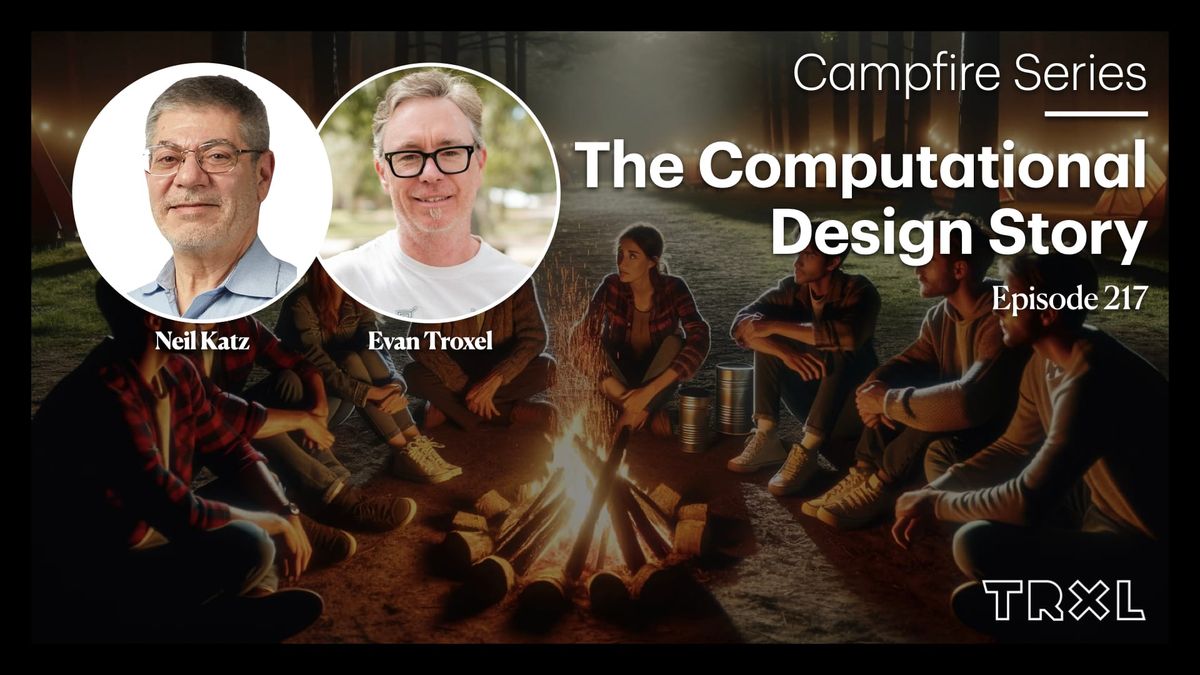
In this special Campfire Series episode, Neil Katz joins the podcast to tell us about the evolution of architectural technology from first principles. Long before CAD, BIM, parametrics, or AI became industry buzzwords, Neil was there. From technics and morphology, to early programming in BASIC and geometry-driven thinking, to custom software at SOM, to landmark projects that pushed behavior-based design into real buildings, his career offers a rare, continuous view of how design computation entered architectural practice.
If you’re interested in where computational design really came from and what still matters as the industry looks ahead, this episode provides essential context.
Original episode page: https://trxl.co/217

Watch This Episode on YouTube:
Some links on this page help fund our work, and we may earn a commission from purchases at no extra cost to you.
Connect with the Guest
- Neil Katz
- SOM profile (computational design & research)
- AIA NY Feature
- Skidmore, Owings & Merrill (SOM)
People and Philosophies
- Antoni Gaudí
- Wikipedia
- A touchstone for computational thinking without computers: rules, geometry, gravity, and material intelligence driving form.
- Gaudí. The Complete Works. 45th Ed. (Amazon)
- How Nature and Mathematics Shaped Antoni Gaudí’s Architecture
- An Exploratory Study of the Geometrical Elements in Gaudi’s Architecture by Po-Hung Liu (ResearchGate)
- Gaudí: Where Architecture Meets Science
- Anne Tyng
- Wikipedia
- Tyng’s geometric rigor profoundly shaped Kahn’s work and influenced generations of computational designers.
- Louis Kahn & Anne Tyng: The Rome Letters, 1953-1954 (Amazon)
- Anne Tyng: Inhabiting Geometry (Amazon)
- The Grammar of Anne Tyng’s Simpler Space Structures (Springer Nature)
- Louis Kahn
- Morphology in Architecture
- Wikipedia
- Explores form, structure, and spatial logic as systems (core to Katz’s lifelong research and teaching).
Computational Design & Geometry
- Pratt’s Center for Experimental Structures (CES)
- Website
- Pratt Architecture, BArch, Morphology Concentration
- Research-driven exploration of geometry, minimal surfaces, and physical + computational modeling.
- Minimal Surfaces
- Wikipedia
- A recurring theme in Katz’s teaching and research: geometry driven by behavior, not aesthetics alone.
- Smart Geometry Conference
- Wikipedia
- 2008 AEC Magazine Article
- A foundational gathering for early computational designers exploring generative and parametric workflows.
Software, Tools, and Platforms
- Autodesk Revit
- Website
- Central to SOM’s early BIM adoption, including the World Trade Center project.
- McNeel Rhino 3D
- Website
- A design-first modeling tool that became foundational at SOM for complex geometry.
- Grasshopper for Rhino
- Website
- Visual programming for geometry, automation, and rule-based design: a direct lineage from Katz’s early scripting work.
- Bentley Systems GenerativeComponents
- ParaCloud GEM (5) Elements
- ParaCloud GEM was an early generative design software application designed to populate mesh components over design models, facilitating the creation of intricate 3D structures.
Landmark Projects Mentioned
- One World Trade Center
- SOM Project Description and Photos
- Wikipedia
- Among the earliest large-scale BIM projects, pushing Revit beyond its original limits.
- Cathedral of Christ the Light (Oakland, CA)
- SOM Project Description and Photos
- Wikipedia
- Computationally designed perforated panels forming a luminous, image-based sacred interior.
- Deerfield Academy (MA)
- SOM Project Description and Photos
- Site of the skylight project illustrating behavior-driven design using solar geometry.
🏕️ Campfire Episodes
- TRXL 144: ‘The SketchUp Story’, with Brad Schell
- TRXL 162: ‘BLDGBLOG Turns 20’, with Geoff Manaugh
- TRXL 174: ‘The Bluebeam Story’, with Don Jacob
- TRXL 176: ‘The Rhinoceros Story’, with Scott Davidson
- TRXL 180: ‘The Dynamo Story’, with Ian Keough
Themes Worth Exploring Further
- Designing behavior, not form
- Computational thinking as a mindset, not software
- Automation as liberation, not replacement
- Geometry as a bridge between art, science, and construction
- Why licensure and embodied knowledge matter more in an AI-driven future
This episode is a rare, first-hand account of how computational design actually entered architectural practice long before it had a name. Neil Katz didn’t chase tools. He followed ideas, logic, and curiosity. The tools simply caught up.
About Neil Katz:
Neil Katz is an architect who focuses on “computational design” (a design process which emphasizes geometry, a logical process, informed decisions through data analysis). Although, broadly considered, computers are not required in this definition, computational tools have become critical to this process. At Skidmore, Owings & Merrill, he applies this process on projects of many types, at various scales, and even at various phases of design. SOM is an interdisciplinary firm of architects, engineers, planners, and other designers; projects are designed in a highly-collaborative environment.
Leading a computational design team in SOM’s NY office, he and his group work with project teams to define and implement computational design strategies – including geometric modeling of complex forms; various types of analysis (geometric, environmental, zoning and other codes); creating tools, usually through scripting or coding; and various research activities (project-specific, or general).
In addition to applying these strategies and tools on projects, Neil encourages others in the firm to apply these techniques on their own, and often teaches computational tools in the office. He has also lectured, published articles and book chapters about this, and teaches classes in Computational Design at City College of New York and Morphology at Pratt Institute.
Connect with Evan
Episode Transcript:
217: Campfire Series - ‘The Computational Design Story’, with Neil Katz217: Campfire Series - ‘The Computational Design Story’, with Neil Katz
Evan Troxel: [00:00:00] Welcome to the TRXL Podcast. I'm Evan Troxel, and this is a campfire series episode, the kind where we slow things down. So pull up a chair as we trace the long arc of a career that quietly reshaped the profession. Today I welcome Neil Katz. Neil is widely credited as one of the original pioneers of computational design and architecture.
long before the term existed, back when geometry code and curiosity were the tools, not software brands.
From programming on an Atari 800 to early mainframes at SOM to writing custom automation, before parametric was a word that architects used. Neil has lived every major technological shift our industry has experienced. From the inside, but this conversation isn't a software history lesson. It's a story of a mind shaped by geometry, morphology, and systems thinking, and how that mindset influenced everything from early CAD and BIM workflows to behavior driven design, fabrication, and today's AI conversations.
Neil shares how SOM approached [00:01:00] technology decades ahead of the curve, what it actually took to make those shifts stick and why the real innovation was never the tools. It was how people thought. If you're a longtime fan of Neil's work, this episode connects the dots across his entire career, and if you've never heard his name before.
This is your origin story, and if you care about where architectural technology came from and where it's headed, this is one you won't wanna miss. As always, there's a ton of additional context and links in the show notes available in your podcast app if you're a supporting member of TRXL+ or at trxl.co if you're not.
If you like the work I'm doing here, it would mean the world to me. If you would consider supporting this endeavor financially, check out trxl.co to learn more, just click one of the join links. I came away from this conversation both nostalgic and energized. So without further ado, I bring you my campfire conversation with Neil Katz.
Alright. Well, Neil, great to have you. Thanks for coming on the show.
Neil Katz: Thank you Evan. It's great to be here.[00:02:00]
Evan Troxel: It was great to meet you in New York City as well, uh, in person for the first time. Obviously I've heard your name a lot over the years and, uh, I mean, you, you definitely have.
A how would you describe your career? Is it illustrious? Is it like, what, how would you,
Neil Katz: never describe it that way.
Evan Troxel: I visited a building that you did in Bim a, a very famous building, uh, when I was there. And, and that's what I think of when I think of you. Uh, so, so what, what come is, is it just a normal career for you? Is this run of the mill architecture
Neil Katz: well, no, not at all actually.
Evan Troxel: good?
Neil Katz: And, um, yeah, I talk to other architects and learn about what they do and you know, we have a big office. I see them work and
Evan Troxel: Mm-hmm.
Neil Katz: lucky that I'm able to do, um. I do.
Evan Troxel: Yeah.
Neil Katz: do love it.
Evan Troxel: Well, let's go back to the beginning, Neil. And, and so I, I like to start, this is a campfire episode where, where we're all, we're all gonna pull up chairs and, and get a nice, warm beverage and, and sit around the campfire now [00:03:00] and, and kind of. Wax nostalgic about where architecture has come over all these years.
And so when I say, let's start at the beginning, what, what does that bring to your mind?
Neil Katz: Um, so I've known I wanted to be an architect for, a long time since high school.
Evan Troxel: Mm-hmm.
Neil Katz: and, you know, I never knew an architect and, you know, had the assumptions about what architects do. the reason I chose that field is because I loved math
and I used
Evan Troxel: Mm-hmm.
Neil Katz: And people would tell me, you know, with, with that combination, you should become an architect.
And I don't know if they knew any better than I did, but that was the advice I got from them. And I
Evan Troxel: I tend to think not. I think that like those high school counselors and stuff who all said that architects needed to know math and take all the math classes, were really thinking about engineers for the most part.
Neil Katz: Mm-hmm.
Evan Troxel: And, and they don't really know the, even the difference between architecture and engineering.
It's like, well that's buildings obviously they're tied to at the hip, and so in high school I took architectural [00:04:00] drafting for four years. And so it was even before that that I knew I wanted to be an architect. And I think it was because we would go visit the bookstore in the mall and I would always go to the magazine rack and pull out the plan magazines.
Right. All the floor plans. Some point I got, I, I laid eyes on the Roby House by Frank Lloyd Wright and I was like, whoa, this is different. Uh, so when, when, when you thought you wanted to be an architect in those early years, was there something like that where it was like, 'cause you said you didn't even necessarily know what architects did, but was what was in your mind back then that you thought architects did do?
Neil Katz: I thought I would use skills in math and, and, and,
Evan Troxel: Okay.
Neil Katz: and I
Evan Troxel: Nice.
Neil Katz: be, you know, using, using, um, those things in, in, in the work that I would be doing. And I
Evan Troxel: Mm-hmm.
Neil Katz: but, um, not in the way that I, I guess I had imagined back then.
Evan Troxel: And if we think about our past in architecture, drawing meant may lines or t squares, and it meant parallel bars, [00:05:00] it meant whatever, like, it, it was very different than, than obviously the evolution that you and I have experienced in this field.
Neil Katz: That's right. And, you know, when I was in high school, it was, um, we didn't have any architecture classes in my high school. so I was doing those things like technical drawing on my own. I
Evan Troxel: Mm-hmm.
Neil Katz: about that and just, just try it.
Evan Troxel: Nice.
Neil Katz: I was really into, um, when I was in high school, um, academics, in addition to math, um, so interested in, in, in science, all of the sciences, and chemistry and biology.
Evan Troxel: Nice. Did you have really good teachers back then?
Neil Katz: I did,
Evan Troxel: Yeah. Right. I mean, that makes a huge difference, right? OO of, because you could really not like those subjects just based on the teacher you had and Yeah. So, so to be able to kind of foster that with good to teachers and that, that's amazing. I, I had a very similar experience to that.
It was like, I liked, I like all, all of these subjects. I, I was very [00:06:00] good at all of these subjects. School wasn't particularly difficult, but at the same time it was challenging in that we were just being exposed to so many new things. And my dad was a scientist, so I always wanted to be one of those too.
Right? Chemistry, he was a chemist and a biologist and, and it was like, I like all of this and I had great teachers, which really helped.
Neil Katz: Mm-hmm. Yep.
Evan Troxel: So my architectural drafting class, we actually got a CAD program when I was in school, and that program was called Generic cad.
Generic cad,
Neil Katz: that.
Evan Troxel: and it ran on my dad's K pro, you know, 3 86 at the time. And, and, uh, it was slow and cumbersome, but we also had an eight and a half by 11 pen plotter in the back room of our drafting class. I was the very first person to ever get to try to figure out how to use that. And, and I mean, just, just talk about kind of the, the changes that we've seen from, and at the [00:07:00] same time, many things that are aren't that different, right?
So it, it's interesting. So, so take us like through the history of, of you becoming an architect from high school on.
Neil Katz: So, um, well, just one thing about computers after I graduated from high school, but before I started college at Pratt, um, I was interested in computers but had never used one.
Evan Troxel: Mm-hmm.
Neil Katz: I bought a, an Atari, um, 800.
Evan Troxel: Nice.
Neil Katz: So I think I go back a little bit farther than
Evan Troxel: Yes. Mm-hmm.
Neil Katz: um, just learned how to program and BASIC and was amazed at the things that, that this kind of tool would be able to do.
Evan Troxel: Right. It's interesting to think back to computers where you turned it on and the computer was meant to be programmed. Like that was what people bought computers for. It was not to run applications, it was to make something and to start, start with code and commands, right? It was very different. Uh uh it was.
It was a, a thing that took a lot of effort and [00:08:00] process to kind of go through and, and make it do things. And then, you know, obviously spreadsheets and things like that came along over the years, but, but in the beginning you just got a prompt and it was like, okay, I'm gonna start programming.
Neil Katz: Right, exactly.
Evan Troxel: So where did it go from there?
Neil Katz: Well, then I started, um, my five year program, um, in architecture at Pratt Institute. And um, one of the first classes I had was called tes, it was sort of an introduction to geometry for architects and it
Evan Troxel: Okay.
Neil Katz: So all incoming, you know, freshmen in architecture were required to take this class. um, the teacher that I had was Ann Tyng and she, um, didn't know it at the time, but she worked with, um, Louis Kahn.
Evan Troxel: Okay.
Neil Katz: And, um, she's responsible for a lot of the geometry behind, behind his work. She was amazing.
Evan Troxel: I, yeah. Now that you've said that, I, I, I recall like he could not have done, he could not have accomplished what he accomplished without her.
Neil Katz: [00:09:00] that's
Evan Troxel: Right.
Neil Katz: Absolutely.
Evan Troxel: Wow. So she was teaching at Pratt in New York City. And that's was your first experience in kind of geometry? Basically in college. Wow.
Neil Katz: right. Well, besides, you know, geometry in, in high school, which I
Evan Troxel: But architectural geometry more than, yeah, more than theorems and proofs. Yeah.
Neil Katz: That's right. Exactly. and she was also teaching at, at UPenn, um, that was a primary, I think, um, teaching job. And once a week she would come to Pratt to teach this, um, technics
Evan Troxel: Wow.
Neil Katz: class
Evan Troxel: Very cool.
Neil Katz: and,
Evan Troxel: office was, was in Pennsylvania, right? It was in Philadelphia, yeah.
Neil Katz: Exactly. That's right. And, um, so her class really inspired me
Evan Troxel: Hmm.
Neil Katz: I, I said while I was in her class, I'm in the right place.
Evan Troxel: Nice.
Neil Katz: But some of the other classes, um, not so much. And I wondered if, um, you know, architecture was, was the right thing for me.
Evan Troxel: Hmm.
Neil Katz: you know, thought [00:10:00] maybe because of my interest in math and, and, and sciences in general, and because I had such an academic experience in high school, a very positive one, that maybe engineering was, would've been a better choice.
Evan Troxel: Interesting,
Neil Katz: And I asked Dan Tyng about that and she, she, um, encouraged me to stay, to stick with it.
Evan Troxel: interesting. And and why did she encourage you to stay? Because she saw something or it was just like, let's just wait a little bit and, and tease this out kind of a thing or
Neil Katz: I got to know her very well,
Evan Troxel: Hmm. Mm-hmm.
Neil Katz: I just loved her class. And I, I think she did know, she did see in me that it would be something that I could, that I could, um, pursue, um, in, in a good way.
Evan Troxel: Yeah. I mean there you think about kind of the bifurcation of design and engineering and a lot of architecture schools really focus on that design side, which of course is steeped in geometry and things like that. But,
Neil Katz: yes.
Evan Troxel: you also think [00:11:00] about like the, the merging of kind of that analytical mind applied to design
Neil Katz: Mm-hmm.
Evan Troxel: it's still totally makes sense, right.
In, in architecture. Yeah.
Neil Katz: that's right. That's right.
Evan Troxel: Wow. So, so you loved that geometry class, and how did that play out when it kind of came to studio time and things like that?
Neil Katz: Well, my projects were very geometry focused.
Evan Troxel: Hmm.
Neil Katz: Um, I think more than other, um, students in my, in my classes,
Evan Troxel: How so?
Neil Katz: start with the geometry, um,
Evan Troxel: Okay.
Neil Katz: with the geometric base, um, as, as, as part of my design. you know, I think teachers and I think it was different, noticeably different from the way that other students were approaching their projects.
Evan Troxel: Nice. So
Neil Katz: understood. They, they, they,
Evan Troxel: did,
Neil Katz: me do it,
Evan Troxel: they let you do it? Yeah. Nice. So, and, and can you, can you explain just for the audience, like when you were in school, what, what was kind of the basic tools for ar an architecture student [00:12:00] back then? Was it, it was, I assume a lot of physical models, a lot of drawings, yeah.
Neil Katz: models and, and drawings, um, sketches and, and you know, manual drafting.
Evan Troxel: And how important was the physical modeling side of it to, for you as a student?
Neil Katz: I loved it. I mean,
Evan Troxel: Yeah.
Neil Katz: by, by studio.
Evan Troxel: Mm-hmm.
Neil Katz: you know, um, encouraged physical models more than others. Um, but I, I enjoyed building physical models.
Evan Troxel: Yeah. For me that was, I had built a lot of models before I went to architecture school, but they were like airplanes and boats, you know, there was plastic, plastic models and
Neil Katz: Yes.
Evan Troxel: going into school or into architecture school, it was, I mean, the, the whole idea of a study model and a finished model and having lots of study models and tearing them apart and putting them back together, but also just think spatially, like that was such a key back then to understanding spatial relationships and even materiality, but [00:13:00] light and shadow and, and thing, and, and the way you could pick it up and hold, and I mean, this, we used to do this in our hands before we did it on computer screens.
Right. And now, now it's on a 2D plane, on a computer screen. Or maybe you're doing it immersively in vr maybe, but probably not. Right? It's like still pretty rare. But that, that to me was really a f. Formative time of becoming an architect and spatial thinking was the, those study models and those final models.
Neil Katz: yes, yes, yes, yes. Um. We also took classes. Um, I mean, no, no, there were no computers in the school when I started at pr. Um, later there were, and I could talk about that in a while, um, some of my favorite things to do in, in, in some of these, like drafting classes were the more complex drawings
Evan Troxel: Mm.
Neil Katz: perspectives with shadows,
Evan Troxel: Mm-hmm.
Neil Katz: like stares with shadows.
Evan Troxel: Mm-hmm.
Neil Katz: that.[00:14:00]
Evan Troxel: Yeah. I think, go back to Richard Meier drawings. Right. Really high contrast, black and white. Figure ground kind of drawings a lot. That's where I, we would study Richard Meier's Axonometric to really learn how axons were made. Uh,
Neil Katz: Yep.
Evan Troxel: e even recently with, with just the recent passing of Frank Gehry and kind of looking at some of the, the times when he put his work on display.
Obviously a huge model shop, but also the drawings were incredible. Absolutely incredible and large format and, you know, just enormous things. Not, not just sketchbook kind of drawings. Right. But
Neil Katz: Yep, yep, yep. Mm-hmm.
Evan Troxel: Wow. Yeah. Incredible stuff.
Neil Katz: as, as much as getting the drawings to, to liquidate with, with contrast and line weight and things like that, um, to be able to visualize and, and communicate, um, with the drawings, the 3D aspects of what I was, what I was modeling in a way was, was interesting to me.
Evan Troxel: I [00:15:00] just read a recent thing about the, the old Kohinoor, uh, rapidograph. Ink pens. Right. Which I have, I have a set right over here that they're might from, from school that haven't been used and they probably don't work anymore. But, uh, interesting thing about the line weights and how they were designed based on being reduced.
So the line weights were exactly twice as big as they needed to be when those drawings got reduced by 50% or whatever. And, and I thought that, oh, I learned something new just last week about the old ink pens that I learned how to draw with in school. Yeah. Really interesting.
Neil Katz: Yep.
Evan Troxel: So, so where did that lead, I, I'm curious how all of this kind of made its way to you guys actually getting computers and starting out using those in applying 'em to architecture.
Neil Katz: So I had my Atari 800, um, and I was trying to use it as much as I could for, um, design classes.
Evan Troxel: Okay.
Neil Katz: I would in BASIC, um, learn how to create graphic models or
Evan Troxel: Really?
Neil Katz: [00:16:00] representations of, of, of things that I had in mind on the screen. There were 2D
Evan Troxel: Right.
Neil Katz: I don't
Evan Troxel: And you would type in the coordinates, right? Like you would draw vectors by typing in the coordinates in the right order for it to draw Yeah.
Neil Katz: yep. And I remember, um, a couple of times I actually would lug my computer right, my entire 800, um, into, into school and, and, you know, present what I was doing with the computer to
Evan Troxel: On the screen.
Neil Katz: on the screen.
Evan Troxel: Right. Were there, were there ways to print out, did you have a matrix or anything back in that, those days to print out those, those images? Or was there
Neil Katz: didn't know
Evan Troxel: Yeah.
Neil Katz: had to be on the screen.
Evan Troxel: Yeah. Right. And it was a monochrome screen, right. Was do you have
Neil Katz: right.
Evan Troxel: and white or amber?
Neil Katz: Right,
Evan Troxel: Not white. Do you either green or amber?
Neil Katz: right. I, I think it was green.
Evan Troxel: I find two because I had,
Neil Katz: pretty
Evan Troxel: had an Apple two E when I was in the fifth grade, and I did what you're talking about where I would.
Neil Katz: [00:17:00] Mm-hmm.
Evan Troxel: Program in the coordinates, and it would draw the lines between those. And I would try to reproduce like the cover of a, of a record album or something by, by actually laying grid paper over it and like figuring out what the coordinates were and then transcribing that basically back into the computer.
Neil Katz: Mm-hmm.
Evan Troxel: Wow. Very cool. So you would bring your computer in and what did, what did your professors think when you would do that?
Neil Katz: Um. I think they thought it was interesting.
Evan Troxel: Really,
Neil Katz: I, yes. Yep.
Evan Troxel: because I, I was thinking they probably were like, ah, get off my lawn. Kind of
Neil Katz: no, I, I think they were impressed that, that,
Evan Troxel: nice.
Neil Katz: and maybe, you know, looking into the future that one day, you know, computers would be able to do these kinds of things, and this was pretty early.
Evan Troxel: Wow.
Neil Katz: think they were impressed and I was the only one,
Evan Troxel: Yeah.
Neil Katz: you know,
Evan Troxel: I, I was projecting a little bit.
Neil Katz: my school.
Yeah.
Evan Troxel: I was projecting a little bit there when I said, get off my lawn, because that was my professors and we did have a [00:18:00] computer lab
Neil Katz: Mm-hmm.
Evan Troxel: still I, maybe I was one of two people who was actually using the computer in the earlier design studios, and it was like
Neil Katz: Yep.
Evan Troxel: they would just kind of shake their head.
They wouldn't say we couldn't do it, but they would just kind of have a disapproving, uh, disapproval. You could, you could just read it in the body language
Neil Katz: Yes.
Evan Troxel: because it wasn't how they did it, it wasn't how, and it wasn't what they, obviously there's value in, in drawing by, by hand and, and learning the techniques that they learned and at the same time things are, are changing and
Neil Katz: Mm-hmm.
Evan Troxel: not as accepting of that.
Neil Katz: that's right. And I had to do that too. It wasn't like what I was doing on the computer replaced what everyone else in the class. I had to do
Evan Troxel: Right.
Neil Katz: but was able to do this additional thing.
Evan Troxel: If, if you look back and think of like where that started with you drawing those 2D lines, do you feel like the evolution of. Maybe just in the next five years from that point, do you think it, did it feel fast or did it feel slow when you think about what? The progression of technology back then.
Neil Katz: It, it, it, [00:19:00] it did feel fast. Um,
Evan Troxel: Mm-hmm.
Neil Katz: I was in my, either third or fourth year at Pratt, um, they actually got a computer in the School of Architecture. even before that, there was a computer science, um, degree program at Pratt, I took some computer classes in, in different programming languages.
Evan Troxel: What programming languages, it was like fortrend, things like that. Yeah. Okay. Yeah, and I think that, I think that one on for a very long time like that.
Neil Katz: yes, yes.
Evan Troxel: Yeah, for sure.
Neil Katz: Exactly. And
Evan Troxel: Wow.
Neil Katz: yeah, so when Fred got their computer, and I don't even re remember what kind it was, but it was, it was a big machine. Um,
Evan Troxel: Mm-hmm.
Neil Katz: you know, I think everything was included, including the seed and the monitor and the keyboard.
Everything was like one unit and, um, not that many people were interested in using it. I was. And, um, you know, I didn't have much competition. There wasn't like a long line to,
Evan Troxel: Right.
Neil Katz: it.
Evan Troxel: Wow. So let, [00:20:00] let's, let's keep going from there. What happened next?
Neil Katz: Um, after I took, um, the technics class with an Tyng, um, I wanted to continue studying that topic. Um, and the next level of techniques was called morphology. And, um, there was a professor whose name is Ani, um, and he taught morphology classes. So I took several of his classes and, um, and it, it deals with, with geometry, um, geometry and architecture, but even more pure, um,
Evan Troxel: Hmm.
Neil Katz: polyhedra and, and, uh, space filling.
Evan Troxel: Yeah.
Neil Katz: things like that.
Evan Troxel: Mm-hmm.
Neil Katz: and I started to use the computer that we got in the School of Architecture to model some of those. um, my professor, not only was I interested in doing that, but my professor was also very interested in,
Evan Troxel: Hmm.[00:21:00]
Neil Katz: that can be used to sort of push forward some of the research that he was doing.
Evan Troxel: Nice. And so was that again, you doing programming level or were you, were there any applications to kind of help out in that way? Early on.
Neil Katz: Yep. So that machine was designed for architects, so you actually couldn't, as far as I know, you couldn't program on it, but it, it had this, um, like early CAD software
Evan Troxel: Okay.
Neil Katz: you, um, you know, I guess really early simple commands, like
Evan Troxel: Yeah.
Neil Katz: lines between two points and copying them and
Evan Troxel: Right.
Neil Katz: arcs and circles and things like that.
Evan Troxel: So was it, was it actually 3D at that point to have 3D coordinate system, or was it still 2D? Okay.
Neil Katz: it, it was 3D
Evan Troxel: Wow. And what was the input? Is it still keyboard driven or was, were there mice at that point?
Neil Katz: There wasn't a mouse. Um, it was a keyboard and, um, I forgot what we used to move the [00:22:00] cursor.
Evan Troxel: There was, there was like a puck, I mean that, that's not the right word for it, but there was, I remember there was, uh, yeah, what was that called? So people can comment on the, on the podcast and let it, we will look it up after the fact because it's not coming to my mind either. But yeah, it was kind of like a digitizer almost, um,
Neil Katz: Mm-hmm.
Evan Troxel: you would use because it, the early ones that I used were in MicroStation, actually in the firm, the first firm that I worked for.
Neil Katz: Mm-hmm.
Evan Troxel: also had a big tablet. That you did it on top of, um, and on that tablet you could put a drawing and then the, the it, you basically trace it because there was actually a cross hair designed into that digitizer puck that you could use to like, move to a position, click it, and then move it over here and click it again.
And it would reproduce that into the machine.
Neil Katz: That, that, that, that sounds familiar.
Evan Troxel: Yeah, yeah.
Neil Katz: it might have been similar.
Evan Troxel: Yeah. Very cool. So, so, wow, that's really interesting that you were doing basically 3D [00:23:00] volumetric, 3D geometry,
Neil Katz: Yes.
Evan Troxel: what year, what year are we talking about here?
Neil Katz: was probably the, the end of my third year.
Evan Troxel: Okay, nice. And so after morphology, where did that lead?
Neil Katz: Um, well, I kept going with morphology.
Evan Troxel: Okay.
Neil Katz: Um, so he, he was developing additional courses, like research courses, um, all that dealt with morphology
Evan Troxel: Nice. And then was he writing a book about it or was that, you said he was interested in it from a research pur.
Neil Katz: yes. So he,
Evan Troxel: Okay.
Neil Katz: um, he was writing books, he was publishing articles in, in, in various journals, architecture and mathematics and engineering, um, like journals or conferences or things like that. he would ask me to, um, help him create the graphics for
Evan Troxel: Hmm.
Neil Katz: that he was writing.
Evan Troxel: Nice. And so how did those graphics get out of the computer and [00:24:00] into his articles and, and books.
Neil Katz: Well, Pratt did have a, um, a, a, a.
Evan Troxel: Okay.
Neil Katz: They
Evan Troxel: So you could,
Neil Katz: that
Evan Troxel: you could get 'em out of there. Nice.
Neil Katz: that's right.
Evan Troxel: Wow.
Neil Katz: also able to export them to, to like image files. I think they were TIF files at the time.
Evan Troxel: Okay. What year, date wise was this.
Neil Katz: It was, um, mid eighties, maybe 83 or 84.
Evan Troxel: Okay. Wow. And so were you aware of people outside of architecture using computers for geometric studies or drawing or anything? Or was it just what you had experienced directly? Okay. Yeah. I'm thinking about like the early stuff that I've seen, you know, Pixar, you know, ed Kamo, things, I'm thinking like that kind of stuff, the early ILM days with, you know, very basic stuff that they were doing in the computer.
And obviously that a parallel industry Right. And, and probably [00:25:00] a lot more advanced even back then, but, um, but yeah. Interesting.
Neil Katz: You know what? One thing that you reminded me of that I hadn't thought about for a long time. Um, I think the software that we were using on this computer that we had at Pratt, um, was developed by, um, people at Brigham Young University.
Evan Troxel: Hmm
Neil Katz: Uh, and we were communicating with them
Evan Troxel: mm-hmm.
Neil Katz: you know, can we, can we do this?
Or, you know, and enhancements to the software based on what we wanted to do that we were not able to figure out using the software.
Evan Troxel: Oh, that's cool. Right. So, so they were, I'm sure, interested in how their software was being used as well. I mean, I mean, that still goes on today, right? But that you were definitely a, a early adopter pioneer in that way, I'm sure. For even from their standpoint of view, it's like, oh, what are people doing with our stuff?
And, wow. Very cool. Wow. So, so you continued with morphology. How far did that, did that go
Neil Katz: Um, well I continued until I graduated
Evan Troxel: okay.
Neil Katz: even [00:26:00] after that and I had already started working at SOM, um, continued to collaborate with, with my professor. His name is Hare Ani.
Evan Troxel: Nice.
Neil Katz: was continuing to write papers and, you know, publish, um, articles and, and chat book chapters and, and journal articles. um, I would, um, not only work on the graphics, but also participate in some of the research that he was doing.
Evan Troxel: Cool. And, and,
Neil Katz: own time.
Evan Troxel: and so you guys obviously had built a relationship with you as a student, but, but did he have, were there other people getting interested in this as well in Pratt to help out with this or go? I don't know if they got more computers, like, like how did that evolve?
Neil Katz: So while I was there, they didn't get another computer. Um. There were, there were other people who were becoming interested in, in, in, in, in, not only the research as part of his classes, but even continuing beyond that, like I did
Evan Troxel: How f foundational [00:27:00] to, I mean, I'm kind of guessing what you're gonna say right now, but how foundational was this kind of stuff to your career as an architect?
Neil Katz: incredibly.
Evan Troxel: It, it had to be right? I mean, this, it's like this set you on a course that you never went away from, right?
Neil Katz: right.
Evan Troxel: Absolutely incredible. And, and it just seems like right place, right time with your mind and what you want and your interests and even, and your professors.
It's just kind of like this magic
Neil Katz: Yes.
Evan Troxel: coincidence of all of those things coming together to set you on this path. Right?
Neil Katz: right. Exactly.
Evan Troxel: Yeah. Wow.
Neil Katz: Yeah. And it's still, still doing research in morphology. Um, my professor is still teaching at Pratt and a couple of years ago I also started teaching morphology at Pratt.
Evan Troxel: Wow. Geez. That's incredible. So, so how long is, you said your professor is still [00:28:00] teaching there, so how long has he been teaching there now?
Neil Katz: Um, maybe 45 years.
Evan Troxel: Yeah. Oh my gosh. Never gonna retire.
Neil Katz: That's right.
Evan Troxel: Wow, that's super interesting. So you said by now you're working at SOM. Can you kind of talk about that process of how you got hired there and, and how you went about that and Yeah, I would love to hear that.
Neil Katz: Yeah, it's interesting. Um, so the dean at Pratt when I was there, um, was friends with one of the partners at SOM um, they were looking for interns, um, to, um, so SOM had a mainframe computer. Right. Um, and who we using the computer, and it wasn't everyone in the firm, of course, it was just maybe a dozen people, um, would be creating their drawings and models, um, during the day, but they couldn't print anything during the day.
Evan Troxel: Mm,
Neil Katz: had to be printed after hours.
Evan Troxel: because it [00:29:00] basically took up the computer. Like that's all the computer could do at that point. Right. So you couldn't use it for anything else.
Neil Katz: exactly
Evan Troxel: Can you, before, can you explain what a mainframe is for those younger listeners who have no clue what, because now a computer way more powerful is in your pocket all the time, right?
So can you talk about what that was and maybe even if you know how much they cost back then?
Neil Katz: Yeah. Oh, I don't know. Millions of
Evan Troxel: A lot. A lot. Millions of dollars, right?
Neil Katz: yes, yes. Um, but
Evan Troxel: Hmm.
Neil Katz: these huge computers, um, in a room by themselves, um, which had to be climate controlled. So it was always cold, it was air conditioned in that room. Um, and. Some companies, I think, had rooms not too far from those mainframe computers where, um, would have terminals, so people using the computers would, would all sit together and the terminals wouldn't have any computational power on their own. Um, but there would be wires connecting them to these mainframe computers.
Evan Troxel: Yeah, that's what,
Neil Katz: they were distributed. It wasn't, they
Evan Troxel: okay.
Neil Katz: located in the same place. They were [00:30:00] distributed throughout the office.
Evan Troxel: We had that in school. It was called the vax, and I don't remember what VAX stands for, but it was terminal. Everybody had, there was, there was a room full of terminals, but they were all just connected through
Neil Katz: Mm-hmm.
Evan Troxel: probably really basic, uh, networking cabling back then to
Neil Katz: Mm-hmm.
Evan Troxel: machines that filled the basement of the library, like enormous amount of, of computing.
Right. So, which, which is again, not, not a lot of compute, but compared to today's standards. But back then it was just an, it was an enormous piece of equipment or pieces of equipment that for you to do that. But you would then basically use Telnet or something, you know, to go in and, and do commands on the computer from your, your very basic terminal.
Neil Katz: Exactly. And the computers we had also were VAX and they were the brand of these, um, I think officially or, or, um, they weren't mainframes, they were mini computers, which I think is one step down from a mainframe computer,
Evan Troxel: Mm-hmm.
Neil Katz: similar. [00:31:00] Um, in concept and Deck, digital Equipment Corporation were the
Evan Troxel: Right,
Neil Katz: of these machines.
Evan Troxel: right.
Neil Katz: And, um, we had, um, I think when I started, we had one of these, um, when I started as an intern. and then, um, when more and more people were using the computer and, um, the one mainframe wasn't able to handle all the additional people. Um, we got a second one and then
Evan Troxel: Wow.
Neil Katz: third one.
Evan Troxel: And so back then, do you know any of the kind of conversations that were happening around technology in a firm like SOM? Like, like were they. Checking it out, not sure they're making huge investments, but at the same time, not a lot of users. Right. It takes a lot of training. It was,
Neil Katz: Yes.
Evan Troxel: see it as the future of the practice of
Neil Katz: they, they
Evan Troxel: Mm,
Neil Katz: absolutely. And um, yeah, I don't know how much of that I knew when I started working there as an intern, but, you know, not long after that, um, realized that even in the [00:32:00] seventies they saw that, that this was coming. And, you know, for a company as large as we are and the types of projects that we do, these huge, um, and complex, um, projects, um, both architecture and engineering, um, they said we have to invest in,
Evan Troxel: mm-hmm.
Neil Katz: some processes that would make it more efficient for us to do these things.
Evan Troxel: Yeah. Yeah. Interesting. And and was that only in the New York office? I assume there were other offices even back then? Yeah.
Neil Katz: Yeah,
Evan Troxel: Okay.
Neil Katz: I think we had nine offices back then and most of the, um, well we had our own computer system, right? We couldn't go and buy AutoCAD or other systems. They didn't exist. and the one that we were using at fra, um, I think was like a single user, um, type of machine and, and single user sort of way of thinking about using a computer. And that wouldn't have worked for us
Evan Troxel: Mm. Mm-hmm.
Neil Katz: a large company and very [00:33:00] collaborative. So we would need a system where people are able to share all, all the data that they're working on, that they're creating.
Evan Troxel: So were they actually developing their own software or were they working Okay. Interesting.
Neil Katz: they developed their own, and most of that was done at our Chicago office,
Evan Troxel: Okay.
Neil Katz: offices did participate in some way in, in the development of the tools of the software,
Evan Troxel: And that software, was it more than just the design studio? Was it also other departments as well?
Neil Katz: other departments as well.
Evan Troxel: Okay.
Neil Katz: Um, at, at that time, um, architects would sort of divide it into two types. There were design architects and technical architects. And, um, there were everyone, all the architects were, um, sort of introduced the compu to the computer. Some of them wanted nothing to do with it, but many said, you know, this looks interesting.
I want to wanna, you know, start using it. Um, and, uh, and engineers as well.
Evan Troxel: Yeah, that's right because SOM is multidisciplinary, right? It's, [00:34:00] it's architecture and engineering and I, that's like one of the, the values of SOM is even to like the, the, the structure, the engineering of the building needs to shine through the, the, the design of the,
Neil Katz: That's right.
Evan Troxel: Yeah. Very interesting.
Neil Katz: Exactly.
Evan Troxel: so when, when you were originally drawn to, were you drawn to SOM because of this or was it just the firm that you chose to go work for and then they happened to have this?
How did that work out?
Neil Katz: It was sort of, um, also, um, handed to me in a way. Um, the dean at Pratt, um, who knew one of the partners at SOM, the partner said, we need, um, a couple of people to come in at night help us to run these prints because we couldn't run them during the day. Um, so he sent four people. The dean, um, his name was Sidney Schev, sent four people to an interview at SOM um, they selected two of us,
Evan Troxel: Okay.
Neil Katz: and I'm still there.
Evan Troxel: And you're still there. You've never worked at another firm.
Neil Katz: That's
Evan Troxel: [00:35:00] Wow. You're shaking your head. For those people who aren't watching, he's like, Nope, I've been here the whole time. So what year was that?
Neil Katz: That was in probably 84.
Evan Troxel: Okay. Wow. So you just,
Neil Katz: student at Prep.
Evan Troxel: wow. So you, you just last year celebrated a pretty major anniversary there. Amazing.
Neil Katz: right. I
Evan Troxel: Wow. So, okay, so let, let's talk about where that journey has taken you now throughout, like, like, let's hit the high, the highlights. I mean, this has gotta be so much information in here, Neil, this, this, we might need multiple podcast episodes with you, but let's, let's, let's talk about where, so you're running prints at night, but then obviously that that didn't, I mean obviously you, you've done way that went somewhere very quickly.
Neil Katz: So as I was coming in at night and, um, I, I, I either came in like at five o'clock after my classes, um, and started doing prints, [00:36:00] or I would come in like in the morning before classes, like five or six o'clock in the morning. and the two of us used to switch off. One of us would come in in the evening, the other one would come in early in the morning. Um, there were people there, right. It's not like,
Evan Troxel: Yeah.
Neil Katz: people leave at five and come in at nine. So we got to meet a lot of the architects who were using the computers and talking with them.
Evan Troxel: Mm.
Neil Katz: I, I was fascinated
Evan Troxel: So what kind of projects were they working on? Like the, the all kinds of projects? Was it, were you just, okay, so it was like across the board, it what? Didn't matter. They weren't saying only this project type, while we do this, like, figure this out. It was just, let's do it all.
Neil Katz: And a lot of it was the people who were, were interested in, in, in trying this out.
Evan Troxel: Mm-hmm.
Neil Katz: force anyone to use it, but, um, they had enough people who, um, were interested in, in, in, in using this new technology.
Evan Troxel: Interesting. So, and when you say printing, can you talk about like what the, what the [00:37:00] printing process was or the technology for printing?
Neil Katz: Yes,
Evan Troxel: Was it pen? Pen, plotters.
Neil Katz: We had two kinds of platters. We had a pen
Evan Troxel: Okay. Uhhuh.
Neil Katz: an electrostatic platter.
Evan Troxel: Okay.
Neil Katz: And, um, most people were using the electrostatic platter, which was a black and white, black and white platter. And it was pretty fast.
Evan Troxel: And was that, was that pens or was it like a Xerox kind of a, a technology. Okay. I, I, we, we used to, early on in, in school we used a pen plotter because we would pen plot onto Vellum and then we could make blueprints from that. Right. I mean, that was the whole point of using Vem was to run it through blue line machines and get re reproductions.
And so with, uh, an electrostatic device, I mean, you're just printing new sheets all the time. Right.
Neil Katz: right. Um, we were able to use different paper in those
Evan Troxel: Okay.
Neil Katz: and, and vellum was one of the types of paper, but usually we would use, um, you know, much less expensive paper.
Evan Troxel: Yeah. And were those sheets or were they on rolls?
Neil Katz: Yes. On the, on the electrostatic platter, it was, it was in [00:38:00] rolls,
Evan Troxel: Yeah.
Neil Katz: platter, um, it was, it was on sheets
Evan Troxel: Yeah.
Neil Katz: pen platter was this huge table. Um, and the, there was a vacuum, so the paper would be, um, you know, attached to the bed of the table. And then it had this carriage that had four pens, so we could use either different colors or different, um, thicknesses of, of, of pens.
Evan Troxel: Right.
Neil Katz: took a long time, especially, you know, if you had a drawing with a lot of text, a very detailed drawing,
Evan Troxel: Yeah. Right. Yeah. I remember using the pen plotter. It wasn't a vacuum table like the one you're talking about, which I think would be what I'm think I'm picturing more of like a modern day CNC machine or a laser cutter or something. Right. Where there's the,
Neil Katz: Yes.
Evan Troxel: running over the top, but ours actually had a roller and you had to feed, you had to put sheets in it.
It wasn't a roll of draw of, of paper, but, but the, you know, the, the pen only went back and forth, but the sheet went
Neil Katz: Right.
Evan Troxel: and back. Right. And so you would just have this. Symphony of movement that was so
Neil Katz: Yes.[00:39:00]
Evan Troxel: to watch that happen. And then it would pause and, and pop that pen weight out and stick a different one in if you needed thicker lines.
And then it would go at it again. And it was so interesting to watch it because it would draw a line over here, but then it would jump all the way to the other side of the page and draw another line. So the, the movement just seemed extra exaggerated. And then you start to think about efficiency of, okay, well what if we start to draw them in the order so that the computer
Neil Katz: Mm-hmm.
Evan Troxel: prints them in that order?
It's like all of these things just kind of waterfall into
Neil Katz: right. Yes. Yes, yes.
Evan Troxel: the next evolution of how we do it.
Neil Katz: So, shortly after I started working at SOM full-time, um, after I graduated, um, the, in addition to these, um, platters, they also got a laser cutter. And I think SO one was the first architecture firm to use a machine like this, um, in our model shop.
Evan Troxel: Mm-hmm.
Neil Katz: use it to, to, to create models. Uh, and, you know, same thing. It would, it would this pamphlet that you're describing, um. [00:40:00] Cut the material in the order
Evan Troxel: Jump all over.
Neil Katz: it would jump all over the place, and that made a lot of noise. That was like a symphony.
Evan Troxel: Right, right. I mean, uh, I used a laser cutter very early in school as well. I think maybe I was in my, my second or third, probably third year.
Neil Katz: Mm-hmm.
Evan Troxel: my structural teacher, who was also my design studio teacher at that time, I did Grim Shaw's Waterloo Station. We did a section model through that, which is a, you know, a three dimensional truss, that really beautiful design.
And I did a section and, and he was blown away by the output of that model. And I was just, I had had to learn so much to get my MicroStation drawing
Neil Katz: Mm-hmm.
Evan Troxel: output as a, as a laser cut because. You couldn't run the laser cutter out of MicroStation. There was a, I think we, I think it actually ran through choral draw back in those days.
And when you would export a DXF out of MicroStation into [00:41:00] choral draw, the circles never came out. Right. And so you had to redraw a lot of it in choral. And then you had different colors for different depths if you wanted to score versus cut in the laser, things like that. And so for, I'm, the reason I'm explaining this is because like we had to go through so much learning and testing just to translate from the one medium to this new machine and and output type.
It was quite a learning curve and there was no one around to teach us how to do it. It was just like trial by fire, learn by doing.
Neil Katz: Right? Yep. Yeah. Yep. So, when I was at SOM, um, I joined the computer department, right? The Plato operators were part of this, um, group of about maybe a dozen people in New York. Um, and, I dunno, maybe 50 people, firm wide. Um, and some people were writing the software, writing the tools that we were using.
Some people were, um, people how to use it. We were doing all kinds of things. Um, so [00:42:00] when we got this laser cutter, uh, we were using our own system, so there was no direct interface from the files that we were generating. Um, so there were some people in the New York office, in the computer department who were excellent at, at code. So they
Evan Troxel: Hmm.
Neil Katz: to be able to take, you know, our files and make laser ready files.
Evan Troxel: Nice. How did the model makers feel about that? Did they see it as a tool to augment what they were doing? Did they see it as a threat? A little bit of both.
Neil Katz: they, they, the, there were two people in the model shop and, you know, I loved models through college and also enjoyed, um, when I could, um, being in the model shop, using the laser cutter or, you know, doing anything in the model shop. I, I really loved that. Um, they were excited and they were
Evan Troxel: Right.
Neil Katz: um, you know, the, the people that were writing the tools to translate, um, to, to, to make it easier for them.
Evan Troxel: Yeah.
Neil Katz: And they thought it's gonna [00:43:00] save so much time,
Evan Troxel: Mm.
Neil Katz: didn't.
Evan Troxel: Right.
Neil Katz: the reason it didn't, we made our models so much more detailed
Evan Troxel: Yep. Uh, sounds like almost every technology in architecture
Neil Katz: exactly.
Evan Troxel: we can, we can do more now. It's, it's not, we can, we can take it easy and, and yeah, we can do more. We can add more detail. We can, yeah.
Neil Katz: Mm-hmm.
Evan Troxel: Like the design's never done even.
Neil Katz: That's
Evan Troxel: So, so I'm also curious how visualization, like rendering was starting to work its way in, in those early days because you're working in three DI mean, then you're taking 2D projections and maybe outputting those to the laser cutters so that, so that physical models could be built.
But there was, we also had watercolor renderers, real people who used to do that in firms and, and then three dimensional visualization and rendering started to work its way into the scene. And, and I'm curious how that was a parallel track with this physical output.
Neil Katz: So the software [00:44:00] that we had created ourselves was, was sort of in, in, in modules. So there was one module, um, called Draft, which is a bad name because it was not just drafting, creating 2D um, drawings. It was, it was a 3D modeler. Um, and there was another module called Plot. you take, um, some projection of, of your model and print it on paper. Um, we had another module called Render, that would take the 3D model and, um, run it through some ray tracing processes and create an image.
Evan Troxel: And, and did the, the renders, the people who were doing re because we all had, the architects rarely did their own renderings. Once they get outta school because you're so busy working on project somebody, somebody was dedicated to that. Like you had two people in the model shop who were dedicated to making models.
Were they using those as underlays for their perspective imagery? Or how, how did that process work?
Neil Katz: uh, so the, the surrender software was able to create renderings [00:45:00] directly, but they were
Evan Troxel: Okay.
Neil Katz: They were, you know, it was able to do reflections and things, but the, the output looked very primitive.
Evan Troxel: Mm-hmm.
Neil Katz: was low. Um, they took days to create one, one image. Um, but it, it was the architects that were doing it.
Evan Troxel: Okay.
Neil Katz: Um, and even the architects, um, our model shop had some full-time people who were running the shop, but even architects would be using the model
Evan Troxel: Nice.
Neil Katz: the laser themselves. Um, we also hired, um, renderers, I remember we, we had this watercolor render who would come into the office maybe a couple of days a month. And, um, you know, we gave him a desk and he would, um, you know, do watercolor enterings, which was so beautiful. Um, and often, um, or eventually, and then, then often, um, they would ask me to grade a wire frame projection building that he would use as an underlay.
Evan Troxel: Mm-hmm.
Neil Katz: So it'd
Evan Troxel: Just to get the [00:46:00] perspective done. Quickly. Yeah. Quickly.
Neil Katz: Yep. Yep.
Evan Troxel: Right. Wow. So, uh, it's incredible that you guys were, were actually developing your own modular system for all of these different parts. Absolutely. Incredible.
Neil Katz: then the engineers had their own modules for analysis and, and you know, design, engineering, design and different kinds of engineers. We had one for structures and and plumbing.
Evan Troxel: It's a huge investment for the company to be making. And you said there were about nine offices at the time, and was that pretty evenly distributed throughout the firm or just in the, the major cities, or how did that work?
Neil Katz: the major cities primarily because,
Evan Troxel: Okay. Wow.
Neil Katz: um, you know, especially to buy a mainframe,
Evan Troxel: Yeah.
Neil Katz: want a lot of people to be using it.
Evan Troxel: Right.
Neil Katz: get one for one or two people.
Evan Troxel: So, so let, where did it go from there?
Neil Katz: So when I graduated and started to work at SOM full-time, um, I no [00:47:00] longer had to in at night and
Evan Troxel: Uhhuh.
Neil Katz: Um, but one of my first, well two things, um, two of my first tasks, one of them was to teach people how to use the software that we had developed. Um, one disadvantage is, you know, we're the only ones using the software. Um, so anyone who wants to use it coming into the office, or even if they're already here, we had to teach it to them. So we had a two week training, um, course. um, because as I was coming in at night and talking to the architects, I was also learning how to use it. So by the time I graduated and started full-time, I was, I was able to teach it.
To teach it to people.
Evan Troxel: Okay. And so was that an extension of you being in that technology kind of department? Was was also doing the training, okay.
Neil Katz: right. That's right. And then I was also assigned to projects. So even though I was in the computer department, um, I would be working on projects that were using the computer um, either just helping them out because they needed more people
Evan Troxel: Mm-hmm.
Neil Katz: create the, the models and the [00:48:00] drawings, um, or to help the people who were using it on the project to use it, um, in a better way. Sort of teaching them as they're working on the
Evan Troxel: Mm. Yeah. What was 3D used for? I mean, was it strictly used for these kind of projections, or would you call this kind of an early version of BIM in any way? I'm, I'm just curious how that
Neil Katz: Well, two things. We were using it as a design tool, not just to create
Evan Troxel: mm-hmm.
Neil Katz: of the project,
Evan Troxel: Mm-hmm.
Neil Katz: um, you know, to see things in, in 3D and spin around them and, and use it to help us design the project. Um, they were using it to visualize design and, and as a design tool,
Evan Troxel: Mm-hmm.
Neil Katz: also to create 3D documentation. So we, we would often create, um, even
Evan Troxel: So Axon kind of like axonometric going back to your early days of Right. Okay.
Neil Katz: Accents, um, even elevations,
Evan Troxel: mm-hmm.
Neil Katz: with, with shadows and,
Evan Troxel: Okay.
Neil Katz: you know,
Evan Troxel: That was pretty [00:49:00] unconventional. I, I bet back then. Right? I mean, and, and to, to be able to communicate depth on facades and things like that. I bet. I mean, that it is just, when you see it, it's obvious, but we weren't taught, we weren't taught to do it that way.
Right. That was an innovation inside the firm.
Neil Katz: Mm-hmm. Yes.
Evan Troxel: Yeah. Very cool. Alright, so I, I'm curious how this makes the translation to where. Programs like AutoCAD and MicroStation started to come onto the market and become more democratized and more available, and then PCs landed on people's desks and away from the mainframes.
I mean, there's a lot of ground that that has been, we've experienced being covered in the last 20 years, 30 years.
Neil Katz: At, at some point as we were developing our own system and using it ourselves, right? We weren't selling it or anything. Um, but IBM came to us with a proposal and they said we'd like to work together and, um, you know, we, we see what you're doing. We'd like to take it and market it.[00:50:00]
Evan Troxel: Hmm.
Neil Katz: so we worked together with them to, it was, it was the same system.
We renamed it a ES Architecture and Engineering series, um, and IBM was, um, sort of selling it to, to other people. Um, it didn't sell very well,
Evan Troxel: Hmm.
Neil Katz: um, either because people by that time were starting to look at other tools that were also becoming available. or IBM wasn't as good as at marketing software as they were in marketing hardware.
Evan Troxel: Mm-hmm.
Neil Katz: Um, and then we ourselves had to decide, um, you know, should we continue to maintain our own tools, um, and teach people how to use them. Or should we start to use tools that were becoming more and more available? Um, so we put together a committee and, and, um, in the end, uh, actually choosing between our own tool, um, or what became a ES, um, AutoCAD and MicroStation.
Those were the three
Evan Troxel: [00:51:00] Mm-hmm.
Neil Katz: at. And, um, we, we chose AutoCAD
Evan Troxel: Okay.
Neil Katz: and a couple of the issues, one of them, you know, it's, it's a huge, um, job to maintain your own software.
Evan Troxel: Mm-hmm.
Neil Katz: And they thought it, you know, at that point it wasn't worth, um, the effort. Also, um, people coming into the office, enough people were coming and knowing AutoCAD that that training, um, would, would, um, either disappear or, or be much less than a two week, two week program. And we were also starting to share our, um, models or drawings with consultants and, and others, um, and. we were using our own software, we had to create, um, translation, programs.
Evan Troxel: Yep.
Neil Katz: And those also needed to be maintained as our own software was developing. And also the, the target software was developing.
Evan Troxel: Mm-hmm.
Neil Katz: if we were using AutoCAD, we, we figured we would have much less of that
to do. Mm-hmm.
Evan Troxel: Yeah, that was interesting. You just reminded me of, [00:52:00] uh, the, the. Firm I was with, we used MicroStation. And so there was a lot of time spent just converting DG n files to DWG files and back and forth. And that wasn't done in the host application. It wasn't like file export as a micro, no, that was not gonna be a thing.
We had to have special translation software just for that.
Neil Katz: Mm-hmm.
Evan Troxel: And, and your engineer might be using the d the other platform. Right. And so
Neil Katz: right.
Evan Troxel: yeah, that was happening a lot back then.
Neil Katz: Yep.
Evan Troxel: And it's interesting that you say that, that the people were coming in knowing it, and obviously there's, there's pros and cons to that too, right?
They may not be using it the way that you use it, but they have the fundamentals, they understand how commands work. And so
Neil Katz: Mm-hmm.
Evan Troxel: I would say is probably a net positive, but
Neil Katz: That's
Evan Troxel: you still had to get rid of people's bad habits.
Neil Katz: yes, exactly. That's right. And AutoCAD initially was designed as, uh, you know, a single user working on one drawing at a time.
Evan Troxel: Mm-hmm.
Neil Katz: didn't work that way. And we didn't wanna start working that way, you know, because we were still doing large
Evan Troxel: Mm-hmm.[00:53:00]
Neil Katz: So we, um, a sort of shell, um, to use on top of AutoCAD. So if you're using AutoCAD, you would actually have to go through the shell and it would ask you, um, like there would be an interface with the form, um, floor are you working on, what aspect of the floor. And it would actually look at many files and sort of load up what you needed to work on, what
Evan Troxel: Wow.
Neil Katz: to do.
Evan Troxel: Wow. Very cool.
Neil Katz: you were all done, it would know exactly where to save everything to.
Evan Troxel: Very cool. Um, yeah. When did X-refs actually get
Neil Katz: Yep.
Evan Troxel: into AutoCAD? It was quite a while after that, I assume.
Neil Katz: This, this was before X-refs. We were
Evan Troxel: Yeah.
Neil Katz: um, AutoCAD map, I think it was called,
Evan Troxel: Okay.
Neil Katz: that had some features that allowed us to do that.
Evan Troxel: Wow. Wow. Very cool. And so, so obviously you were still developing certain aspects of the pipeline so that you could work the way that you were working.
Neil Katz: [00:54:00] that's right.
Evan Troxel: But, but for the most part, you've, you've stopped developing your own full fledged products to work together. You were relying on off the shelf software at that point?
Neil Katz: right. That's right. And I was reluctant to give it up. I got so comfortable using it and enjoyed using, using it.
Evan Troxel: Mm-hmm.
Neil Katz: think I was the last person to use it.
Evan Troxel: Oh, really?
Neil Katz: Yes.
Evan Troxel: Well, I assume that, that, like I said, desktop PCs had to be coming in at some point where you didn't need these terminals in the mainframe, and at some point the mainframe's very outdated. Right. It's not gonna move even as quickly as the desktop machines.
Neil Katz: that's right. So we, we did that in two steps actually, when IBM joined, um, in, in, in the development of this tool, um, we sort of went away from mainframes and started using heavy duty workstations. They were UNIX workstations, so one person would get one workstation, and they were so expensive.
Evan Troxel: Mm-hmm.
Neil Katz: Um, and, you know, more and more people were using it. So that was a bit of an issue. [00:55:00] And then as, as PCs were becoming more available, um, IBM finally ported the software to, to the PC environment. So in the end, um, we were able to use it on PCs. Mm-hmm.
Evan Troxel: And, and so how did that rollout across the firm start to, like, how fast did that happen? Because like you said, even what, what used to be a terminal on mainframe then became a very expensive Unix workstation.
Neil Katz: That's right.
Evan Troxel: I mean, we're even back then it was in the tens of thousands of dollars, right.
For that, for that it wasn't just a few thousand dollars, you know, cheap PC clone, because remember there was IBM and then there were all the clones back.
Neil Katz: Yes,
Evan Troxel: At some point. At some point that was a thing, um, because people were very interested in not spending money on the, the real IBM workstations. But, but, uh, but yeah.
How fast did that rollout, that evolution happen in the firm?
Neil Katz: it probably took a couple of years at least,
Evan Troxel: Oh, that's not too bad.
Neil Katz: overlap. Some people were still [00:56:00] using a ES and people were starting to use, um, this sort of version of AutoCAD that we had developed.
Evan Troxel: Yeah. Wow. Can you talk about the kinds of projects that you were doing back then? You said you, you, you were getting really complex, big projects. I mean, talk about maybe some of soms, you've seen a lot of projects happen over the time. Can you talk about the kinds of things you were seeing?
Neil Katz: Yep. So lots of, you know, large commercial buildings, skyscrapers, um, lots of large projects, um, but sometimes not tall. We were doing a
Evan Troxel: Hmm.
Neil Katz: airports, for example. So it's, it's a huge project, but sort of flat,
Evan Troxel: Mm-hmm. Mm-hmm.
Neil Katz: very spread out. Um, I remember one of the first projects that I worked on after I started full-time when I was assigned to, to help out with a project was a hospital that we were doing in New York, and I was creating the drawings for the hospital.
Um, my assignment was to work on the reflected ceiling plans,
Evan Troxel: Oh yeah.
Neil Katz: and [00:57:00] this was when we were still using our own software before AutoCAD um, know, just drawing grids and rooms. And, um, I said, there must be a way to do this.
Evan Troxel: Uh.
Neil Katz: And, um, our tool had a very simple, um, I don't even know if I would call it a programming language, like a, uh, almost like a simple scripting language. Right that, that used the commands that were part of the tool, like draw a line or, you know, um, draw a polygon. Um, but it was able to do things like loops and, and sort of tests and, you know, basic logic, um, types of things. Um, so I wrote a little, um, scripts, we call them command files draw a reflected ceiling plan.
You would pick the room outline you would say, you know, do you want the lines to be in the center or do you want a tile in the center? And, um, you know, either assume two feet by two feet or would ask you that question as well. And it would just in a second, create the ceiling plan. [00:58:00] And, um, you know, pretty much, um, in a short amount of time other, other people were starting to use it.
Evan Troxel: I bet
Neil Katz: Yes.
Evan Troxel: when you automate,
Neil Katz: Yes,
Evan Troxel: you automate that low hanging fruit of the super repetitive stuff like that. It's like, oh yeah, I, I want people, that's crack for them. Yeah.
Neil Katz: Mm-hmm. Exactly.
Evan Troxel: Okay.
Neil Katz: Yep. And I,
Evan Troxel: Was
Neil Katz: enjoy doing those kinds of things, so I, I eventually got to do a lot of those types of automation tools.
Evan Troxel: And nobody was asking you for that, right? Like it was just draw the ceiling plans. Yeah.
Neil Katz: That's
Evan Troxel: And so you said like other, other people who were users were.
Neil Katz: Mm-hmm.
Evan Troxel: in saving time and not drawing those. But
Neil Katz: that's
Evan Troxel: how did leadership respond to that? Did they see that as a,
Neil Katz: yes, absolutely. So we
Evan Troxel: interesting.
Neil Katz: collection of tools and they became part of this
Evan Troxel: So you had like a toolbox full of these different kinds of tools. I mean, I've heard stories of people who, they would do things like this, like automate [00:59:00] parking stall layouts
Neil Katz: Right,
Evan Troxel: and ultimately would get fired for it because it was like their, their leadership did not know what to do with if we're not gonna draw all this by, by hand.
Right. It's, it's, it's interesting the different kind of, um, openness to the way technology was changing the practice.
Neil Katz: Yep.
Evan Troxel: Were there any proj?
Neil Katz: go ahead.
Evan Troxel: Go ahead. Go ahead.
Neil Katz: so in addition to doing these, um, mundane tasks like working on reflective ceiling plants, if there was a project that had some piece of complex geometry, um, I would often get asked to, to help with that as well.
Evan Troxel: Hmm.
Neil Katz: Some sculpture or, you know, a paving pattern that was not just rectangles. so I would, um, often create tools like these command files, but not something that many people could use. Um, but a tool that would be, you know, for one specific purpose, one specific model.
Evan Troxel: Those were early days. Neil, like you're talking about it, is just incredible. 'cause [01:00:00] now, now that's Grasshopper or Dynamo or whatever and Yeah, but, but you were doing that back then. I mean, that's,
Neil Katz: Mm-hmm.
Evan Troxel: really cool. Were there and, and I assume that kind of came out of your morphology kind of roots, right?
It was like complex geometry. That's, that's Neil. He's the
Neil Katz: absolutely.
Evan Troxel: That's really cool. Wow. Was there any project that was really, i I, I guess the answer it could be challenging, transformative, I don't know. Like it was there a project that you look back on? It was like that, that was something that really changed the direction that we were going.
Neil Katz: Um, yeah. You know, there's one project in particular that wasn't as early as that, but um, a little bit later we were using AutoCAD and um, we were designing a school in Massachusetts. Um, Deerfield Academy is, is the name of the school. We were doing a building, um, and we were collaborating. Um, some of the education projects we [01:01:00] collaborated with, with artists, for example, were working with James Terrell on this particular project. one aspect of the design was a skylight. And, um, we wanted the light to come through the skylight. Um, but. sort of light up the space, but project a spot of light on a wall that was near the skylight.
Evan Troxel: Mm-hmm.
Neil Katz: And, um, I was, they asked me to work on it because the geometry turned out to be pretty complex. Um, initially we wanted, and the spot of light would move as the sun was moving.
Evan Troxel: Sure.
Neil Katz: and you know, the intention was to have the spot of light appear all day long and all year long. Um, at different times of the year, the spot would move up and down the wall, depending on whether the sun was low or high. And during the day it would move sort of from left to right.
Evan Troxel: Mm-hmm.
Neil Katz: and what you saw in the ceiling, right, if you walked into the space, was a hole that was about [01:02:00] six inches in diameter
Evan Troxel: Okay.
Neil Katz: would come through. Um, but the space between the ceiling and the roof was about three feet.
Evan Troxel: Oh,
Neil Katz: on the roof needed to be much larger.
Evan Troxel: yeah.
Neil Katz: And, um, in order for it to. For this effect to happen all day. Um, the roof would, the hole in the roof would be huge. It would take up the entire roof. Um, so we said let's limit it to some period of time that would be reasonable.
Evan Troxel: Mm-hmm.
Neil Katz: That would still, um, give the students, for example, um, an idea of, of the movement of the sun, right? Since this was a, a school building, we wanted to use this as a teaching tool. Um, and, we said two hours would be, would be effective time. So from 11 o'clock in the morning till one o'clock in the afternoon, you would see the spot. Um, and it would also create a reasonable size opening in the, in the, in the roof, in the rooftop. Um, so my task was to figure out what would be [01:03:00] the shape of the opening
Evan Troxel: Mm-hmm.
Neil Katz: would limit the sun to, within this two hour period of time. Exactly.
Evan Troxel: Mm-hmm.
Neil Katz: And, um, the, the interesting thing there was, um, it's a beautiful design. Um, but it wasn't that a human designed it, it was designed for a particular behavior.
Evan Troxel: Mm-hmm.
Neil Katz: And that's something that interested me. Um, and, and you know, does in, in so many of the projects that I work on,
Evan Troxel: Yeah.
Neil Katz: that was a specific case, designing something to allow the sun in a particular times, but now the behavior could to do with energy or,
Evan Troxel: Mm-hmm.
Neil Katz: other sustainability aspects or, or
Evan Troxel: Interesting. So that really opened up kind of the possibilities of how technology could be applied
Neil Katz: Yes,
Evan Troxel: to figure out these kinds of design challenges. Yeah.
Neil Katz: it's not just technology. out
Evan Troxel: Hmm.
Neil Katz: changing people's way of thinking about design
Evan Troxel: Mm-hmm. Mm-hmm.
Neil Katz: [01:04:00] you know, here's my form. I wanna create this form,
Evan Troxel: Mm-hmm.
Neil Katz: rather, you know, here's the behavior that I want, that I want.
Evan Troxel: Yeah, it's like, it's like looking at it in reverse. A lot of times you're using the tool to kind of break down or deconstruct or make something buildable or whatever, but you're actually talking about it like the o the other way around. It's like, well, here's the outcome we want to accomplish.
Neil Katz: yes.
Evan Troxel: How do we design it to achieve that?
Right? I mean, that's,
Neil Katz: Yeah.
Evan Troxel: Wow. That, that's a really cool story. I, I like that a lot. So, so did that start to open up more possibilities when it came to design at SOM because of the way you guys went about taking on that challenge?
Neil Katz: Um, well, you know, it was easy to convince people that they should be using this new tool, the computer to,
Evan Troxel: Mm-hmm.
Neil Katz: to make it easier to do the work that they do. I think it was the hardest challenge, and it still [01:05:00] is to, to change the way that people design or think about designing.
Evan Troxel: Hmm, hmm. Yeah. Those are, those, those grooves are deep, right?
Neil Katz: Yes,
Evan Troxel: Those grooves are very deep.
Neil Katz: And it's, it's, you know, you think people think that I'm giving up control because I wanna have, you know, ultimate control over the form, what this looks like. Um, but you're controlling in a different way
Evan Troxel: Yeah. Right,
Neil Katz: you, you, you're gonna get a form that you couldn't possibly have thought of without,
Evan Troxel: right.
Neil Katz: using this process in these tools,
Evan Troxel: Yeah. Well, I'm curious about, you know, it sounds like you've been doing 3D for quite a long time, but do you feel like there was a shift where it went from primarily 2D with a little bit of 3D to primarily 3D with 2D outputs based on that.
Neil Katz: um, for many people in the office. I think so, but from the start, I, I was always, [01:06:00] um, modeling in 3D.
Evan Troxel: Okay, interesting. So can you talk about
Neil Katz: ceiling plants.
Evan Troxel: right. Right. Those macros, those, those little computer fi, those programs were, they needed 2D. Yeah. So, so can you talk about that shift though, when, how that started to happen? Because I know you're really known as kind of maybe the, the earliest adopter of bim, at least for, for a major, major project.
And so I, I'm curious how that got to the point where that was even a possibility for you.
Neil Katz: Um, you know, my definitions of, of terms like computational design and, and bim, um, I think I'm much broader than
Evan Troxel: Mm-hmm. Okay.
Neil Katz: so when I think of computational design, and that's what I do, I'm a computational designer and I use computer tools to do that. Um, but I think of computational design as something that doesn't really require computers. my favorite computational [01:07:00] designer is Gaudi.
Evan Troxel: Mm-hmm.
Neil Katz: of the way that he thought.
Evan Troxel: Mm-hmm.
Neil Katz: It's, it's his process,
Evan Troxel: Mm-hmm.
Neil Katz: computational design process using logic, using geometry, um,
Evan Troxel: Gravity physics.
Neil Katz: That's right. Yep, yep. Influences from all the sciences, nature
Evan Troxel: Mm-hmm.
Neil Katz: Um, and BIM as well. I have a broad definition of bim I think some of the early tools that we were using, I mean, BIM wasn't a term that we used back then,
Evan Troxel: Mm-hmm.
Neil Katz: but applying information to, to, to the models that we were building,
Evan Troxel: Mm-hmm.
Neil Katz: within the models is, is something that we've always been doing. it's because of the layer that it was on,
Evan Troxel: Mm-hmm.
Neil Katz: it was a wall because it was in the walls layer, um, or attaching additional attributes. Um, and, and, uh, AutoCAD lets you do that and the tool that we were using also let you, um, assign metadata or non graphic information,
Evan Troxel: Mm-hmm.
Neil Katz: to the objects in the models.
So we were able to make queries, um, based [01:08:00] on that information.
Evan Troxel: What kinds of examples of, of that metadata can you remember that, that you were putting on that? So, so was it like ratings for a wall? Like, so if you have all the interior walls on an interior wall layer, it's still not differentiating elements or, you know, even geometric kind of relationships, but is that the kind of thing you're talking about?
Neil Katz: exactly.
Evan Troxel: Yeah. Okay. Mm-hmm.
Neil Katz: You know, we had a, um, we call them symbols, right?
Evan Troxel: Mm-hmm.
Neil Katz: and we were able to attach information to those, to those elements, like, like manufacturer like
Evan Troxel: Mm-hmm. Right. Yeah. I remember early days of MicroStation, our, our firm had written libraries for their cell libraries, is what they called. So they weren't, they weren't. Blocks. And they, and they weren't symbols. We micronization had to have its own word and it was cells, and so cell libraries were, and so it was doors, it was windows, it was toilet, it was bathroom fixtures, sinks, all the things that used over and over and over again in our [01:09:00] project.
And those were a gold mine. I mean, to not have to redraw that stuff over and over again until you, you know, it automatically went on in MicroStation. It was levels, it wasn't layers. Every, they have their proprietary naming. We had 50 levels that we could put things on. And level 15 was walls, for example.
Right. But it was like the, it automatically went on the right level. It automatically was the right color. It had the metadata already attached to it.
Neil Katz: Yes,
Evan Troxel: was, these were the early kind of efficiencies in, in cad.
Neil Katz: that's right.
Evan Troxel: Yeah.
Neil Katz: You know, you mentioned sales and, um, initial software, um, that we developed, you know, when I started it was, I think we had five different types of elements. we had lines and polylines and, um, text and symbols. And, um, there was one more, I forgot what it was. We didn't have circles or arcs.
Evan Troxel: Mm-hmm.
Neil Katz: There was a command to add a circle, but it would add it as a [01:10:00] segmented,
Evan Troxel: Mm-hmm.
Neil Katz: Um, and you could define how many segments you want.
Evan Troxel: Mm-hmm.
Neil Katz: kept improving the tool. So at some point we had circles that were real.
Evan Troxel: Yeah.
Neil Katz: we had walls eventually. So
Evan Troxel: Mm-hmm.
Neil Katz: a wall, it, it, it, it, uh, you know, you could define what the wall looked like.
It's not a single line, it's a double line or,
Evan Troxel: Mm-hmm.
Neil Katz: you know, has these other elements within it. They developed one element type that was called a cell. And I mentioned we had these command files or these scripts. Um, a cell was a script that you can place in the drawing, so it had a location and the instructions in the cell can be, read my location, tell me what room I'm inside of, the area of that room, and then add a piece of text with that area.
Evan Troxel: Mm-hmm. Very cool. Yeah, so it's a smart, it was like a smart block at that point, right? It was. It was reading the metadata around it based on [01:11:00] some set of rules. Yeah.
Neil Katz: exactly,
Evan Troxel: Very cool.
Neil Katz: yeah. Unfortunately
Evan Troxel: just
Neil Katz: pretty
Evan Troxel: mind blowing.
Neil Katz: Yes. It, it, it, it it really was.
Evan Troxel: Yeah. You just place this in there and it knows, it knows things around it. Yeah. Very cool.
Neil Katz: Yep. It came pretty late in the development process, so we, most people didn't use it or even know about it,
Evan Troxel: Yeah. Yeah.
Neil Katz: of times, you know, now I'm doing a lot of scripting and, and grasshopper
Evan Troxel: Mm-hmm.
Neil Katz: for teams, um, that are using, using Rhino. And, um, often I'll use containment as, as, as a way to find out, um, you know, what things are contained in other things.
Evan Troxel: Yeah, very cool. The, the information lives on even today, right? I mean, it's, it's, it's really interesting. So, so let's talk about that early BIM project. Can you kind of introduce how that happened and, you know, you know the one I'm talking about, the,
Neil Katz: Yes.
Evan Troxel: one?
Neil Katz: Yep. So, [01:12:00] um, as we were using AutoCAD right, and, um, working with Autodesk, right? We, we, we knew very well the people at Autodesk that
Evan Troxel: Mm-hmm.
Neil Katz: tools for architects, and one of them was, was Revit. and we started using it actually, um, even before Autodesk acquired, um,
Evan Troxel: Okay. So you are using the Charles River software
Neil Katz: Exactly.
Evan Troxel: version of Revit? Yep.
Neil Katz: Uh, and, you know, I wouldn't even say using it.
We were looking at it
Evan Troxel: Okay. Yeah. Mm-hmm.
Neil Katz: Um, and then when Autodesk acquired them, um, I think we, we became even more interested
Evan Troxel: Hmm.
Neil Katz: because we knew that they would, um, put a lot of development,
Evan Troxel: Mm-hmm.
Neil Katz: into making it, a useful tool, um, for architects.
Evan Troxel: Okay.
Neil Katz: Initially we had the same concern that we did about AutoCAD, that it wouldn't be appropriate for large teams working collaboratively on, on large, complex projects. they said that they would work with us to make it work for the most [01:13:00] complex, large project we can imagine, which was the world's rate center.
Evan Troxel: Okay.
Neil Katz: And, um, we started using it and ran into issues. They actually had a team of people, um, that would spend time with us in the office, um, to do two things. They would show us how to overcome some of the obstacles that we were running into, um, but they were also learning about how we were using their tool. And they would say, you know, okay, architects wanna do things this way. Um, and they would change the software to make that possible.
Evan Troxel: And and was that a pretty fluid process at that point? I mean, I, I think nowadays in how complex the software is, and that's gotta be extremely difficult to operate like that. But maybe back then it was a little bit easier.
Neil Katz: I,
Evan Troxel: Yeah.
Neil Katz: so. I wouldn't say it was easy.
Evan Troxel: Right. Easier than today though. Yeah.
Neil Katz: Exactly. Yes.
Evan Troxel: that's really interesting. So, so how was the decision made then?
How, how did you get comfortable enough? Was it because they were in your [01:14:00] office before this project was a possibility in, in doing this and working with you? Or did that come afterward? How, how did that play out?
Neil Katz: You know, I think if they weren't, um, in the office and, and especially watching how we were using this tool, it, it, it, it, I don't think it would be the same tool today. think it's, it's much better and, and
Evan Troxel: Mm
Neil Katz: for these types of projects
Evan Troxel: mm-hmm.
Neil Katz: than it would've otherwise been.
Evan Troxel: And so are we, are we talking what, what year is this at this point?
Neil Katz: This was early two thousands.
Evan Troxel: Yeah, I was gonna say 2002, 2003. It's like right around when the, the acquisition happened. Obviously it's after nine 11, but,
Neil Katz: right. Mm-hmm.
Evan Troxel: but still, I mean, there and there was a big design competition for that whole site. And wasn't it libo skinned?
Oh,
Neil Katz: yes. So there was a competition for the Master plan
Evan Troxel: right, right,
Neil Katz: KIN won that competition. I
Evan Troxel: right,
Neil Katz: finalists and, and Kin was the one that was selected.
Evan Troxel: right.
Neil Katz: but, and I think he thought that he would also be designing all the buildings [01:15:00] on the site,
Evan Troxel: Uhhuh.
Neil Katz: uh, I think Larry Silverstein had other, other ideas.
So,
Evan Troxel: Wow.
Neil Katz: David Chiles, who did a lot of work with Larry Silverstein, asked to design, um, tower One
Evan Troxel: Nice.
Neil Katz: at
Evan Troxel: And
Neil Katz: the Freedom Tower.
Evan Troxel: that's right, right. Yep. I mean, I, I remember that name. And I also remember the renderings from the levy skin. And I remember very early it was like, that's never gonna happen. Like it was, it was an an incredible master plan, but it was also like, there was so many asterisks on it where it was like,
Neil Katz: yes.
Evan Troxel: that's not what's actually gonna get built.
And kind of everybody knew it, but there was still this competition and this winner declared, I thought that was such an interesting.
Neil Katz: Yes,
Evan Troxel: Period in Architectural American architectural history.
Neil Katz: Mm-hmm.
Evan Troxel: Yeah. Okay. So, so Autodesk is in your office, they're listening to you, you're the, they're helping develop the software based on how you work, and they're also teaching you maybe ways to approach because it's gonna be different than, than [01:16:00] what you've done before.
And so when, when you guys were officially going to do Tower one, like, was it a tough decision to say, we're gonna do this in this tool? Or was it like, was it like, let's see how this goes. We can always declare bankruptcy and export to 2D or whatever? Or was it like, no, we're we're doing this no matter what?
I'm, I'm curious what the thinking was.
Neil Katz: Well, I, I think the leadership had a big say in, in
Evan Troxel: Mm-hmm.
Neil Katz: um, so Carl Gallo, um, who I mentioned before, he was the friend of the dean at PR that actually got me as an interview, um, as an intern. he had an incredible vision and he said, we have to move forward with the tools that we use. Um, he was a partner in charge of technical, um,
Evan Troxel: Okay.
Neil Katz: architecture at SOM and, um, he said, we're gonna make this happen. And not only, uh, well, um, I was gonna say not only did he force people to do this, um, but he just, his [01:17:00] way of, of, um, um, encouraged people also to, to be really willing to, to, to learn this
Evan Troxel: Hmm.
Neil Katz: and to make this work.
Evan Troxel: So that's a key part of the success story, right? Is that that leadership that was there early on in this project. Yeah. Yeah. Very cool.
Neil Katz: Right. And you know, this was still probably one of the more complex projects, and we've been using it for many projects since then.
Evan Troxel: Of course. Yeah. Wow. So, so can you kind of talk about the, the, the challenge, I'm sure it was challenging still to u to use. I mean, think about how young Revit was at the time and obvious limitations and, um, what it's been through a lot of developments since then. But what, what, what was that experience like using a completely different style of tool?
Or, or was it that different? Was it, was it kind of the way that you guys had been working and you just applied it with that tool, [01:18:00] or how, how would you explain that?
Neil Katz: Um, so as we were starting to use Revit, um, was mostly the, the technical architects that were sort of using it because, uh, it was really less useful for expl ex design exploration. So to be really free in creating models, um, either as if you were sculpting them in clay, right? Designing a form that you have in mind or even, um, as I was mentioning before, have a behavior in mind and using a tool to sort of show you the model that would reflect this behavior. once you had a form. I think it was, um, getting really good at documenting it, but
Evan Troxel: Mm-hmm.
Neil Katz: the initial form. Um, not, not as much.
Evan Troxel: Right.
Neil Katz: we were looking at other tools, um, to do that and eventually, um, started using Rhino as, as sort of the standard SOM tool for, um, for the design people.
Evan Troxel: I was, [01:19:00] I was gonna ask that next is like, when did that track show, or when did that app show up in the toolbox? Because I mean, yeah. If, if you think about the geometry of that tower, it's a, it's actually a pretty simple, I mean, a lot of, a lot of big move architecture is just one big move, right? And like this.
Loft, this blend from one shape to another. But like you said, like the early Revit tools didn't have very many options for lofting or massing. I mean, my, it, I don't remember, I didn't use it that early, but even in 2009, it was still pretty basic when I started using it. So I was a later, later comer to the, the Revit game.
Neil Katz: Yep. And you know, the World Trade Center building that was built, which is simple in form, as you said, um, is not the, um, first version of the project.
Evan Troxel: mm-hmm.
Neil Katz: designed a version that was more geometrically complex.
Evan Troxel: Right. That's right. Mm-hmm.
Neil Katz: and we, we, we, um, we had to change it, um, for several reasons. [01:20:00] And it became, became the simpler
Evan Troxel: Oh.
Neil Katz: now. But even, even that earlier one, we were still using Revit to, to do the documentation.
Evan Troxel: How far did you guys get along in that process before the, the design changed?
Neil Katz: Yeah. I, we got pretty far along in CDs. It was, it
Evan Troxel: Oh.
Neil Katz: Pretty far.
Evan Troxel: Painful.
Neil Katz: Yeah,
Evan Troxel: Maybe I don't.
Neil Katz: yeah. No, it was,
Evan Troxel: Yeah, so, so I mean, overall, I mean, the building's there, it's a success. It's, it's wonderful. I mean, how do you feel like it was transformative for SOM to have done that project that early in Revit?
Did it really set kind of the standard moving forward from that point on? Or did it, was it still like, uh, we'll, we'll really pick and choose which projects we use this on? How did, how'd that play out?
Neil Katz: the standard and,
Evan Troxel: Mm
Neil Katz: of it was because of, you know, the leadership,
Evan Troxel: mm-hmm.
Neil Katz: making sure that it was because, um, yeah, I think the [01:21:00] investment in using it was, was, was, um, pretty steep.
Evan Troxel: Yeah.
Neil Katz: sure that, that we were actually using it,
Evan Troxel: I, I would assume, I was gonna say, I assume for Rhino as well, right? Like you said, it became kind of the standard design tool and yeah.
Neil Katz: But that tool Rhino, I think, um, many more people enjoyed using Rhino for what they were
Evan Troxel: Mm
Neil Katz: for
Evan Troxel: sure.
Neil Katz: than, than people using Revit.
Evan Troxel: Mm-hmm. And, and you said your technical department was really doing most, I would assume the modeling of, of the, the tower, but, but the design side is happening in an, so talk about kind of like, you know, the, the buzzword of, of the mid two thou or early two thousands was interoperability, right? Like
Neil Katz: Mm-hmm.
Evan Troxel: everybody wanted to figure out how to send stuff from, you know, back and forth
Neil Katz: Yep.
Evan Troxel: least one direction, if not back and forth.
But
Neil Katz: right.
Evan Troxel: SOM had some tools in its toolbox that may, you know, at least that the [01:22:00] understanding of how to make that happen. Did you write a lot of your own tools to do that kind of thing?
Neil Katz: of our own tools,
Evan Troxel: Mm-hmm.
Neil Katz: But then also looking at tools that were available to, to sort of, um, we had to keep updating our own tools. But if something was available, um, you know, we, we. I think would prefer to use that. Although
Evan Troxel: Yeah.
Neil Katz: off, if you're adding your own tool, you really have control over exactly how it works and what it does
Evan Troxel: Mm-hmm. Yeah. The, the build versus buy question is, is something that Yeah, that's, that's a hard one.
Neil Katz: Yep. And you know, because I was brought up on, um, our own custom build tool, I always lean towards the build side
Evan Troxel: Yeah.
Neil Katz: sometimes that frustrates some people. I say,
Evan Troxel: Right.
Neil Katz: we wanna do something. Let's, let's, let's actually do it and
Evan Troxel: Yeah.
Neil Katz: for it. But they'll say, oh, I found this plugin that does it.
Evan Troxel: So when did Grasshopper come on the scene for you? Was it, was it around that same time as well, or was it after that?
Neil Katz: It was the late two, two thousands,
Evan Troxel: Okay.
Neil Katz: like [01:23:00] 2005 to 2007, I would guess
Evan Troxel: Okay.
Neil Katz: because I, um. Ever since those early days when I was writing these command files to do reflected sailing plans and then so much more. Um, when we switched to AutoCAD, I, I couldn't think about not working that way. So I learned how to use Lisp
Evan Troxel: Mm-hmm.
Neil Katz: and um, yeah, made it do everything for me
Evan Troxel: Yeah.
Neil Katz: in, in, in 3D right?
I would, I would, anything I had to do, I would usually use Lisp, um, to do it. And people were amazed 'cause most people were using AutoCAD as, as a 2D drafting tool.
Evan Troxel: Mm-hmm.
Neil Katz: then even to imagine that you could work in 3D in AutoCAD was, was surprising to many people.
Evan Troxel: Yeah.
Neil Katz: But then to see with, with, with a tool like Lisp, um, how much you can do is I, I think even, and I've, you know, been doing it is, is is pretty amazing.
Evan Troxel: Yeah, I, I remember the 3D Face Command in AutoCAD back in, [01:24:00] back in the day. But even the early version of Rhino, like the earliest version, it was, it was running on top of AutoCAD. Right. It was, it was like a nerves model. It was a nerve, a command set of running on top of AutoCAD stuff. Right,
Neil Katz: And Rhino was easy to learn because if, you know AutoCAD, the commands are pretty much the same except it has these additional features. Yes.
Evan Troxel: And at some point they added Rhinos script into Rhino. I'm, I don't know when that happened. I don't, I don't have the exact history, but it did, it didn't start with the, the earliest stuff. It came later.
Neil Katz: And I, I never used Rhino Script.
Evan Troxel: Hmm.
Neil Katz: Um,
Evan Troxel: So you went straight to Grasshopper at some point? Yeah. Okay.
Neil Katz: Yep. And you know, even learning AutoCAD, um, funny story. Um, we. At, at some point. Um, someone who was at prt, I think he was one of the directors in the School of Architecture, um, went to a different school, the New York School of Interior Design, and we were still using our own, [01:25:00] you know, software.
He called me up one day and he said, Neil, at this new school that I'm at, um, we're starting to teach, know, to, to the students and we want you to come and teach AutoCAD. And I said, no. I said, you know, I never thought of myself as a teacher.
Evan Troxel: Mm-hmm.
Neil Katz: It was never something I was interested or thought I could do very well. And I didn't know AutoCAD 'cause we
Evan Troxel: Yeah,
Neil Katz: started using it yet. um, I don't know how, but he convinced me that I should do this
Evan Troxel: you don't need to know how to use it. You just have to be one step ahead of the students. Yeah.
Neil Katz: And that was one of the best things I ever did.
Evan Troxel: Uh, because it forced you to learn it.
Neil Katz: It forced me to learn it and in a different way, I think, than if I had started using it on a project.
Evan Troxel: Oh, interesting.
Neil Katz: in order to teach it to other people.
Evan Troxel: Yeah.
Neil Katz: we started using it here at the office, I, I sort of had a huge head start
Evan Troxel: Yeah.
Neil Katz: was able to teach other people how to use it as [01:26:00] well.
Evan Troxel: I mean, AutoCAD and even Rhino are, are apps that were built for not specific to architecture. Right. And so you're using them and applying them to architecture and maybe building some tools on top that make it more architectural. Right.
Neil Katz: right. Mm-hmm.
Evan Troxel: Um, same, same thing with Grasshopper, right? Grasshopper being a, a plugin at the beginning for Rhino.
I mean, it didn't come with Grasshopper back in the early days and, and it was still kind of a general. Visual programming language that you could use for geometry. Right. It wasn't specific to architecture. A lot of architects have obvi like it for some reason. I'm not quite sure why, but it maybe just because it was so extensible, really took off in the architectural,
Neil Katz: Yes.
Evan Troxel: uh, profession.
Um, did you, were you aware of others in the profession using these tools when, when SOM was adopting them? Or did you feel like you were the, the early examples of, of people who were adopting these because you saw the potential?
Neil Katz: Yeah, I was definitely one of the early [01:27:00] adopters and um, you know, in 2006, um, so I think we were using Rhino, but um, this was before I had started using Grasshopper. fact, I'm not sure exactly when Grasshopper came out. It might be,
Evan Troxel: Mm-hmm.
Neil Katz: this might be before that. I found this conference called Smart Geometry and, um. I thought it would be interesting to, you know, just check it out. Just the name I think sounded so interesting that I wanted to see what it was all about. And, um, I either convinced, um, people to, to let me attend this conference, um, or I just went on my own. I don't remember. I might have gone on my own. and the conference was, um, I think sponsored, um, by Bentley. And the tool that they were using at the conference was MicroStation and generative components. And generative components is a visual scripting language,
Evan Troxel: Mm-hmm.
Neil Katz: um, I think seen as the pre predecessor to, to Grasshopper. [01:28:00] So before this conference, which was in, in Cambridge, England, um, we had to take a workshop, a one or two day workshop to learn generative components. And I was fascinated.
Evan Troxel: I bet. Yeah.
Neil Katz: Um. Then when I got to the conference, you know, I met so many other people there who were doing similar things and facing similar challenges in, in other firms,
Evan Troxel: Mostly architecture was, was it all architecture? Okay.
Neil Katz: this was primarily geared to its architects. Yes.
Evan Troxel: Okay. Yeah.
Neil Katz: also was a changing, um, you know, life
Evan Troxel: hmm.
Neil Katz: event for me.
Evan Troxel: Nice. Yeah. The earliest, uh, example I can remember from, from that kinda thing was I was a Mac user, always a, a Mac user. So I, I, they did have AutoCAD pretty early on, on the Macintosh, and then at some point it went away. A MicroStation was available on the Macintosh.
But, but the generative side of things, for me, it was, uh, an application called Para Cloud Gem. Do you remember that?
Neil Katz: I
Evan Troxel: [01:29:00] I mean,
Neil Katz: yes.
Evan Troxel: it was, uh, it was like, whoa, this is incredible. Because now I can have, you know, I can basically define a loose framework of cells. That is morphing or changing along a spline or whatever, and then it's gonna pack those cells with whatever geometry
Neil Katz: Yes.
Evan Troxel: and I can further manipulate how the cells like squish or taper or do these things as they're moving along this.
And that was like, whoa. Just like you said, super transformative and
Neil Katz: Yes.
Evan Troxel: the possibility of what you could do with, with 3D geometry and design.
Neil Katz: Yep. Absolutely.
Evan Troxel: I don't know what ever happened to that, that program, but yeah, I, I think the last time I tried to look, I was, there's, it's just the, it's still those kind of initial release videos and then it just kind of went away.
I don't, there wasn't enough user base for something like that on the, on the Mac side back then.
Neil Katz: Yep, yep. Well, was it only on the Mac or was it also available
Evan Troxel: That's what my ex, that's what I remember. I don't remember. I don't know for sure, but I was [01:30:00] the, it was the only thing available to me.
Neil Katz: Right,
Evan Troxel: So on the Mac,
Neil Katz: and I don't remember it if it's, I just knew about it or if I was
Evan Troxel: yeah,
Neil Katz: you
Evan Troxel: I.
Neil Katz: testing it out. But I do remember that.
Evan Troxel: I remember the stuff also, it wasn't long after that that Raja was doing at McNeil, um, w with, and I'm, I'm, the name is escaping, escaping me right now, but, but panel tools, paneling tools inside of Rhino. Right. It was a kind of a similar idea where it was like, define these cells, these grid cells, and then you can pack them with, with various geometries.
It was really cool. Yeah. Yeah. I gotta speak with her once it was at an Autodesk University. We just happened to sit down at the same table for breakfast and, and I didn't know who she, I, I mean, I knew the name, but then we just started talking and, and she's like, what, three, you know, I'm, I used, I used Form ZI was a big Form Z user back in the day.
Neil Katz: Mm-hmm.
Evan Troxel: uh, she's like, oh yeah, I use Rhino. And I'm, and I'm, and then I find out who she is and I'm like, you don't just use Rhino.
Incredible person. Yes. [01:31:00] Well, I'm, I'm, I'm really interested to kind of see what you think now about like. With technology in architecture. I mean, you've experienced it all literally from the Atari 800 up until where we are now with a new AI tool every six hours. Um, there's, there's a lot that's changed.
But then fundamentally, you know, architects, I think over overall are, are cautious and, and
Neil Katz: Yes.
Evan Troxel: to adopt a lot of these things. But it sounds like SOM has has been ahead of that curve for the most part in a lot of ways. What are you excited about with architecture? What are you not excited about with technology and architecture?
I mean, from, from your point of view, I'm, you're the oracle as far as I'm concerned. What do, what do, what do you think is, is what's going on this good? What's going on this bad?
Neil Katz: I'm pretty optimistic. I think, um, you know, people are asking me about AI and. I'm afraid of AI and, um, I, I think it's gonna be an amazing, [01:32:00] um, transformative tool that we'll
Evan Troxel: Hmm.
Neil Katz: Um, I think personally I've been a little bit, um, hesitant to jump in, um, because some of the tools that I've been, um, um, are not really, um, doing things that I'm so interested in. Like a lot of the visualization, um, tools. I mean, I've done renderings in the early days, but not so much anymore. Um, very interested in, in, in what it's able to do. I mean, looking at these, these results and it's just, it's unbelievable. and how, how quickly they can be generated,
Evan Troxel: Yeah.
Neil Katz: um, but more interested in, in using these kinds of tools to generate models
Evan Troxel: Mm-hmm.
Neil Katz: to, to, you know, figure out geometry to ask a question,
Evan Troxel: Mm-hmm.
Neil Katz: you know,
Evan Troxel: Yeah. I mean, we. We both got to attend the a EC Tech conference in New York City. Was there something there as far as that, that really stood out to you that you thought, oh, [01:33:00] like interesting use case? Oh, I didn't think about that before. Do you just see this more as an evolution of things where, where we've been to where we're going?
Neil Katz: I see new things coming out, and it probably is an evolution,
Evan Troxel: Hmm.
Neil Katz: not, not something that just came out of nowhere, um,
Evan Troxel: Yeah.
Neil Katz: like some of the tools that work within Grasshopper to, in a window, let you describe what you want the Grasshopper tool to do and it builds it
Evan Troxel: Yeah, yeah. Yeah. It is interesting that kind of democratization, further democratization of, I mean, we thought, okay, wow, with access to these tools, we can make some incredible stuff. There's still a big learning curve to, to those kinds of tools
Neil Katz: That's
Evan Troxel: and to be able to reduce that down to a description in natural language is, is.
Um, incredible to be able to do that. And, but then, you know, so, so do you have concerns about, I guess, you know, you talk about the optimism in with ai when you think about kind of the different generations that are in the [01:34:00] architectural profession right now, and, uh, think about who's being affected by the democratization of these tools.
The theory that's playing out in, in my head is that for a while there I was really scared for, not scared, but you know, just concerned about the older generation, obviously retiring with a lot of information inside of their heads and not having documented that, or mentored or apprenticed, you know, like the, just getting people up to, you know, they, they can only do what they can do.
They can't just mass apply it to everybody who's coming outta school and address the gap of academia to the professional practice. Then I was really just thinking like, okay, well the, the younger generation is gonna adopt all these tools and okay, they're, they're, they're gonna have in access to instant information all the time, right?
So if there was documentation, now they have access to it. [01:35:00] But now I'm, I'm concerned the other way around again, and that is that, that the people who have been in the profession of architecture for a long time have the experience. And we're at the point now where, yeah, you can tell the tool a description and it'll spit something out, but there's only one of those two people actually knows how to get that thing built, right?
It's, they, they have been through it all because it's a complex system. Architecture, the built environment, AHJs codes, consultants, uh, liability risk insurance, budgets, like you name it, there's a lot going on there. And. It's, it's complex and every site and every owner is a different version of that. Right?
And so it's, through all of that experience, that project can be successful, right?
Neil Katz: That's
Evan Troxel: so [01:36:00] I'm once again nervous for the young people who come to the profession where there are no older generation because they've retired with that inform that knowhow, that wisdom. Not the data, not the knowledge, not the lower level versions of information on the hierarchy, but the wisdom.
Neil Katz: Yes.
Evan Troxel: And so, so that's, that's what I'm tumbling around in my head. Have you been thinking about, about our profession and these different levels and the way the tools are gonna be applied?
Neil Katz: yes. So we, we have a couple of programs at the office, um, to sort of help with that.
Evan Troxel: Hmm.
Neil Katz: and we probably need to do a lot more than we're doing, but we started this program called Master classes where we have people with that experience, um, teaching, um, younger people. These classes are actually open to anyone in the firm.
So it could be someone who's just starting, or someone who's been there a while, about things like how things get built, how to properly document something, right? Even if you're using AI right, you, you still need to check it and make sure that what's going [01:37:00] out is, is something that, that, that works. Um, we also encourage people to visit, um, sites and actually see how things are built.
Evan Troxel: Mm-hmm.
Neil Katz: And um, you know, when I was, I was in Chicago for a number of years and, um, there was a time when we were doing a lot of work overseas, but not much locally, and thought that one of the, um, missed opportunities is that there aren. Building sites that we can send people to, to learn about those things. Um, in New York, we're actually doing a lot of buildings, so that's, that's more
Evan Troxel: Mm. Mm-hmm. Yeah. I I I'm glad to hear that you're, you're doing that and being proactive about that because I think for a long time I, I've also witnessed like that lack of real connection to the work of, okay, what did the line,
Neil Katz: exactly.
Evan Troxel: meant when you drew that line versus what actually happened
Neil Katz: Yes.
Evan Troxel: are sometimes two very different things.
Like, I had no idea, I didn't like you. Explaining our reflective ceiling plan to somebody who [01:38:00] doesn't know what it is, and they're like, I have, what are you talking about?
Neil Katz: That's right.
Evan Troxel: It's a, it's an interesting conundrum because like you have to be drawing and doing the billable hour kind of a thing and then, you know, but, but that connection is so important to the real work.
Neil Katz: Yes.
Evan Troxel: It makes me think that the, the, the liability, the legal architect title slash license registration is going to be more important than ever. But then it makes me think that the licensing bodies in our professional organizations also need to step up and really be addressing that because
Neil Katz: Yes.
Evan Troxel: we talk about the future of this profession and it's like, well if, if anybody can describe a design and the machine's gonna output the design, like people are just gonna go ahead and try to build it.
So
Neil Katz: Mm-hmm.
Evan Troxel: where, where do the checks and balances around liability? And, and all of those things really start to come in. And I think that's where there has been a, um, kind of. A lull in the profession, at least in, in my,
Neil Katz: Mm-hmm.
Evan Troxel: point of view of people [01:39:00] pursuing licensure, at least there was for a while. It might've might've started to jump back up,
Neil Katz: Mm-hmm.
Evan Troxel: but that, that is going to be more important than ever, I think.
Neil Katz: Yeah, I agree. Absolutely. And we're really encouraging people, um, here at the office to, to become licensed.
Evan Troxel: Mm-hmm. Yeah. Important for, for an individual's future, I think, to, to finish what they started by going to architecture school and, and getting through that so that, yeah. Yeah.
Neil Katz: Yep. You know, at SOM it's, it's required actually to, to, to, um, be promoted up to a certain level. Um, you have to have your license. Um, when I, um, started at SOM, um, people always used to say, what do you need that for? At that time, that wasn't the case, right? You didn't, um, you could still be promoted without a license.
Evan Troxel: Mm-hmm.
Neil Katz: I always thought it was important you know, sort of dismiss people who said, bother. It's not worth it. Um, even though, you know, my focus was, [01:40:00] was something other than maybe the typical architect, I was always interested in computational design. Um, but I, I thought it was important not just to get a piece of paper, but to, to, to prove um, I'm able to, know. an architect. I know
Evan Troxel: Yeah. Right. Yeah, absolutely. Are there any, you know, final, parting thoughts that you'd like to share? Uh, I was just thinking it might be interesting if there was anything that really stands out to you in your career. Maybe it was a project, maybe it was, I don't know. I don't know what it could be. Maybe it's a technology, but something in your career that is like, just like a top highlight that, that you would love to tell me about.
Neil Katz: Yep. well, a couple of things I mentioned, um, one of them is, is just this, this concept of, of, um, designing the behavior
Evan Troxel: Mm-hmm.
Neil Katz: the rules and then being able to, um, use tools, right? Even if it's your mind, but, but computational tools to, to, to realize that, to see, uh, something that you didn't [01:41:00] expect
Evan Troxel: Hmm.
Neil Katz: is what excites me the most.
You know, here's the rules. Um, this is what you're showing me is possible based on those rules. And then to be so inspired and surprised by, by what I'm seeing. Um, and that happens once in a while.
Evan Troxel: Well, yeah. I was gonna ask you, have you, can you think of a, of a, an outcome like one you're describing different than the, the school that you did, that you were just really struck by? I mean, I think about like James Terrell's
Neil Katz: Yes.
Evan Troxel: skyspace installations, right? As, as a, as the kind of example of what you're talking about.
It's like, it, it's mind bending to go to, to
Neil Katz: Yes.
Evan Troxel: those kinds of things that he's able to do with light and color. Right. It's
Neil Katz: yes.
Evan Troxel: basic palette.
Neil Katz: That's
Evan Troxel: But, but
Neil Katz: Yeah.
Evan Troxel: it, to me that that's kind of what you're describing, but are there examples of that kind of thing in the built environment for you?
Neil Katz: absolutely. The second thing I was gonna mention was another project
Evan Troxel: Okay.
Neil Katz: was one of my favorites. You know, it's interesting, my two favorite [01:42:00] projects are not skyscrapers. Of them is this school or, you know,
Evan Troxel: Mm-hmm.
Neil Katz: just a piece of the school, the skylight. Um, another one is a cathedral that we did in Oakland, California, Cathedral of Christ Delight. um, the building, it's a very contemporary cathedral. And inside the building there's a sculpture that's, um, metal panels, um, and they're perforated there's a glass window behind them. And, um, the perforations are different sizes, and when you're looking at it, because of the light coming through, it creates this image of Jesus. And I was asked to, to model that.
Evan Troxel: Okay.
Neil Katz: and um, yeah, that was, an incredible project to work on.
Evan Troxel: I bet.
Neil Katz: and I worked with our graphics department in the San Francisco office, and I had never seen it. It was interesting to my, I love the model that I created and
Evan Troxel: Mm-hmm.
Neil Katz: be able to, um, create the fabrication, um, files [01:43:00] that they were using to, to construct it, um, was, was a really interesting process. then about two years ago, I went to San Francisco and was able to visit the building in, in Oakland for the first time. I was amazed.
Evan Troxel: Nice.
Neil Katz: It's
Evan Troxel: Wonderful.
Neil Katz: I couldn't, you know, I've seen renderings of it, I
Evan Troxel: Yeah.
Neil Katz: of it, but
Evan Troxel: Right.
Neil Katz: that was, was something else.
Evan Troxel: Wow. Very cool.
Neil Katz: Yeah.
Evan Troxel: It's, it's, I love what you do because you are. I mean, even in these two final kind of projects that you're explaining, where it all comes together, is it that that's what it is? It's like it's coming together to affect real people and their experiences in the built environment.
And we don't do our jobs so that we get to use these tools. Like we didn't become, we didn't become architects to use these tools. Right. We came a, we became architects
Neil Katz: Mm-hmm.
Evan Troxel: change the built environment to make it better, to have, give people experiences to get [01:44:00] to better our built environment. And the tools are in service to that.
And I think a lot of times, you know, there's, especially with, with all of the fury around AI and stuff right now, it's like that conversation is backwards
Neil Katz: Mm-hmm.
Evan Troxel: a, a huge extent still. It's like. Because of the tools. It's like, no, not because of the tools. It, it's about the people. And, and I think that's, I mean, that's a really wonderful thing about being an architect is that you get to have a hand in that.
But also, I mean, it just really comes through in the story that you just told. It's like
Neil Katz: Yes,
Evan Troxel: even you not getting to experience it for so long and then getting to experience it, even though you had experienced it in d in ways that no one will ever get to leading to that point, but then you had that final, like, that experience and that's, that's really cool to,
Neil Katz: Yes.
Evan Troxel: hear about.
Neil Katz: Yep. Yep. And, you know, another aspect of what I do is, is, um, more theoretical. So, you know, I'm still into morphology and geometry and in fact still working with, with my professor who [01:45:00] I now teach with in, in doing research in, in, in various very abstract, um, geometric forms. And, you know, you, you would think that it's all been discovered. It's not true.
Evan Troxel: Mm,
Neil Katz: more to learn to, to,
Evan Troxel: very cool.
Neil Katz: And it's similar also. I mean, it's not the tool, but it's, it's, it's, it's what comes out of it.
Evan Troxel: So you're teaching at Pratt, are you, do you have, like, is this documented? Is there, are you putting together a book? Is there a way that people can see the kinds of things that you're talking about here for themselves?
Neil Katz: Well, the, the program at Pratt that I'm teaching in is called the Center for Experimental Structure, CES. And, um, on the Pratt website, there's, there's, um, a page about, about that program.
Evan Troxel: Okay.
Neil Katz: right now we're looking at minimal surfaces.
Evan Troxel: Okay.
Neil Katz: So exploring them, and most of the students are actually creating physical models.
Evan Troxel: Oh, nice.
Neil Katz: I'm working with them to develop grass rapid tools, for example, to explore some of these shapes. But, but [01:46:00] we're also using physical models to, to, to, to look at them, to research them.
Evan Troxel: Wonderful. Well, I'll put a link to that in the show notes, uh, so people can, can check that out. Neil, this has been a wonderful conversation. Thank you so much for.
Neil Katz: me
Evan Troxel: Taking the time out to do it. Yeah, I mean, we, we covered a lot of ground today, that's for sure. Decades worth of things, and I'm sure we missed a lot of details, but, uh, this has been a really fun conversation to have with you.
I appreciate it.
Neil Katz: Thank you very much. I appreciate it.