
215: ‘Proactive By Design’, with Wes Reynolds and Hugh Soward
A conversation with Wes Reynolds and Hugh Soward about how OPN Architects is intentionally shaping its future through digital practice, innovation culture, and the importance of an annual firm retreat for aligning design and technology across their mid-sized firm.
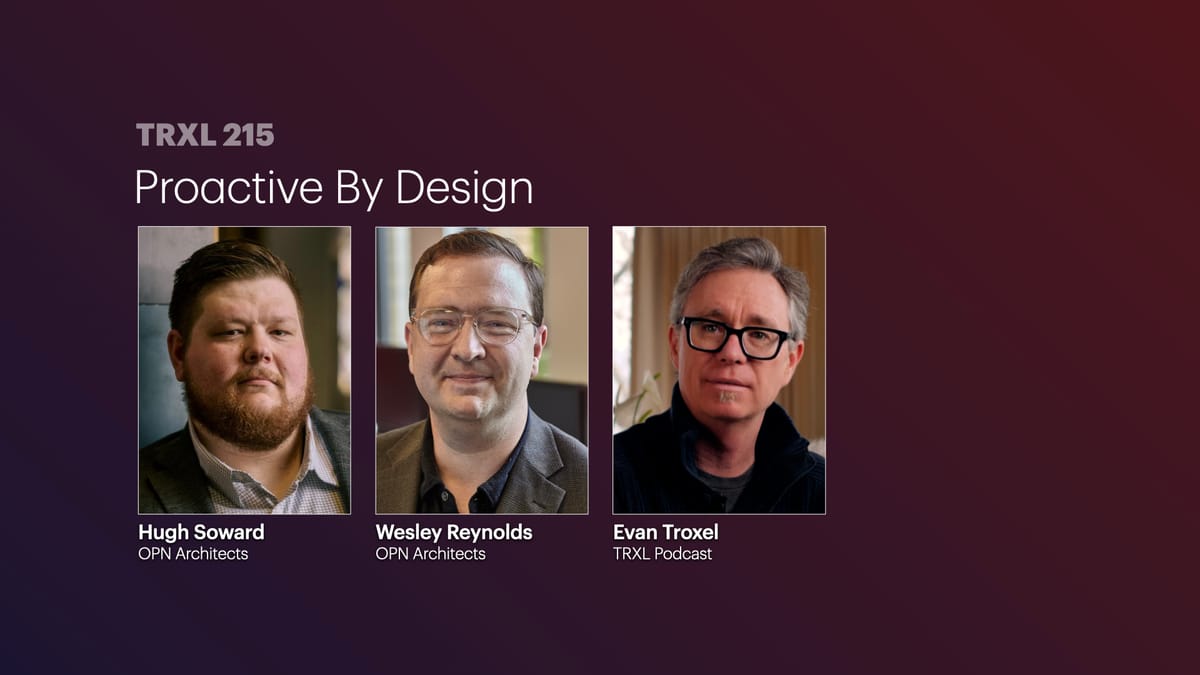
Wes Reynolds and Hugh Soward join the podcast to talk about how OPN Architects is intentionally shaping its future through digital practice, experimentation, and culture-building. They discuss the evolution of OPN’s digital practice group, how they evaluate and adopt emerging technology, and why their long-running annual retreat has become essential infrastructure for aligning design, tech, and people across the firm.
For anyone navigating innovation, change management, or digital strategy inside an AEC organization, OPN’s approach offers a clear example of what proactive firm development really looks like.
Original episode page: https://trxl.co/215

Watch This on YouTube:
Connect with the Guests
- OPN Architects – Official Website
- opnarchitects.com
- The practice behind the firm-wide retreats, innovation culture, and project work discussed in the episode.
- OPN Architects on LinkedIn
- Company Page
- Follow firm updates, project news, and design technology initiatives.
- Wes Reynolds – Principal, OPN Architects
- Hugh Soward – Innovation Manager, OPN Architects
- OPN x Skema AI Charrette
- Lessons from our charrette with OPN Architects – Skema AI
- Shows how Wes and the OPN team experiment with AI-assisted blocking, stacking, and early design workflows.
- OPN Firm-Wide Retreat & Culture
- OPN converges in Cedar Rapids for Retreat 2025
- Shows how OPN uses annual gatherings as a lever for culture building, alignment, and experimentation.
- OPN’s Innovation Lab & Digital Practice Group
- OPN’s innovation work and Digital Practice leadership (including Hugh’s role) are highlighted in their promotions and innovation posts:
About Wes Reynolds:
As a Principal of OPN Architects, Wes has been with the company for 25 years. He founded the Madison, Wisconsin studio in 2013 and has led it to impressive growth. He has a passion for design and a commitment to finding thoughtful solutions that best suit the client's needs. He codeveloped OPN's digital practice and innovation team to focus on design technologies within the firm.
About Hugh Soward:
Hugh Soward is the Innovation Manager in OPN’s Digital Practice Group, where he leads the research and integration of advanced and emerging design technologies across the firm. With expertise in digital fabrication, extended reality, visualization, and reality capture, he helps project teams and clients understand and refine design decisions through clear, data-driven workflows. His work bridges digital and physical processes by streamlining collaboration among designers, contractors, and fabricators, ensuring that the tools and methods adopted provide value. Through a people-focused, practical approach, Hugh and his team foster an innovative culture throughout OPN’s studios, making technology an accessible and meaningful part of the design process.
Connect with Evan
Episode Transcript:
215: ‘Proactive By Design’, with Wes Reynolds and Hugh Soward
Evan Troxel: Welcome to the TRXL Podcast. I'm Evan Troxel, and in this episode I welcome Wesley Reynolds and Hugh Soward from OPN Architects. OPN is a 120 person architecture firm based in the Midwestern United States. And here on the podcast, I talk with many people from larger firms that have access to incredible resources, but I've also been wanting to talk to mid-sized firms that are resourceful. This is where OPN comes in. I recently had the chance to spend time with their team in Iowa meeting their people, talking about tech and architecture, and experiencing the culture that they've intentionally shaped over decades.
Today's conversation is a window into that culture, especially around how they approach technology, design, and the future of their practice.
Wes is a Principal and Hugh is OPN's Innovation Manager. They're part of a group that reflects something I wish we saw more of in AEC... a firm taking a proactive stance towards its own development, not waiting for the industry to figure things out, not outsourcing innovation, and not assuming that great design and great technology grow on parallel tracks.
At OPN, those things fuse by design. And in this episode we get into how their digital practice group came to be, How it evolved from questions about BIM into a strategic capability and how experimentation with things like VR and AR and lidar and performance tools and custom software actually plays out inside a Midwestern firm of their size.
There's a humility to the way that they try things, accept when something isn't ready, and double down on what adds value. But the thing that really stood out to me is how intentionally OPN invests in culture as a foundation for all of this. Their annual all hands retreat, something they've been doing for decades isn't just a junket It's infrastructure.
A multi-day gathering where the entire firm hits pause, tour recent work, including their own, learns from outside voices, digs into the future of practice and reconnects to the shared purpose that keeps people rowing in the same direction. It's where projects, people, and ideas gain momentum and is where OPNs tech and design ambitions get fused into the culture rather than bolted on from the outside.
This is a conversation about what it looks like when a firm treats innovation, both technological and cultural, not as a reaction to industry pressure, but as a practice in itself.
There's a lesson here. You can't just upgrade your tools. You have to upgrade your culture. And the firms that do this intentionally are the ones shaping their future rather than chasing it. As usual, there's an extensive amount of information in the show notes, so be sure to check that out. You can find it directly in the podcast app if you're a supporting TRXL+ member.
And if you're a free member, you can find 'em over on the website, which is TRXL.co. So without further ado, I bring you my conversation with Wes Reynolds and Hugh Soward.
Welcome guys. It's great to see you again.
Wes Reynolds: great to see you, Evan. Thanks for having us.
Hugh Soward: I.
Evan Troxel: would love to kind of get a little bit of backstory before we jump into the conversation today. And let's start with you, Wes. tell me a little bit about your story, your trajectory in the architectural profession.
Wes Reynolds: you know, I'm, I'm a Midwest
guy, born and raised in Iowa. I went to Iowa State University, graduated with. Uh, architecture degree from Iowa State in 2000. Uh, I found myself at the end of that, like, what is next? And in my mind, I had two paths of was I gonna be a professor or was I gonna be a practitioner? I really never thought I'd be doing what I'm doing today. I was really interested in the academics and education process and really kind of avant garde thinking. Um, but I needed a job like everybody does, right? And, um, found myself still being in Iowa for personal reasons. And this firm called OPN was kind of coming of age and some good professors of mine really thought it was a to look at.
And so I met, two individuals actually, that are my partners still today. Uh, that hired me, gave me an opportunity, and somehow now going on 26 years later, I'm still at this firm doing really wonderful things. And You know, it's been a amazing ride. Um, midway through my career, I had the opportunity to start our Madison, Wisconsin studio for us, uh, to lead that. Begin building that presence outside of Iowa for the first studio for the company outside of, of the Iowa market. And it's been wonderful and we have a great team here. So that's, that's where I am.
Evan Troxel: Can you give us just kind of an overview, like what's, what's the. Give us what your firm looks like and how, how you might classify yourself. Are you, are you a small firm, medium firm, big firm? You know? And, and, and just give us some context here.
Wes Reynolds: Yes. We're 115 going on. 120 people typically as a firm size with five studios. Uh, three in Iowa. We were founded in Cedar Rapids, Iowa. Then we built the Des Moines studio, uh, in the capital of, of Iowa. And we have an Iowa City studio as well. And then, uh, Madison was our fourth office at Madison, Wisconsin.
And then we recently, in the last four years opened a Minneapolis, Minnesota office. So that's our, that's our kind of realm, uh, a hundred percent, you know, Midwest centric in these three states. Uh, but right now we find ourselves practicing probably 80% in the Midwest and becoming, uh, what we would probably call a regional heading to a national transitional firm, uh, more regional 'cause we are working coast to coast with our projects.
Uh, we're a generalist practitioner firm. We are interested in a lot of building types, uh, civic, higher ed, K 12, science and tech, healthcare, uh, corporate. I mean, we're just a good generalist firm that is interesting in projects that we can bring a lot of value to our clients. We are architecture and interior designer design only as services, so we
stay inside those design focused parts of the industry.
No engineering services. Those are partner based. So, and we, and really our ethos is based on great design, uh, performance and caring about people. So we, you know, want to give back to the planet and, and do wonderful
architecture that's meaningful.
Evan Troxel: Nice. was I, I'm gonna put a link speak episode where we
Hugh Soward: Cool.
Evan Troxel: the tours that Hugh took uh, so, you've been and
Hugh Soward: Yeah. Uh, fellow Mid-Westerner,
never saw myself becoming an architectural tour guide, but maybe that's a
fallback
that doesn't work out.
Evan Troxel: cruise
Hugh Soward: Yeah.
grew up in, uh, the Peoria, Illinois area, central Illinois, about midway between Chicago and St. Louis.
Um, ended up going to school up at uw, um, Milwaukee
and that's where I met Wes at the, uh, career day there.
And I was doing some research with a professor, so I interned in the Madison studio and um, got hired full-time to go to our Cedar Rapid Studio.
But was living in Iowa City at the time. 'cause everyone said that city is super fun when you're 25. So I, uh, lived there and then the next year we opened up the Iowa City Studio and that was a fun ride.
Um, being able to, uh, work in a very small office with the backing of a large firm.
Evan Troxel: Nice. And give us an idea of what you're doing now.
Hugh Soward: yeah, so now my title is, uh, innovation Manager. And that was a journey starting, I wanna say late 2019 when Wes and the partners saw the need for, um, OPN to focus on what's out there in the world of design, technology, and, uh, innovation and how we can push that forward for our firm.
Evan Troxel: Cool. So Wes, you started the digital practice group at OPN. Can you just talk about the timing of that and what led to the, what built up to actually kind of facilitate that happening?
Wes Reynolds: Yeah, it was myself and one of my partners that now has stepped out of OPN, Justin Bishop. He and I kind found ourselves many times late at night thinking about the future of practice and the future of OPN and where we want to go. Both were very technology interested and somewhat literate, and all these wonderful like things in front of us from visualization to the future of. You know, AI wasn't even a conversation then, right? It
Evan Troxel: Mm-hmm.
Wes Reynolds: where is BIM gonna go? Where's automation gonna go? Digital fabrication. We were both makers and we're like, how can we just look differently? Right? How can our firm elevate continually design work and how can we make this technology realm like serve us better?
And so he and I were thinking, and we both did a lot of stuff with Hugh, and it was just such a natural fit for the three of us to kind of start this first cohort to start thinking about this. And, and then other individuals with our firm, uh, Holden Rasmussen who joined the group, he is a part of it.
That's kinda that first core group that really kind of has been pushing and still part of it, uh, today, thinking about what we're gonna do in a firm. And, uh, you know, we, we found ourselves in a strategic plan with the partnership saying, us have a chance here. You know, this is something not a lot of firms are doing. us try this, let us experiment. Let's actually invest time in people, you know, pull them out of the day-to-day practice of architecture and just focus on what's this new cutting edge pieces, um, how can we bring 'em to then the staff and team to then deliver different type of work, you know? So that was, that was it.
And I can still picture the, the night where we were at the top of a hotel sitting there thinking really kind of crazy. It was about 3:00 AM and we were making a pitch that we knew we had to our partners the next day and put a slide deck together of all this crazy stuff that was happening. Not even just in architecture, but other pieces were out there and what
Evan Troxel: Hmm.
Wes Reynolds: we do?
So, and I dunno, we must have done an okay job 'cause they, they bought it and uh, the partners has supported it ever since and they get it. And you know, it's been an underlying part now of our firm of, about earlier. We care about
the planet design. Um, underneath all of that then is supporting technology that supports all those kind of initiatives.
And so it's really part of our day to day, I would say. Now you right.
Hugh Soward: Yeah.
Evan Troxel: you
Wes Reynolds: I.
Evan Troxel: things
Hugh Soward: Yeah. Um,
it was right at
the same time that we were doing a big renovation of,
uh, we actually might still be working on it.
Um, it's a long project of
the oldest. Yeah, the oldest, the oldest dorm at University of Iowa, uh, Hillcrest,
um, that's been added to several times, um, throughout the last century pretty much.
And, um, that's where just reality capture really came into play and that, that being super important. Um, the university was actually having issues with, uh, parents coming in with a tape measure. And the old CAD plans they had were
few square feet off from what was advertised that their, uh, student is gonna be in.
So they wanted to, at first just get the whole thing, uh, documented properly, and that's when we were contracting that out and we were wondering, can we take this in-house? We know it's a big lift upfront, but, um, now it's completely embedded into our process and helped us, um, communicate to the client that they can trust the data that we're giving them and the drawings and all that too.
Evan Troxel: Nice. Yeah. It, it, it seems like there's always one project that just kind of becomes the tipping point for, for this. So how, you know, technology is a tool and tools allow you to, uh, use leverage on
Hugh Soward: Mm-hmm.
Evan Troxel: I'm curious from, from both of your points of view, how you've seen the digital practice
and technology help OPN use that leverage in different ways.
So like adding value to what you're giving to clients that they can trust. That's a great example. do you have other ones that, that are at the top of your head that you could
that, that you see as, you know, may, maybe they're not even competitive. Maybe they are competitive advantages or strategic advantages, but just like, oh, we couldn't do that before, but now we can totally do that.
Wes Reynolds: Yeah, I wish you know that it's, I bet there's a hundred of 'em here. If we actually
Evan Troxel: Hmm.
Wes Reynolds: and like documented this someday, I think sometimes what sticks on our head is all the things that didn't work. But, you know, I mean, Evan, we were, we were trying to
Evan Troxel: I'd love to hear those too,
Wes Reynolds: No. No. And, and those are
Evan Troxel: because
Wes Reynolds: mean, that list is
Evan Troxel: Yeah.
Wes Reynolds: Right. But, um, but like, especially now, we can't keep up with how many failures we have before successes in a
Evan Troxel: Mm-hmm.
Wes Reynolds: Right? Like, I mean, that was what we told the partners day one. Like, Hey, we're gonna fail a lot, but that's the whole point of this. Let's like, like test things and bring it in and figure out if it's hardware or software that brings value to our firm, you know?
But we were early adopters of buying our own lidar scanners. Those are huge investments for a firm of our scale, right? We were early to drones and photogrammetry and um, you know, we were trying to ar vr, you know, VR was just becoming a thing with headsets. That's still, that's been, um. reality of success.
The AR has become extremely successful
recently, but the vr, it's still that device is holding people back, you know, I don't know what it is. And it's, it's, that's all I can say. The device, I think is what stops us and, and being busy. We'll talk about that probably later. Right? That's always an integration challenge.
And you brought that up when we were our retreat. You know, how do you make these things adoptable? But, um, go ahead. Like, that's, where I was. So I guess you other first initial thoughts, wins.
Hugh Soward: Yeah. Um, the stuff that sticks out to me from the early stuff was,
um, when we first started this, we were kind of, you know,
spraying like a fire hose, trying to get a lot of stuff in front of people,
um, and trying to understand what, what works for our firm and our culture and our projects. Um, we don't have a one vertical that supports most of the,
um, firms, so we, it's hard to just pick one and then just completely optimize that.
Um, but we had little projects like, um, using Grasshopper and, um, some interoperability methods and digital fabrication to make climate studio, uh, studies easier between Revit and Rhino inside. Um. Using it to communicate with the contractor better. The, if I have to distill it all down, it always seems to come down to communication and, um, helping our client or our consultant or fabricator contractor understand our design intent better so that we can have more accurate, um, results and, uh, predictions so that more of the cool stuff stays in the projects.
Evan Troxel: Yeah, I mean, that's a great point. I, I feel like, um. intent realized is, uh,
of architects struggle with, right?
Hugh Soward: Mm-hmm.
Evan Troxel: the, the, it's difficult to convey in all the different ways that people consume the story information, the documents, whatever that is. and then obviously the coordination of all those things as well. But, it's interesting to watch the profession go from, design intent from a, a very loose thing to LOD 400 models, right? Where
Hugh Soward: Right.
Evan Troxel: can just go and go and go in into the detail because you want to really the control over the outcome, right? What it actually turns out to be. And while recognizing that architects aren't the builders, they're not the ones that, you know, they, there is a, there is a hard wall between, you know, unless you're design build. Um, or you're an art studio, right? That, that makes your own stuff you have that wall between you and the actual hands-on making
have like, contractors, the for right? it's
Hugh Soward: Yeah, well, uh, having no ego is, uh, helpful
with that. Um,
are, they're,
Evan Troxel: right? Like,
Hugh Soward: they are ready to humble you
you learn about the means and methods of how they're gonna build something
what makes it, what makes it tough, what makes it expensive. Um, that's, those are the kind of questions I'm trying to get answered so that we can work on it together because they wanna make
great projects too.
Um, not every contractor is out there just to make Yeah, exactly. Um, and part of that is us aligning ourselves with great contractors as well.
Evan Troxel: Mm-hmm.
Hugh Soward: has been a really cool partner that has been a client, but also a fabricator for some of our work, and they do really awesome stuff too. So part of it's choosing the right partners, but also part of it's making it easier for a lot of the smaller contractors that we have in rural Iowa to be able to utilize some of this stuff too.
And that's some of the other things we're working on with visualization and things like that.
Evan Troxel: Yeah. you give us an idea of what your digital practice group is like? You mentioned Holden, obviously
but then just
I met office? question that with smaller in the
Hugh Soward: Yeah. Um, so from my role, I'm actually pretty decentralized. I live in Peoria,
um, and travel amongst all the studios, which is relatively centrally located out in Minneapolis. But,
um, I make my way to each studio at least
times a month
at minimum, but we're all talking digitally all the time anyway, so it's not as big of a deal.
But, um, we have Holden, who's our digital enterprise leader,
and, uh, formally BIM manager and him and, um, our new digital practice specialist, Justin, both work in, uh, Des Moines. And then Monique, who is our BIM specialist, she works out of the Cedar Rapids studio. Um, we also have a couple of IT folks, uh, Nick and Roger that um, are split between, uh, Des Moines and.
Uh, Northern Illinois, Madison area, and, uh, we all are happy to travel whenever we're needing to, but we stay contacted with everybody. The interesting thing is how we're interfacing with the rest of staff is that we have a ton of champions that are really interested in some technology or another, or process or something.
And so we try to keep them involved and find ways to get them, um, using stuff on their projects or, um, working towards different initiatives too. So we recently did, um, some joint research with Iowa State, um, and Shelby Doyle at their computation and construction lab, um, with their, uh, concrete 3D printers.
And that was a project completely born from, uh, two of our staff that, um, wanted to, uh, do some research into it. And we were considering like, does OPN want to look at buying a concrete 3D printer? And then we looked at the price tag and was like, no, we are not, we are not interested in that. Um, but we are interested in the technology and how
Wes Reynolds: We just can't afford to be interested to the full extent.
Hugh Soward: a better way to put it.
Wes Reynolds: There you
Hugh Soward: Um, but we are interested in what does that look like when it, when that technology is more common in the Midwest, and can we be ahead of that? And luckily we had, um, a relationship with, uh, Shelby at Iowa State, and she's already doing a lot of that research, so we found ways to, um, benefit her by giving her a real project that's gonna be permanent, but also benefit us by getting us access to her
knowledge base and her studio.
Evan Troxel: Nice.
Wes Reynolds: I mean, Evan, the, go.
back to your core question of the team. I mean, we didn't plan for it to be decentralized, but it
Evan Troxel: I was gonna ask, I was gonna ask you like strategically, because like these are centralized, there's distributed, there's combination of both. There's
Wes Reynolds: Yep.
Evan Troxel: analog and digital, right? Like you've got all these things kind of playing together. And I was curious from like when you, when you first had the vision, did you see it a certain way and then it played out differently?
Wes Reynolds: I don't think we ever cared about where people were. And I think if there was a group, I mean, talk about pre COVID going into all this. We were a firm that was like already doing all these things. It made that transition that everybody else was trying to figure out. We already were doing it as a
Evan Troxel: Hmm.
Wes Reynolds: Like we had everything ready to be remote, but was not a point land. I think it was tied around people. That's, that's the key, right? You have to get the
Evan Troxel: Use people where they are.
Wes Reynolds: do, we're
Evan Troxel: Mm-hmm.
Wes Reynolds: to have wonderful people that want to collaborate one together. And it's such a wonderful egoless team too, with the same kind of vision to just keep elevating the firm and elevating architecture through technology.
Right? And whether their expertise is in software or the hardware or bim, it's just such a collaborative group. And if you said, did we know it'd be six people in a few years? No. But will I be surprised if we're 12 people in four more years? No. Right. I mean, it's the, what we're struggling in our annual, like strategic planning of that team is you look at the number of initiatives currently, massive, right?
I mean, you can never put enough time to it. So then you really have to pick and choose all those categories, from digital fabrication to ai, and everything in between, what you invest your time in, that's gonna bring the best value to internal group of all the architects and designers working hard to make their work better and maybe more. Efficient for themselves so they can again, spend time on the right things and then what's the most value to our clients. And
Evan Troxel: Yeah,
Wes Reynolds: it's hard. There's always more to do than we have time for is our, is our challenge. And you gotta pick the right battles.
Evan Troxel: Where did those initiatives come from? I, I mean this is open to either one of you. Is it something that you have open communication with the staff and it's just kind of, a lot of ideas come from grassroots, or they saw their friend using something and they want to, they could apply to what they're doing? Or is it more coming from the innovation hub of digital practice? So I, I'm curious is, is it all of the above?
Wes Reynolds: Mind if I start here and then you can
Hugh Soward: Yeah, go ahead.
Wes Reynolds: I think it's both of those, Evan. I mean, we do have the grassroots and that's how probably we were working the first couple years is a little bit of that fire hose shotgun effect that he was saying. We had so many things we were interested in. We have definitely honed the team trying to say, all right, we have to stay on this project. Deploy this project, manage this project, show the teams why there's value to it to adopt it. then now we have kind of a running list. We just literally worked on it this week of, you know, 50, let's call 'em core exercises we want to get into, and, and some of these you have to do before the other so you get the right process, you know, but I think you saw at our retreat when you saw those like, um, PCHA, Chas, people did, some of those are completely individuals just trying something on their projects, which is even more exciting to us, right? that? they see the value of exploring through technology to bring value to their projects. And we have nothing to do that minus excited and glad to see other people are trying
it and go, wow, I can do that on my work as well. So, and that's been our firm's success. We love grassroots. We try not to dictate too much.
We let like a lot of freedom, right?
Evan Troxel: to that?
Hugh Soward: Yeah. Um, it, it's a funny balance that you have to try to find with, with the grassroots versus the top down kind of approach to it. Um, 'cause there's like the longer term,
um, bigger projects that we're trying to do, like,
um,
wrangling all of our disparate data and all of that kind of stuff. And
how, what if OPN knew what OPN knows,
you know, that's part of being distributed.
That is a challenge and that is, uh, something that we're
doing a little bit more from a top down perspective. 'cause it's a much longer, bigger project that's gonna take a lot of effort from a lot of different, uh, areas of expertise. And then some of the. Really interesting, random, bespoke things that we get that are grassroots, that some of them being are just, Hey, we provided a really specific solution to this for this client.
I don't know that we're ever gonna do this again. But that was cool.
Like, uh, documenting laser scanning and, uh, building a custom scaffolding for a hundred year old taxidermied birds that are covered in arsenic. Like, I don't know what I'm, we're gonna do something like that again. But, um, other things like, yeah.
Um, but then, uh, other things like, uh, building a connection between, you know, our FCA software and our client's, um, uh, facility management software and things like that. Like that's something that came from a project, but has potential to be a much larger connection across all, all of our projects.
Evan Troxel: that, that makes me just think of kind of potentially creating products, right? That could be extension of your business model, uh, your what, what you do as a service to clients, right? Architecture as a service. And, and maybe it's not like architectural design, but maybe it's like what you just talked about, Hugh.
It's like connecting
Hugh Soward: Yeah,
Evan Troxel: to that and we've figured that out and now we could package that. Do you guys talk about that in your partner meetings? Do you talk about kind of the evolution of the business model of, of where OPN is headed, especially with technology enabled practice?
Wes Reynolds: Yeah. we def we definitely have, and even part of our original probably quote unquote pitch to think about this, of, is that an opportunity that we might find something like that along the way. Yes. Is it required? No. Have we found it yet? No. We've, we've had some pretty interesting explorations. Uh, we've been part of some great pilot programs with some software groups that have seen that we have interested in this and they know we have enough scale of a firm that they wanna see what we can do with their. New tools or their new products. And that's been exciting to, you know, be a part of. And then trying to figure out of those products, how can they value us and how could we encourage those projects maybe to adapt that they bring more value to our firm and other architects like us. So
that's been, that's been really great.
And, um, we, OPN had the privilege to be part of the Design Futures Council, and so through that networking with some other individuals in that organization that kind of have like-minded pieces, it's been great to share kind of like where, where others are going with technology as well. So it's been good.
Evan Troxel: Nice.
Wes Reynolds: Yeah. But we haven't found
Evan Troxel: Hey.
Wes Reynolds: know, million dollar software connection to sell yet.
Hugh Soward: Yeah. Mm-hmm.
Evan Troxel: I, find that
these kinds of things start though with. Somebody needing to scratch their own itch inside the firm to solve a specific problem. then you kind of step back and say, oh, like you said, like maybe this
to more projects. What can we do to build on that? And you don't necessarily have the intention of using it to expand your
Wes Reynolds: Yeah.
Absolutely. Totally agree.
Hugh Soward: Yeah.
Evan Troxel: so,
Wes Reynolds: I think we've had those same conversations, Hugh, right? Of where are those tipping points when we need a individual like that in the firm or
Evan Troxel: yeah.
Wes Reynolds: our customization right now is, I'd call it low hue,
Hugh Soward: Mm-hmm.
Wes Reynolds: I think It, feels like it's picking up the kind of custom and connections that are going to be coming at us constantly.
Hugh Soward: It, it, that is a hard line to find at a firm our size is when can you afford to
fully hire a
full-time software developer or a team of them
to, to do something like that?
Evan Troxel: Okay, so a big theme at the a EC tech conference that I was just at was really around vibe coding, right? And this
Hugh Soward: Mm-hmm.
Evan Troxel: of, there's a little bit of a stigma coming from, especially people who code a lot, it's like architects looking at image generation, right? It's like, ah, yeah, but that'll never work, kind of thing, right?
Uh, there's just kind of that natural response. But then there's people who are saying like, uh, Turner Construction, um, just deployed ChatGPT enterprise level to all of their employees. Like 15,000 employees, I think was the number.
Wes Reynolds: Wow.
Evan Troxel: I could be wrong on that number, but it's a lot of people and it's in every department.
And so they have people in the finance and accounting department writing apps that is something they could never have done before. Because I mean, even though they're that huge of an organization, they're not hiring a software developer to. custom apps right there,
Wes Reynolds: Yep.
Evan Troxel: but now there's the ability to do that.
And so I guess, I guess what this really dovetails is into my question about incentivizing your staff to play and to explore and to solve their problems with technology. do you, do you think about that? Do you do that? Do you say it out loud? I'm just curious how, how that works at OPN.
Wes Reynolds: Yeah, I would say we say it out loud, it's just everybody's constantly busy and you know that change to pause and pull up and I know how to get to. That destination in the project by doing exactly how I do it today and how I've done it 10 outta times, why would I pause and try to adapt that? It, it is, uh, I believe it's a little bit of a generational thing.
So it's great to have, you know, young energy come into the firm or new personalities come into the firm that say, well, can you do it like this? And, you know, that's it. But we try to create white space, you know, it's
Evan Troxel: Hmm.
Wes Reynolds: busy and it's then it's also the challenge of being busy, of making time for these things.
And I
Evan Troxel: Yeah.
Wes Reynolds: as a, as a digital practice group overall, that's always been our struggle is to get snowball effects on new concepts, new softwares,
new products that, you know, the guys have kind of organized, tested, see the value. 'cause they are, um, pretty much the whole group is, uh, architects, or trained architects, I should say. So they understand and they were practitioners. They know what we're trying to do to put drawings together. They're just on the technology spectrum of it now of what they're doing. Um, so they see the value as just, again, pausing to learn and do it and execute it. That's, that's what I see. But
Hugh Soward: I'd say some of our more successful.
Um, versions of that are when '
we stay embedded in some,
uh, aspect on the team to like truly support them. It's not,
uh, swooping in, here's this tool,
use it on this project goodbye. Like, um, when you're really in there and you're, you know, sometimes I become a part of the design team
at least to a certain phase to try this new method out.
And
it's not just being tech support, but it's also being design support in that way too, which helps our design muscles, um, with uh, not just not being in that world anymore. But, um, and I think it also helps them because they know that we're there to help truly figure that out with them when we're doing that.
Evan Troxel: I think coming at that, like from an architect's perspective is super, super useful, right? Like as a
Hugh Soward: Mm-hmm.
Evan Troxel: I would go into a client and we would talk about what they need, what they like, what they don't like, what are the problems, what are potential solutions that they've already thought of? And, and you get to partner with people on the design team, Hugh, and do
Hugh Soward: Mm-hmm.
Evan Troxel: It's like a design problem, right? Software is still a design problem when you approach it that way. I mean, creating a digital practice is also a design problem. Thinking about the strategy of business models for OPN is a design problem. It's a, it's a, is the design problem also, right?
So
Wes Reynolds: No.
Evan Troxel: you kind of think about it in these are, it's the same. of set of constraints with design thinking applied to that? Um, it, don't think everybody does that. Um, I wish more people would, would do that, especially in these smaller firms where, like, it, there's a, there's a cost to having dedicated people to do this, but it's also a huge advantage to have dedicated people to do this
Wes Reynolds: Sure.
Evan Troxel: they're not
okay, Like, know all your struggles solve And, and so you're gonna both learn from each other in that, in that exchange. And I would think the product's gonna be better for that, whether it's a script that gets used once or it does actually have a life beyond that.
Hugh Soward: Yeah, it's a, it's a balance of treating your colleagues, like both your clients and also your partners
Evan Troxel: Mm-hmm.
Hugh Soward: in that, that, you know, we're in this together neither, we all want this to be successful, but I'm also here to.
Serve the project and
as a core design team, we're doing that.
Wes Reynolds: In Evan, you asked earlier like, you know, where do these ideas come from? I think some are from the digital practice team to implement new ideas, but you know, Hugh and Holden have had a history going to every one of the studios. I think for the last couple of years, Hugh, where you sit down with everyone, invite everyone in and say, what are your challenges?
What are those things that we could help you fix or improve or flow? And then we, you know, get common themes out of that like post-it note exercise and it creates, you know, 50 projects for us and some the ones that have the most value or we can see the value as like what we start working on as quick as we can.
And some are quick wins and they do those too. So it's, um, I think that's what's great and it makes our firm work well. I mean, it's a
Evan Troxel: It seems like that would help you. Yeah. Yeah. I, I agree. I, and I think it would help you prioritize because we're all drinking
Wes Reynolds: Yep.
Evan Troxel: tools. It's been three days. There's a new tool kind of a thing, right? And you mentioned that earlier. There's just, there's this, a huge amount of stuff, helps you prioritize what actually matters because it's problems that people are having, and you're not chasing things where you're trying to find a problem that fits the tool.
You're doing it the other way around, which is, okay, here's the problems. Now how do we go about attacking this with technology?
Hugh Soward: and that's a really easy pitfall to fall into the finding the problem for the tool.
Evan Troxel: yeah, yeah. Well, I, I'm, I want to talk about the staff retreat, but before we do that, I, I want to cover one more thing, which is, is you've got a digital practice, and you said, Wes, you alluded to, okay, well maybe in four years. It's twice the size. Okay. So you've got six people. You've got 150 people, total six people on the, on the staff of digital practices.
Wes Reynolds: total. Hmm.
Evan Troxel: Okay. So I mean, just talk about that, like, as the practice gets more and more rooted in technology, like you can't even do, you can't deliver anything without it anymore. Right? There is no other way that we're doing this.
Wes Reynolds: Yep.
Evan Troxel: Can you just talk about like that growth and not, not from like a, there's no, like, there's no ego in this.
I feel like, like if anything,
six people serving 120 people, if the, if I understand the way that it works, that sounds like, okay, that's a really small number. That's gotta be a really difficult job for those six people. It's just gotta be go, go, go. Because there's so many people. Okay, so let's talk firm strategy in like the digital department, which has quotes around it right now.
I used to say, you know, digital it's, we call it digital practice, just so everybody knows what we're talking about, but it's just gonna be called practice someday, right? This is. It is just
Hugh Soward: Yeah.
Evan Troxel: of practice. So it, it's the current version of practice actually. It's just, we still have to call it this thing.
So I talk about that from a leadership point of view at OPN and, and where, I don't know, just what are you guys thinking? Where are you seeing things going?
Wes Reynolds: yeah, I mean, so to your, like, it'll just be practice. Some days I try to say like, you know, a technology firm that practices architecture,
Evan Troxel: Mm-hmm.
Wes Reynolds: Some days to kind of flip this on our head for our,
Evan Troxel: Right?
Wes Reynolds: of my partners just to go, do you understand like everything most people do today in our company is tied to a laptop or some piece of technology that makes it work. Right? now we're all pure designers at heart and we want to create beautiful spaces. That's what we wanna do. We actually, not many of us are technology focused. It's just Yep, those are the tools to get it done.
Evan Troxel: Mm-hmm.
Wes Reynolds: we'll keep working on that. But, you know, I don't know where it's gonna go. I've had, we've never had a pushback on, Hey, should we get one more person?
We, we've been a firm that's been successful when we're lucky enough to have somebody like our newest team member. Say, Hey, I'm kind of interested in joining OPN and I
am interested in these technology things and this is what, and by chance, the newest person was, had a really kind of a 50 50 dynamic of pure technology and then, uh, sustainability performance, which was like really something that's another part of our firm that's really growing quickly is our perform performance for focus.
And Hugh and Holden and others are finding themselves like, all Right.
now we're building tools for the performance side. Well, now if you have a person that's really digitally literate and performance literate, that's even a great combo. So
Hugh Soward: Hmm.
Wes Reynolds: I think when those people have, we've seen the opportunity, it's like a perfect timing and like, yes, um, do I have, and you know, between Hugh and Holden and I, a game plan of here's the next five people we're gonna hire. Not necessarily, but I think when we do these strategic planning efforts and we see we have, let's say 50 initiatives and we can only get to four this year, it keeps saying, how do we balance keeping all that going and benefiting the firm and not getting behind? And that's. Yeah, was a moment I would've said three or four years, three years ago, let's say, I thought we were in really great shape.
We were starting to be ahead of this technology curve and wow, it just felt like overnight post COVID somewhere in there, and then the AI kicked. I mean, you just feel behind every day. And that's, that's not a good feeling when you're a group that really wants to be successful. And
we're really driven individuals, really competitive, classic architects, right?
We don't like to lose. And you know, this, look, you look at this amazing list of efforts, people, the crew wants to work on every one of those lineups is super exciting. And it could be wonderful for, say for, our healthcare team, building some custom tools or something. You know, you look at these lists, it's, it's all fantastic opportunity. It's just got, he needs to sleep. Right? You know? Uh, that's how it works. And, and,
Hugh Soward: Yeah.
Wes Reynolds: practice architectures our primary job, right? So I, I think it'll continue to grow Evan as, as a firm. the mindset our partnership is set on. So what it
Evan Troxel: Yeah,
Wes Reynolds: keep playing that out.
Evan Troxel: Okay. So Hugh, let's pretend that you and Wes haven't talked about this already. I, I maybe you have, maybe you
Hugh Soward: Hmm.
Evan Troxel: have, but let's pretend that you haven't. what potential do you see right now that OPN could leverage and just like make some way that you do something completely out of the
Hugh Soward: Hmm.
Evan Troxel: like a really for
of can't on bite
Hugh Soward: I think that would be hiring that software engineer.
Um, right now to
help us supercharge the efforts that we're already doing. We have a level like yeah, the vibe, coding conversation that we've leveraged that quite a bit. Um, we all have a cursory knowledge of, uh, a handful of languages and APIs and whatnot, but,
um, having someone who really knows all of the ins and outs
can really help us build the,
the custom tools.
Or maybe there's that,
golden goose that, um, you know, your secondary revenue stream or whatever that is. But, um, I think that's the supercharger to letting us scale this thing a lot more.
Evan Troxel: Yeah.
Well, it, it takes me back to what I mentioned a few minutes ago at Turner where it's like somebody in accounting is writing an app that like changed the game for accounting. And so you maybe have people already in your firm who just have an idea and it's like, well, let's just prototype this.
Like that to me is what's
Hugh Soward: Yeah.
Evan Troxel: about the newest development is like. With a language that somebody already speaks and they're already using ChatGPT on the side or Claude or whatever it is, through that exact same thing. You can build something that will do something for you. And I think that the potential and, and, and it's untapped because you already have all those staff members.
You have 120 people and it's like, oh, if we just gave this
Hugh Soward: Mm-hmm.
Evan Troxel: that I, I like to think It's, super to be practicing maybe not just architecture, but a lot of people are, there's a huge
Hugh Soward: Yeah. The uh, I mean specifically the vibe coding and that being empowering to people. We've seen a.
A big chunk of that were people that I thought that would never be interested in making their own macro even, or, but they're sitting here trying to make, um,
almost like a full, on,
a full on web app
Evan Troxel: Mm-hmm.
Hugh Soward: some part of the process faster.
Evan Troxel: Mm-hmm.
Hugh Soward: or automating something.
And
I guess where I said that I would like to have a software engineer in it is that, you know, when you take it to the next level where it becomes a sellable tool and you have to vet all of that stuff that you're vibe coding to, there's, there's one thing when you're building tools for yourself and then when you're building external things, I have to have the proper security and all that.
That's, that's a whole nother level
Wes Reynolds: Yeah. I was a little, I mean, that makes total sense. You said that one first. I was surprised you maybe didn't talk about digital fabrication a little bit too, because as far as
Hugh Soward: I knew you would.
Wes Reynolds: Yeah. Okay. All right. You knew I would, I mean. The, the digital practice team, Evan, is also kind of like really made up of a lot of makers, which is super awesome as like artists, sculptors, furniture makers, and true classic designers, right? And so we talk about that a lot and, and we love our contracting friends and partners and sub consults, but we know we're on the edge of architects. Be able to become master architects again, of our craft. And when we can work with partners that have those great robots and all we're doing is really feeding, uh, our design through a code or something like that, we can have that craft back.
And that,
that, that, um, experience that we had with Iowa State and that CCL lab, I mean, that project just won an AI Minnesota award and the objects that we created are sitting in front of the building and are definitely a part of the architecture. And again, no one would know. We 3D printed through concrete, all those objects that kinda look like a series of follies, you know, and. That's, that's what's so exciting to me is, you know, that balancing act of getting to play contractor
Hugh Soward: Mm-hmm.
Wes Reynolds: with our craft of architecture again, and not just that small scale, that's where we have to experiment and prototype, but it's coming, right? I mean, the edge of the next decade of what's gonna actually look like, what construction will look like is gonna be really amazing for us,
Evan Troxel: It cuts both ways, right? Like you've got this ability to have access to making physical things through and so that, that that direction is coming at you, that democratization of access to that kind of stuff. And it's happening to architecture too, right? And, and there's, from a partnership strategic level, like you have to be thinking about like, okay, we are getting access into this.
What are other people getting access into? What, is our domain? Right?
Wes Reynolds: Yep.
Evan Troxel: it's, it's, it's interesting to watch that. I mean, thing things are uh, in, in all directions. And, and that's something to keep your eye on as, as a leadership team, but also as a, through that r and d process, because you're, expanding, but you're also getting pieces taken away at the same time, potentially.
Wes Reynolds: Yeah. Our
Evan Troxel: Alright. So,
Wes Reynolds: on all that.
Evan Troxel: All right. Well, let's talk about this retreat that you did. Can you give, give a, a kind of an overview of what you do and why you do it?
Wes Reynolds: Yeah, so Our firm's been in business for about 48 years, and I think for about of them we have had an annual retreat, and that was even when it was just one office, one studio, they would shut the office down and just recharge get together and talk. what it's become with five studios and five very different locations. We call it one OPN. Um, everybody's in that same pool of, I don't care where you sit, you might be in Madison and you are working in a project in Iowa, and you might be in Cedar Rapids and you're working on a project in Madison, right? That's not, it's just 120 unbelievably talented people, is how we think about it, right? But that geography separates us. So for two days out of a year, we shut all the studios down. We find a wonderful major city in the Midwest. It's tied to travel that we go to, and we have a great loop from Chicago, Minneapolis, Kansas City. and we take time. The first day is about thinking about the business, where we're going, how's everybody doing a wonderful social event like you saw that evening.
And then day two is about, uh, seeing architecture, typically architecture that's not ours, architecture that's gonna inspire us to come back to our clients and just bring great value and. the last five years through our design excellence, uh, program, we've invited wonderful national and international architects to come in and just talk to us.
Part of it is a crit of our work, like reviewing and giving us pretty direct feedback of how we can improve. You know, that good to great exercise of Yep, that's a good project. Here's how it could be even better. And each one has been so different. Um, so those have been fantastic. And then like this year we wanted it, um, it was inward looking, so we were in kind of our, our town where we all started.
So we were in Cedar Rapids, uh, went and saw some of our own work, which is nice to sometimes
take a pause and look at our own projects and then invite two great
speakers, you know, you and Dwayne, and a great combination. And the mindset was this year that we are trying to culturally shift everybody to think about, you know, the digital side of what we do
and how that can. doesn't have to change how we do great architecture and great design, but what can we do culturally? So, as always, it's easier Somebody else says that for you than yourself. Right.
Hugh Soward: Hmm.
Wes Reynolds: they'll listen to, they'll listen to you, Evan. And they did, right? It was, it was great.
Hugh Soward: Yeah.
Evan Troxel: everybody who
Hugh Soward: actually Wes is the one that showed me his work for the first time. Um, 'cause Wes hasn't talked about it, but he is a metal worker and so is Dwayne
because, but, uh, Dwayne Oyler is a teacher at SciArc, along with his wife Jenny Wu, and they do some of the most incredible, um,
it design build.
I don't know what the actual technical business model would be, but,
um,
Wes Reynolds: no.
Hugh Soward: it's the most literal version of design build I've, I've seen,
um, where they make, some of the most intricate and, um, beautiful, uh, projects by hand. Um, and it was really interesting to see how their, um, how their practice is scaling.
It's incredibly forward thinking. Uh, the scale of their projects is getting enormous.
He was telling us about like a,
a model he had to put on a flat bit of a semi, um, just for a model, not even just the installation. Um, it, their work's always been very inspiring to both of us. And since we were thinking, you know, where are we going with this firm?
There was the, the two sides of it, which was technology. Um, how are we integrating that? That's where we, uh, thought to call you. And then what's some of the most avant-garde stuff out there that we can be inspired by? And we thought they were one too.
Evan Troxel: yeah.
Wes Reynolds: and you didn't say, but the, the firm's Oyler Wu Collaborative. Um,
Hugh Soward: yeah.
Wes Reynolds: their, their work is such built in craft, which our firm cares a lot about, and it's just a whole different level of craft that and Jenny are doing. And so like, it, we thought it was so great, and yet, you know, when you hear Dwayne talk about it, I mean they're, they're working digitally too, right?
So how do we take this large sculptural type object building and then, you know, work in the technology side of it? So I, I loved, we, it was everything we hoped it would be when we had you guys both join and I dunno, the, this was something where we tried a little differently where, um, you obviously both presented and talked with us, um, and then, and then that sit down of, you know, Hugh going through some questions and talking about it, you know, questions that we're asking ourselves internally, our teams are asking of 'em, getting both of your opinions. as practitioners thought leaders was, was really influential to the firm and exactly what we were hoping it would do. it created a buzz, um, talking about these things. Um, both you are, you know, you have wonderful brands and I loved it when many people were, I talked after the, like you had Evan TRXL join you guys.
That's amazing. You know, I, I listen to his podcast all the time. Like it Well, I mean, we're very thankful you guys did that and it was, it was everything we hoped it could be. And then, I'm glad you guys both stayed late and had drinks and played ping pong with us. And like we, you know, we're long time friends.
I'm sure. So.
Evan Troxel: I had some great long conversations too, uh, which I, you know, hanging out afterwards affords like talking with Justin, your on, on your team, Hugh, right. For a long time. Um, and getting to meet Holden and getting to meet people whose names I had heard earlier in the day. And then
all in the same place together afterwards and not everybody's at a table have the freedom just to kind of go stand in a line and strike up a conversation with somebody who, who you're standing next to, I think is, is fantastic.
It was great to meet kind of a wider range of. you know, besides the partners of the firm and Hugh as you know, the, the digital practice team. So I thought what was really striking to me was just kind of this proactive approach that you take with the
Hugh Soward: Hmm.
Evan Troxel: to get on the same page and talk
of course, there's lots of projects going on.
Not everybody has, uh, transparency into those projects, right? Because they've got their own projects and they're in a different department. Maybe they're in hr, maybe they're in finance, maybe they're in contracts, maybe they're in graphics and marketing, and they don't get to even, they don't, they just don't see what's on the boards. Not that there are boards, right? What's on the monitors? Um, especially as a distributed, you know, amongst five
Hugh Soward: Hmm.
Evan Troxel: and a lot of different team members. So. a great opportunity to bring everybody together and get them on the same page as far as like that looking inward of the firm. But then are we going and why are we going there? And then kind of setting a new datum for the next year.
and you said like this is an inward year. I'm curious what you mean by that. 'cause I kind of think of this as like cycles of, of a breath almost, where it's like, okay, this year's an inward year, next year's an outward year. I don't know if that's what you mean, but could see something like that really helping you kind of structure and organize this kind of staff retreat around to have a different posture when you get together the next time.
Right. I just think that there's a lot of interesting things that you
Hugh Soward: Hmm.
Evan Troxel: with something like this and, and so I'm just curious from like that broad perspective. Um, obviously I bet you get a lot of great feedback and I bet there's a lot of people who say, I don't have time for this because I'm so busy too, but you make, you make it happen, so it's important.
So just like that, from that priority standpoint of, of getting the staff together and putting 'em on the same page, can you just talk kind of towards that and, give other firms out there who are listening an idea of how this has benefited you?
Wes Reynolds: Yeah, there's not one partner that's ever paused and said, should we stop doing retreats? They're
Evan Troxel: Hmm.
Wes Reynolds: just so successful for us. It's a great, great time for our culture. Yes, every single human that's at that event is super busy, but they knew for two days they're gonna set their pencils down and revived. Listen to speakers that are gonna challenge us to be better on whatever it is that that theme or topic might be. then see those people that maybe you aren't collab, you are collaborating with, but you're not physically in the same place. There's so many new people to our firm constantly that are coming into it, that you get to meet those people, they really quickly get a part of our culture when you get to have an event like that. Yeah. I would encourage every firm to not look at the fiscal side of that event and look at what it could do for you. Um, and when I said inward, we've taken the last two years just to pause. 'cause we've always, and we enjoy it. Looking at other people's work in some other major city that we're not in. We had some, we, the humbleness of us, we have some really fantastic work. And when you're not on those projects, or even sometimes when you're on it, you don't even get to go enjoy it. Right. So it's proud for those people that led those projects to present them, showcase them, and those that haven't seen it. But, you know, we had a Fire station Cedar app is at one of our first national, a i a, of us never stepped foot in there in that building and everybody wanted to see it.
We knew it, we knew it by photos. We had talked about it. Everybody was proud of the recognition. But you know, it was that time to go see that kind of work that ourselves just influencing others in this country, you know, of projects.
So that's, that's what I meant by inward on that,
Evan Troxel: Okay.
Wes Reynolds: So,
Evan Troxel: It was a wonderful event, Hugh, your team was integral, or maybe you uh, in kind of making this event from
Hugh Soward: Mm-hmm.
Evan Troxel: fires and,
Hugh Soward: Yeah.
Evan Troxel: maybe
Hugh Soward: Mm-hmm.
Evan Troxel: and, from it?
Hugh Soward: Well, retreat. I'm always involved in it in some way in the last,
four years, I would say.
but not to the point where I'm picking speakers or suggesting who we reach out to. That was a unique opportunity.
Um, and I got a Miro board with, um, a lot of other really cool names on there too. Now for, for the future that gives, it gives, um, myself an opportunity to expose, uh,
my colleagues to
some really interesting stuff that they might not have thought of before.
Um, and that's when I got approached this year about, um, you know, a lot of people were very inspired by, um, the talks at, um, a i a national this year around technology and stuff too. Um, and that's when they reached out to me like, Hey, who's a really good. Voice for this. And, uh, not to, uh, toot your horn too much on your own podcast, but you were my first choice on that.
'cause when we were starting this, watching your videos was actually really inspiring. Um, when we were getting into the digital practice thing, um, it really helped me find a way to, um, learn how to communicate this to my coworkers and what's communicate the value of that. Um, but, uh, what we normally do during retreat is it's an opportunity for us to communicate to everybody at once you got a captive audience, it's hard to find a stranger at these.
Um, and so we've done them where we have a tech demo, where we have a whole bunch of booths with all of our technology, a whole lot of money in one room. And, uh, we're showing them, we're doing, uh, we called it ar Jenga with the HoloLens and, um. Uh, playing building blocks and having a time trial with that.
Um, there's a drone flying around another part of the room and people are scanning. People are in, uh, vr, doing other stuff. Um, looking at 3D print a table of 3D printed models. Just, um, opportunities to, uh, embed this in the culture of OPN and all the different kind of technology that we're working on.
Sometimes it's building a custom sculpture, um, completely digitally that, um, is, uh, using things like the HoloLens to steam bend, plywood and conduit to make a show them, Hey, here's how we can communicate with contractors in the future.
Evan Troxel: That's cool. Nice.
Hugh Soward: It's always, it is always something unique and it's always stressful for two weeks leading up.
Evan Troxel: I bet events are difficult for sure. And, and you held this, you, you hold this event offsite, right? So
Hugh Soward: Yeah.
Evan Troxel: many people are traveling from offices to go there. It's maybe in a city that an office is located in, maybe not, but can you talk about the venue for this year, the
Hugh Soward: The Pickle Palace.
Evan Troxel: Pickle Palace?
Wes Reynolds: Yeah.
I mean, it's a
Hugh Soward: Yeah.
Wes Reynolds: it was a great venue and our um, HR director, uh, Jen, she's a huge part of this. Our hr, our marketing director, Carly, is a huge part of this. And they were definitely two that wind up our game and they said, Hey, we wanna do something different. And we're always up for it, you know, like, what's, what's the venue?
And typically when you got our size, you, you end up being in a convention center at a hotel. 'cause we got a. is 80 people that are, you know, not, or a hundred people that are out town, you know, so it's all those kind of like challenges. But Jen found this place and
what a great combo of like, the Pickle Palace is pickleball and ping pong and all kinds of social venues.
And obviously we need to have a good
size, uh, place to have, you know, uh, food and, and uh, the actual meeting event. And it was, it was a blast. It was a great place. And, uh, I found myself playing pickleball right before, uh, we had the night event and I wish I would've came better clothed 'cause I could've done that all night.
Right. I came, I came in dress
shoes and I was
Hugh Soward: Yeah.
Wes Reynolds: over the court. But yeah,
Evan Troxel: I believe you invited me to play pickleball too. If I would've. Yeah, if I wanted to.
Hugh Soward: Yeah. I.
Evan Troxel: was. It was a cool venue for sure.
Wes Reynolds: you know, it's, it's about having fun together. That's how you
Evan Troxel: Yeah.
Wes Reynolds: people. Right. You know, and it, it's no better, it's, doesn't get any better than that. So, yeah, it was, it was a great venue and. Uh, minus the microphones. I could have lived without those working a little better, but that's okay.
You always gotta have some glitch, and that's what makes you humble. Right. So can't be
Hugh Soward: Yeah.
Evan Troxel: there's a group that I'm a part of and they have a, a, a channel in their chat called RFI, and it's not RFIs like architecture, RFIs, it's uh, people can actually put ideas in there. And RFI stands for room for improvement. And
Hugh Soward: hmm.
Evan Troxel: if there is room for improvement, and that could come
it could literally be, you know, there weren't enough trash cans at the event. Like something very small to like the mic. We need to own the microphone set up next time so that it, we make sure it works, for example. And, and I thought, okay, that's a pretty cool, pretty cool idea. The r the RFI channel for, you know, the, the annual event.
Could ideas could and should come from. experience and insight, so
Hugh Soward: Right.
Wes Reynolds: we're always up for, we try not to have a. Roadmap, that that's when it becomes kind of corporate-y and not us. And
Evan Troxel: Mm-hmm.
Wes Reynolds: those Pecha Kucha's, we started those last year of letting others like just talk about their work and small and big. And I don't know, those Pcha Chas this year were just somewhere hilarious and didn't see that coming and, and the work is all so fantastic.
So proud of the
Evan Troxel: Yeah. Well, I really wanted to have you guys on the podcast to highlight what you're doing and that kind of proactive nature that I saw that you firm has and that you're instilling through the whole staff, through events like this. And also just the way you're communicating, kind of where you're going and, and taking time out. do that intentional work, I think is kind of the rarity that I see. I see, you know, a few people from the firm go to this conference and a few people go to that conference and rarely does what happened to that
brought back and presented to the whole, I mean, that's, that's not everybody's interested, but also hard to do.
Right? And so for you guys to actually take the time out to do that, I wanted to highlight that on the show. Thank you so much for having me there. I got a lot out of it and I went to contribute, but I mean, I, I'll just say I got a lot out of it as well. And I, I particularly liked the, all the human stuff that happened there.
I mean,
Hugh Soward: Hmm.
Evan Troxel: speeches, uh, the tears that were shed, the, cereal boxes with. Retiring partners on them. And I mean, it was just, you guys have a fun culture and I wanted to also point that out to listeners, right? And I'll say it like I did on the other podcast, if, if you're looking for work at a Midwestern firm, you guys should be looking at OPN. and I feel like you guys have have a good thing going there.
and everything that you're
Wes Reynolds: Evan, it's, uh, you, you're definitely a friend, OPN and it's an absolute privilege for us to be on this. And thank you for having us. And, he said it, you, you know, you were our number one on the list and we didn't even know if you'd even like pick up the phone and call us back. And, uh, we're so glad you did.
'cause everybody loved hearing your thoughts on it. So thank you for being a part of the retreat and thanks for continuing this relationship.