
214: ‘Partnering with AI to Solve Knowledge Problems’, with Todd Henderson and Christopher Parsons
A conversation with Todd Henderson and Christopher Parsons about partnering with AI to solve knowledge problems, building a learning culture in architecture firms, and the practical applications of KM 3.0 in enhancing project delivery and collaboration.
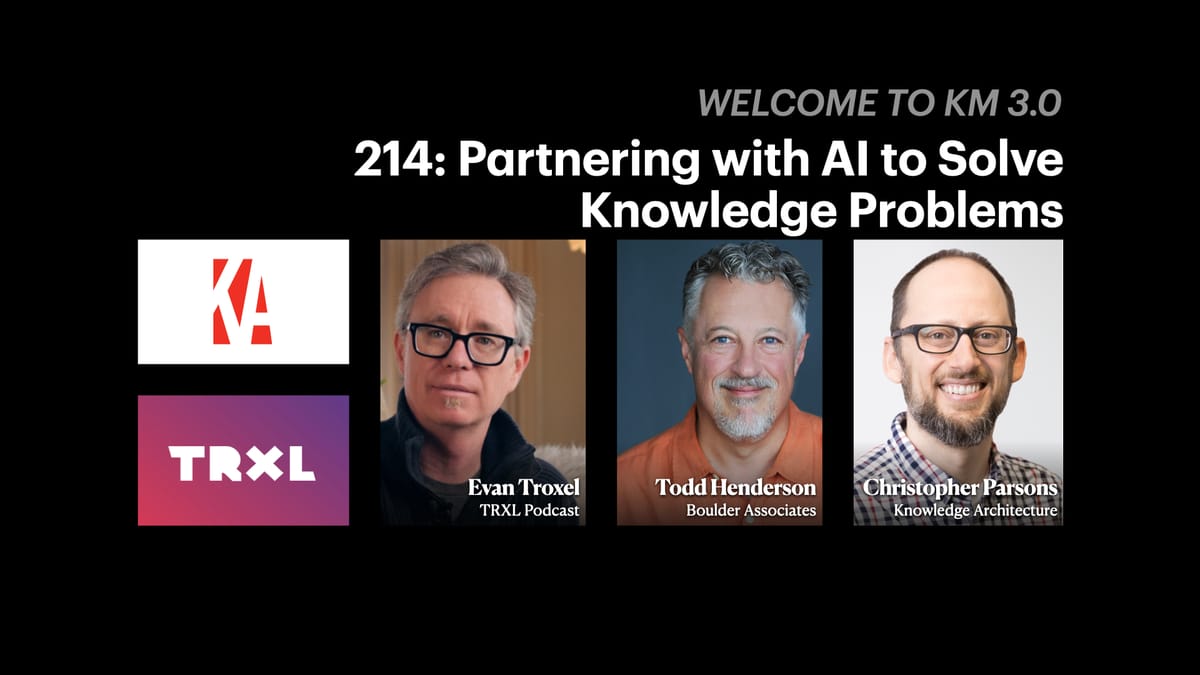
In this special partner episode, Todd Henderson and Christopher Parsons join the podcast to talk about what it really takes to build a learning culture inside an architecture firm—one that actually sticks, scales, and improves project delivery over time in this final installment of the KM 3.0 series.
Drawing from Todd’s background in Lean, Scrum, and healthcare design—as well as Chris’s leadership in knowledge management, intranets, and now AI-enabled search—the conversation goes straight to the operational reality: how people learn, how they share what they know, how they improve, and why many firms fall short. The episode explores the evolving role of AI-augmented KM, the importance of making institutional knowledge searchable, the value of intranets that don’t die on the vine, and how learning management systems give firms a real advantage in consistency and quality.
Todd also breaks down practical strategies for coaching teams, supporting project managers, and turning continuous improvement into a repeatable habit rather than a once-a-year aspiration.
About the KM 3.0 Series
This episode concludes a seven-part, in-depth series created in partnership with Knowledge Architecture, designed to give the AEC industry a comprehensive, modern framework for knowledge management. Across these seven conversations, leaders from operations, digital practice, learning & development, and technology share what’s actually working inside their firms—and how they’re using KM, AI, intranets, and training systems to move from isolated expertise to firm-wide capability.
The result is a robust, openly accessible resource for anyone in AEC looking to build or modernize a KM program. Whether you’re starting from scratch or leveling up an existing initiative, the KM 3.0 series delivers a rare combination of strategic clarity, practical examples, and hard-won lessons from people doing the work every day.
If you’re responsible for digital practice, firm operations, KM, or elevating your team’s skills, this finale ties the whole series together and points toward what’s possible. It’s an in depth look at how firms can work smarter today than they did yesterday using the right systems, culture, and leadership making that future achievable.
Original episode page: https://trxl.co/214

Watch This Episode on YouTube:
Connect with the Guests
Todd Henderson – Principal, Boulder Associates
- Todd on LinkedIn
- Todd’s Boulder Associates Bio – Lean leader, ScrumMaster, and healthcare architect helping teams “do what we do better today than yesterday.”
- Boulder Associates Website – Healthcare-focused architecture and interior design practice where Todd leads from the San Francisco office.
- Boulder Associates on LinkedIn
Christopher Parsons — Founder & CEO, Knowledge Architecture
- Christopher Parsons on LinkedIn
- Knowledge Architecture Website
- Knowledge Architecture on LinkedIn
- KM 3.0 Overview
- Synthesis – KA’s intranet platform
- Synthesis AI Search
- KA Connect Conference – Community-driven event for knowledge management in AEC
- Smarter by Design Newsletter
Previous KM 3.0 Series Episodes
- TRXL 190: ‘AI + KM = Smarter AEC Firms’, with Christopher Parsons
- TRXL 194: ‘CEO as Knowledge Architect’, with Ellen Bensky and Christopher Parsons
- TRXL 198: ‘Unlocking Sustainability with AI-Powered Knowledge Management’, with Corey Squire and Christopher Parsons
- TRXL 202: ‘Knowledge Management is Everyone‘s Job’, with Katie Robinson and Christopher Parsons
- TRXL 208: ‘Aligning AI with Firm Values’, with Kate Grimes and Christopher Parsons
- TRXL 211: ‘Discovering the Value of AI Through Experimentation’, with James Martin and Jess Purcell
About Todd Henderson:
With 20+ years of experience as a healthcare architect, Todd has recently come to recognize that his deepest professional satisfaction comes not from project work but from facilitating organizational improvement. As a result, he has pivoted to a role of Director of Practice Improvement, taking on assignments that target critical business needs.
He sees his calling as being an agent of change to help achieve strategic business goals more effectively by, for example, leaning on systems thinking to uncover leverage points for action. He takes inspiration — and "borrows" ideas — from powerful schools of thought like lean, agile, and knowledge management. He gets unreasonably excited about using what he's learned to help the people around him experience greater ease in their work.
Outside of work, Todd loves to cook, especially Indian and Chinese cuisines and slow things like fermenting miso or making cheese. He tinkers with electronics, coding, and 3D printing, often in ways to facilitate his food projects. Running, rucking, hiking, and feeble attempts at fishing round-out his freetime.
About Christopher Parsons:
As Founder and CEO of Knowledge Architecture, Christopher is responsible for product development, marketing, and organizational health. He is also the executive producer of KA Connect, our annual knowledge management conference for the AEC Industry. Christopher has been a technology leader in the AEC industry since 2002, including serving as the Chief Information Officer for Steinberg Architects and the Information Technology Director for SMWM (now Perkins+Will).
Connect with Evan
Episode Transcript
214: ‘Partnering with AI to Solve Knowledge Problems’, with Todd Henderson and Christopher Parsons
Evan Troxel: [00:00:00] Welcome to the TRXL podcast. I'm Evan Troxel, and before we dive in, I want to acknowledge Chris Parsons and thank him for his partnership throughout this series. This Marks the seventh and final installment of the KM 3.0 journey that we've been on, a project we created together as a lasting resource for the AEC community: something that captures where knowledge management has been, why it matters more than ever, and how leaders can respond. It's been incredibly rewarding to build this series and watch it resonate with so many of you working to move your organizations forward.
In this episode, Chris and I talk with Todd Henderson. Todd is a thinker, advisor, and practice leader who has spent his career helping organizations navigate complexity, build resilience, and rethink what it means to operate in a world that rarely behaves the way we expect. His work crosses strategy, leadership, technology, and human behavior, and he brings a clarity and honesty that's especially needed right now.
Our conversation spans a wide range of issues: how AI is [00:01:00] reshaping knowledge work and expert driven fields like architecture and engineering. Why VUCA - , volatility, uncertainty, complexity, and ambiguity is now the constant backdrop for professional practice and what leaders must understand about the fragility of institutional knowledge.
We get into the rising cognitive load inside firms, the limits of traditional knowledge management tools and the shifting identity of the "expert" when machines can retrieve information instantly. Todd brings a deeply human lens to all of it. The role of language and narrative in leadership, the tension between identity and adaption, the psychology of AI adoption, and what it takes to build organizations that learn rather than simply react.
It's the perfect conversation to close out the KM 3.0 series because it elevates the discussion from tools and tactics to the broader mindset and operating system firms will need going forward. As usual, there's an extensive amount of additional information in the show notes.
You can find them directly in your podcast app if you are a paid [00:02:00] supporter of TRXL+, and if you're a free member, you can find them over at the website, which is TRXL.co. Please help the podcast by sharing episodes with your colleagues, and I hope you'll stay through the end of the episode to hear and my closing thoughts on the series, so now without further ado, I bring you my conversation with Todd Henderson and Christopher Parsons.
Todd Henderson, welcome to the podcast. Great to meet you.
Todd Henderson: likewise, Evan. Thanks for having me.
Evan Troxel: All right, I'm gonna pass this straight off to Mr. Christopher Parsons, who has a relationship with Todd. They've been working together for quite a long time, and I'm actually really excited to hear about Infinite Todd at some point during this, this episode.
So take it away, Chris.
Christopher Parsons: Oh yeah. Good. Uh, good foreshadowing. I've known Todd for close to a decade now at this point, and I have come to think of him as one of the most , generous and inventive knowledge leaders in our community. So he spoke at KA Connect twice, um, once, several years ago about lessons learned with one of his coworkers.
And this past [00:03:00] August he spoke at our conference and he gave a talk that has already become one of the most discussed sessions of the year. It was called Rethinking KM Teams, When Your Newest Teammate is AI.
Evan Troxel: Hmm.
Christopher Parsons: we'll get into that today. Um, we're gonna learn about, talk about what it means to build a learning and knowledge program when AI isn't just a tool, but it's a collaborator on your team. So Todd leads a bunch of things. You'll hear about his plates that he's spinning, but learning and development, knowledge management and AI at Boulder, he champions their Synthesis platform there. He's a Director of Practice Improvement. Um, and his intranet, they call Biscuitnet. We may or may not get into why it's called Biscuitnet.
Um, that's their, that's their intranet platform. Um, so Todd is a huge continuous improvement person, um, that will come up for sure. And he's one of those people that's always experimenting. he's curious, he's optimistic, he's quick to turn ideas into action. He once described himself as the person that [00:04:00] puts the fork in the light socket just to see what happens. um, I think that's a
Todd Henderson: the
Christopher Parsons: huge part that that's actually describes a lot of people that I hang out with. So it's a fun, it's a fun group to be with. So over the years, he's just been a great, contributor to our community. And I think this talk, you'll see that, um, he just brings playfulness and fun to knowledge management and business, and I've always appreciated that.
But Todd, so with that, um, Todd, let's dig in and welcome to KM 3.0
Todd Henderson: Thank you so much. I read, I read something recently, Chris, about how, I don't know, in the context of what we do, it's like we're in a jar, And you can't read the label on your jar and
Christopher Parsons: on your own jar.
Todd Henderson: on your own jar. It can sort of read other people's jars. But so that, that introduction was very heartwarming for me 'cause it's like I know what I think is in the jar, but it's nice to hear what other people see.
Christopher Parsons: Yes,
Evan Troxel: Todd's personal brand is curious, but dangerous. That's what it sounds like to me.
Christopher Parsons: like. It's like that Christopher walk-in sketch, [00:05:00] the Saturday Night Live one with the, where he is with all the plants, you know, and he puts the goog eyes on all the plants. 'cause you don't turn your back on a fern, you know? Yeah. That way he can make eye
Evan Troxel: Good.
Christopher Parsons: with a fern and make
Evan Troxel: Nice staring contest. Go. Yeah,
Christopher Parsons: Hard transition to AI search. No, I'm kidding. Um,
Evan Troxel: good segue.
Christopher Parsons: segue.
Todd Henderson: Yeah. Yeah.
Christopher Parsons: Um, no, so, so one of the things, Todd, I usually bring in early into beta when we're building new stuff because Todd can see past what's broken and can see what's possible, which is very helpful when you want to collaborate and build something new. Um, and so Todd, you were one of the first three firms into AI search. When we introduced it to Synthesis, you were right on the edge of what it could do. Um, so we appreciate that. And I'm kind of curious for you what that was like, like what drew you to wanting to be part of that beta and that process and kind of like what you learned kind of early on and how you started. You were one of the first people in our community to [00:06:00] evaluate, is this working? Is it doing what I would hope? Would it do what? What even do I hope it should do? Like take us through that, what you remember of that. That was like the last October is when we started.
Todd Henderson: Oh gosh. Well, okay. Oh, oh. A thing about me is, you know, my favorite dish at any restaurant () is always whatever I haven't tried, right? Um, I live in novelty and curiosity and, and what's new and what's out there. And so I just, that's just how I meet the world is, uh, is by, oh, there's a button I haven't pushed.
What happens if I push it right? what's that alarm, you know, now? Um, so that, that kind of thing is right up my alley. Just the, an ambiguous situation or a new situation or unclear situation, I kind love, that's where I love to live. [00:07:00] Um, the dark side of that is I get bored. Really fast. really fast.
Like I went skydiving once and I was bored
Christopher Parsons: On the way down.
Todd Henderson: Yeah. I was like, okay,
Evan Troxel: Wow.
Todd Henderson: cool. I can turn left, I can turn right,
Christopher Parsons: You got probably less bored right at the end though, right? Like that
Evan Troxel: Yeah.
Christopher Parsons: That would be interesting to know how that turns out. Yeah.
Todd Henderson: So I love, I think I might be part Guinea pig, you know, genetically or something like that. I, I love that kind of testing stuff out and then see if I can break it, see if it's broken, whatever. So, um, that is context. I mean, what, what was fascinating for me is, you know, I always say every, every tool works at both ends. being able to search Biscuitnet, our intranet in this other way, this much more, you don't have to know where stuff is. You just have to write a question. Was this big [00:08:00] just a. Oh wow. And then kind of right, follow behind it, like a, oh no, we really should have been investing in our
Christopher Parsons: Mm-hmm.
Todd Henderson: because now it's gonna pay off, it would have if we had, you know, been doing this all along. And so that's Chris, that's what comes back to
Christopher Parsons: Mm-hmm.
Todd Henderson: first. Was that like, I get it now. really
Evan Troxel: question about
Todd Henderson: Yeah.
Evan Troxel: this. The,
so, so AI combined with search, combined with intranet, right? Um, but I'm, I wanna know where, where were you in your kind of tool curiosity when Chris came to you in regards to AI in a, a more practice based or just even consumer level?
Todd Henderson: Man, it's been going so fast. I, it, it's
Evan Troxel: I know it's been a, a year and, and a, it's been a lifetime at the same time.
Todd Henderson: October was a decade ago. Um, I was. Using a, uh, you know, like large language models, [00:09:00] you know, chat, GPTI think at that point in time I might have been a, a perplexity fan, I forget. And, um, using it, uh, a fair amount sort of, sort of dabbling in it, kind of, you know, poking it.
Like what, what does this do? You know, I'd gotten past the, the, the stage of, you know, this in a funny style. Okay, that's okay, cool. You know, we, we've, we've written, wrote some new Shakespeare and we're done with that. And then was sort of sort of like, well, how does this become useful? And, and of course at the same time, those tools are sort of rapidly evolving and, and gaining in their, gaining their abilities.
But I think that's kind of where I was, was this is important, um, happening and I need to know what it is. And it's cool as heck. And also trying to find like, okay, where does it, where does it go? What's it for?
Christopher Parsons: That tracks. 'cause you know, uh, pretty early on we asked you to, I mean, [00:10:00] again, thank you. Like we asked you to do a webinar like six weeks after you started using the product to show people like what you were learning. And you showed a really cool example of kind of critical knowledge transfer from a couple subject matter experts. Um, one of them was Darcy Hernandez, another was Emily Nightingale, where you stitched together. Multiple different kind of AI workflows to do something. Super cool. So I wonder if you can kind of tell us about those early projects.
Todd Henderson: Yeah. And that, that was all, all of that was kind of, sort of coming up simultaneously, right. Along with the AI search and, and so forth. So what, um, I think what I think what, what sparked this for me was the, all of a sudden we have tools that transcribe recorded speech, and they do a pretty good job. Knowledge architecture built that into synthesis. So any of the videos that we post there have a transcript and you can like, huh, that's cool. And, and Teams does this, and it, it, [00:11:00] it that that technology became available. And, um, I don't know, some, somewhere the idea came to me like I could take that transcript and then use that to write intranet content. And actually I could have my friend ChatGPT write the intranet content and I can kind of, you know, be the, the director of that. And so, so outta that came this pipeline that I've sort of iterated, you know, time get expert talking, record it, transcribe it, those basically are effortless at this point. then go and run with it and, you know, use AI to. To mine it, right? Whether it's analyzing it for patterns, whether it's crafting a, you know, a, a summary or a, you know, you know, content end, use content from it, whatever. Um, this is this pattern that I just do kind of all the time now, and that that was [00:12:00] right around when it was born.
And so, you know, the, the two examples, Chris, that you mentioned are two different experts in our firm. One's my partner, uh, Darcy, from, uh, who leads our, our, um, of our offices, Southern California. And she actually, actually, I think this is where this really kind of, kind of landed for me as like the aha. She was lamenting like, ah, I have something to share. And it was about the politics of healthcare construction in California. Very niche thing, but, but kind of a deep. And she's like, I know I should share this on Biscuitnet. I just, I I'm never gonna find the time.
Evan Troxel: It's a heavy lift
Todd Henderson: time.
Evan Troxel: for sure. Yeah.
Todd Henderson: And I think in that moment I was like, I have an idea. How about you and I have a conversation and I'm gonna send you a draft. Right. All I need to do, Darcy, is
Evan Troxel: Hmm.
Todd Henderson: for a half an hour. [00:13:00] 'cause it's, the writing is the part that sucks if you're an expert in X as long as X is not equal to writing. If you're an expert in healthcare architecture, you're not great at writing.
Writing experts at writing are great at writing. You know who else is great at writing large language models.
Christopher Parsons: It might even be hard for an expert in writing to write about writing though
Todd Henderson: That's probably true.
Christopher Parsons: Right.
Todd Henderson: Yeah. Yeah. And, and that, um. That hypothesis that, hey, if I can get the writing out of the equation for the expert and really all I need from the expert is talk to me, which is a thing they tend to enjoy doing,
Evan Troxel: Yes. I was gonna pipe in with that.
Todd Henderson: We love to talk about what we know
Evan Troxel: Yeah.
Todd Henderson: we're good at it because we enjoy it. So it's just a source of pleasure, right? It's the writing is the painful part. So that's, so that's, that's a thing I've now, that [00:14:00] that little, that sort of, you know, pipeline is something I do just kind of standard operating procedure, you know, the, the, the knowledge that, that of us, you know, experts hold when it's at rest, it's unreachable. If you can get it out in the air and like literally in the air, in the form of wave vibrations. That a thing like a microphone can pick up,
Christopher Parsons: Yeah,
Todd Henderson: then you can do amazing things with it.
Christopher Parsons: well, they hate writing, but I think the other thing, Todd, that I've seen you do is they also don't know what they know. And so you've been pretty good
Todd Henderson: Yeah.
Christopher Parsons: them kind of big, simple questions or following up or like, wait a minute, hold on there. What do you mean by that? And clarifying and digging for examples. And I think what I've seen you produce is a thing that they probably maybe not have been able to write on their own 'cause they wouldn't have access, you know, just a top of memory to some of those things. Like they would be much more [00:15:00] buried, right?
Todd Henderson: I think that's it. And, you know, talking about, you know, the, the run up to this meeting with Darcy where I wound up interviewing her, I even, you know, we sort of had a, you know, like, well, what, what are the points you want to cover? And, and I said, okay, well cool. I'm gonna just facilitate this
Christopher Parsons: Mm-hmm.
Todd Henderson: talk.
Christopher Parsons: And
Todd Henderson: you mean I don't have to worry about kind of getting us. this to the end, I'm like, Nope, I got this. And just let her just drop into her expertise and not really worry about it. And, and so, and, and then, yeah. And then I can, I know enough that I can poke and prod and dig and, um,
Christopher Parsons: then you can restructure so she can talk about it out of order and kind of meander off to a piece. And then you have the ability to kind of.
Todd Henderson: yeah,
Christopher Parsons: Synthesize that that's not too on the nose. And then, and then put it back in the right order. Right? Like and, and then I think the part that you said, and then share a draft.
So then it becomes back and forth and she's like, actually, I missed these three things. Shoot. You know?
Todd Henderson: [00:16:00] yeah. She doesn't need to tell any, you know, they don't need to tell a, a coherent story from start to finish and we're just gonna write it down for them. It's like, just pop the cap and let it fizz out. As long as we catch it, we got it
Evan Troxel: Yeah.
Todd Henderson: Those, those transcripts become this precious, this precious gold mine. Um, and it doesn't have to be pretty, just,
Christopher Parsons: Hmm,
Todd Henderson: it,
Christopher Parsons: hmm.
Todd Henderson: capture it.
Evan Troxel: Can I ask about the output from that and like, obviously you had this back and forth then with the draft and, and, and so then it goes into the intranet and it becomes a source of. This information that people can look up. I'm just curious how it connects to the end of that whole workflow. The people who actually need the information, do they read it?
What did they think about it? I mean, I'm just curious from like an actual, like rubber meets the road practice improvement. Right? That's what you're doing there. So, because you can, how many times have we all [00:17:00] done this? Like Chris has been in it, I've been in digital practice. The stuff that you're doing, it's like you put it out there and then you don't hear a thing about it ever again, right?
Never. That never happens.
Todd Henderson: I'll, I'll pivot to a different example. Um, that, that maybe illustrates a kind of a more. A richer sort of end, end use case. And that is the other one that Chris uh mentioned. Emily, one of our just rock stars, just generally project manager and she is really good with Bluebeam Bluebeam. If folks don't know, is this PDF?
It's kind of it kind of for architects replaced Adobe Acrobat as a thing that reads and edits PDFs and a lot of us spend a lot of time in Bluebeam. That's where we mark up drawings these days since we don't tend to print them out that much anymore. Anyway, a complex program. It's got a billion settings and thing.
Emily was like, she's [00:18:00] known to be this resource. And I actually, in this case, I approached her and I said, Hey Emily, what do you think about doing a quick masterclass on Bluebeam for project managers? Right. And in this case we invited some other folks. So she had an audience that she spoke to and they could ask questions and naturally, yeah, recorded it, transcribed it, and so fast forward right on Biscuitnet, there's now a page Bluebeam for project managers.
Actually, I think I kind of, I kind of rephrased it 'cause you don't have to be a project manager to, you know, it's like Bluebeam for like busy people. And you can watch the video, you can watch the video automatically transcribes the video. So synthesis search doesn't need anything else from me in order to, if someone says, ah, what is the difference between a Bluebeam Studio project and a Bluebeam studio session, which sound like the same thing, but [00:19:00] actually are different. Synthesis gives a lovely answer to that.
Evan Troxel: Hmm.
Todd Henderson: on the page where the, there's the video. I still have a written summary that, you know, I use chat GPT to develop because a lot of people would rather skim,
Christopher Parsons: Mm-hmm.
Todd Henderson: to kind of go right to the thing that they want. So, so I mean, and that took 10 minutes to create.
I mean, it just, it's so fast, right? Um, we, uh, one of the plates that keeps spinning is our onboarding program and redesigned our onboarding program. Well, that page, that content is a part of onboarding. And so new hires, um, unless they're entry level, they get a kind of a very basic to Bluebeam from that blue that Bluebeam themselves produce. if you're, you know, have some experience, we have, you go do this and you can either watch the video or you can kind of
Christopher Parsons: Hmm.
Todd Henderson: it and off you go. And so that's a way of, of trying to [00:20:00] operationalize that, that knowledge.
Christopher Parsons: And meet people in different, um, you know, I don't think, I don't tend to say learning styles, but like, you know, different preferences or if you're in a hurry, you don't wanna watch a video, you wanna get right to the shortcut key or whatever. It's, you want the
Evan Troxel: Yeah.
Christopher Parsons: Yeah.
Todd Henderson: exactly.
Christopher Parsons: Yeah. So you took this, um, so timeline wise, we're kind of in like Q4 of last year, October, November, December, kind of thing. And then we, we started talking the beginning of 25. And I'll just, I'll, I'll skip some of the, the, the, the kind of the, the back, the history there. But like, you ended up with this idea of creating a medical planning accelerator. Which I just want to
Evan Troxel: Hmm.
Christopher Parsons: and I want our audience to hear more about what, what is a medical planning accelerator?
Why did Boulder Associates need one? Should we all have one? You know, what is this?
Todd Henderson: this was one of those, this was one of those moments where, um, just a need came up. I'm like, holy cow, this is what I've been training for. [00:21:00] Right. And I didn't even know it.
Evan Troxel: You didn't know it ahead of time.
Todd Henderson: Didn't even know it. So another partner of mine, let's call her Kate, because that's her name, uh, was lamenting that. Oh, and so Kate, Kate, like Darcy is a rock star expert.
Her expertise is medical planning, especially the early phase of medical programming and user group meetings, and really complex medical planning. Incredible expert. And she has built of medical planners around her, a growing team, around her word came to me that she was lamenting like, ah, it takes, it takes too long to get people kind of up to speed, So we have a few people whose job is actually medical planner, but we have a whole lot. I should mention our company, 80 90% of our work is healthcare work. And so we have a lot of folks that. You know, [00:22:00] do typical projects and, and may not even use our, our actual medical planning
Christopher Parsons: And like 200 or so employees something in that order of magnitude.
Todd Henderson: 50. Yeah,
Christopher Parsons: Yeah. And then how many medical planners that of that? Those people.
Todd Henderson: Six,
Christopher Parsons: Okay.
Todd Henderson: something like that.
Christopher Parsons: Yeah.
Todd Henderson: a, they're a, a kind of a precious commodity. And this is, this is a relatively new thing. I mean, this is just, this all was sort of born like last year, so this is, you know, new and growing and evolving. Anyway, the problem, we need to get the, the sort of the most project teams working on healthcare projects up to up to speed faster.
We're hiring a lot of folks who are maybe experienced architects but are new to healthcare and there's a lot to learn there. Um, we also, there was the observation that when teams do engage with our medical planners, they don't do so great. Kate talked about, getting a phone call. Hey, I have a user group meeting tomorrow.
I'm hoping you can [00:23:00] run it. Well, that's not great. That is not a best practice. Um, so how do we, how do we, how do we just raise our game on some, some of the basic stuff, but also how to use these experts that we're growing and developing, and also how do we take those medical planners and actually keep kind of elevating their work as well? So that's sort of the, sort of the rundown. It, it struck me as the most perfect knowledge management. Like what a, what a juicy km challenge This is. This is a poster child for a wonderful knowledge management challenge. Right. So I, I did some research and you'll see the threads of what we just talked about coming through, where I just went and I interviewed all of medical planners and to do the, you know, I did a structured interview. I kind of interviewed them the same things, and I'm not a skilled [00:24:00] interviewer. So first of all, I had chat, GPD help me, like, hey, help me, help me plan
Christopher Parsons: Hmm.
Todd Henderson: an interview.
Here are my goals. I wanna surface the, the lived experience, if you will, of our medical planners. I want to understand what their world is like, how they got to where they are, where are they feeling friction, blah, blah, blah. Right? And it helped me figure out, you know, like a half an hour, kind of a, you know, just an interview plan, a series of questions. So I started interviewing these folks. Then I feed the, I feed the first transcript back in and I say, Hey, I did one of these interviews. How did I, how did I do as an interviewer? First of all, give me some coaching. You know, in all of this, I want to be, I'm not trying to hand off my work. I actually want to get better at all of this stuff. And are the questions working? Do we need to tune anything? And so we're able to, you know, just rapidly iterate. I mean, I had, sometimes I had a half an hour between interviews and I could re revise the interview plan, you know, easily within that time, [00:25:00] get the interviews done, 'em all back in here are six or eight interviews, whatever it was. And now it's a task of mining that gold for the, the nuggets, right? What are the patterns? What are we seeing? What's, what's missing? What's, you know? And it was just this kind of just fantastic process. It was so easy. 'cause I'm not trying to, if I had to do this manually and sort of read through these transcripts or re-listen to them or read my notes. A
Evan Troxel: Yeah,
Todd Henderson: doesn't have the the bandwidth to do that easily. Ai, a problem.
Evan Troxel: I, I think what's interesting about that process, I mean 'cause it, you've started out, and I think Chris mentioned it in the, the introduction, which was. When AI is your, your newest teammate, right? This was part of your talk at KA Connect. So, so you really, I mean, that's becoming very clear that that's how you're treating it.
And I think what's interesting, kind of hear through hearing you and through my experiences, and I would love to hear from [00:26:00] both of you, your experiences in this, but it's like, it's like somebody is there and they're always available and it's the person that knows about the thing, right? So it's like, it's like when you're interviewing Darcy or Kate or you know, it's like you just have access to them then, but they only have so many hours in the day and they're working on all these other things and you actually don't have access to them.
And so I think that's what's super interesting about this. And then multiply that across multiple offices and people having access to this information in a very, like, I get to ask the question kind of a way, not just I get to read the report that was. Generated from through writing or through an interview or a video or whatever, right.
But I think that that's, that's like a super interesting shift in the way that we're interacting with technology as it represents what people in your firm are authoring. And so I'm curious [00:27:00] from both of your, you know, speaking about AI as a teammate or a collaborator, does that kind of, is this the experiences that you're having?
Because I know there's a lot of people who just still use it, like, oh, answer my question.
Todd Henderson: Yeah.
Evan Troxel: And, and you're, I think you're, you're, you're really speaking to this kind of back and forth between you and IT and bouncing ideas, getting feedback, all of those kinds of things.
Christopher Parsons: Well, I think, I think, um. Todd Todd's point earlier, it's like, oh yeah. And then, oh no. Like I, I think another way of kind of saying that is, you know, we use these tools internally, like we use our own technology I have written more content on our internal intranet. I've probably written five to six times as much content this year as I wrote in the previous year.
You know, like probably higher than that. Because what you realize is if you want that to be possible, if you want people to be able to have conversations with,
Evan Troxel: You gotta get it outta your head, right?
Christopher Parsons: right? But you have to treat, this is the thing if like, if, if the [00:28:00] AI is a teammate, you have to think about it's learning and development as
Evan Troxel: Mm-hmm.
Christopher Parsons: So how is it possibly gonna answer that question? And it's got all these knowledge gaps and part of what you're now trying to do is like you're trying to externalize. What you know, and not just what I know, but like what our team knows or like what nobody knows, like you could, there's a gap here. It's like nobody here can answer this question.
We need to go find the answer to plug the gap. 'cause you're trying to build, if you imagine it's like a foundation, like you're trying to build a solid knowledge foundation for your company and you don't want there to be cracks and holes and gaps. You want to build on rock, not sand, all the metaphors,
Evan Troxel: Mm-hmm.
Christopher Parsons: And so when you get that metaphor in your head of like we're trying to build and then also maintain this solid knowledge foundation you're thinking about these future teammates that maybe ai, it just changes your whole approach. Like as I'm designing stuff new features, lot of what I'm doing is then [00:29:00] talk.
I do a lot of that through audio mode, which I know Todd, you do as well. And at the end of that I'll say like, let's kind of tell me our design decisions that we made while we were designing. Like what did we decide to do what not? Why did we make these decisions? What are some workarounds. And then I'll log that, 'cause I'm not gonna remember that three months from now or six months from now, or 12 months from now. So I can personally go back and get answers to those things. But that opens it up to my team too. So like, why aren't we supporting this feature? Well, it's because of this, this, and this, and we have to do it in the future. So it's a, it's a mindset shift, Evan, and an awareness that like if you take the time to write all this down, and I think this is what's different from the past of knowledge management is everybody, especially subject matter experts, get it. They're like, oh, I see. I can retrieve it, my team can retrieve it. You know, it's setting us up for AI success. So it just feels like that ROI on doing all that knowledge work has just gone through the roof.
Evan Troxel: That retrieval part is so important, right? Because it's how many times? Like, okay, it could be a Revit model, it could be a Rhino [00:30:00] model. It could be a Bluebeam document. But you have to go in and look for that information if you want to find it, or it's just forgotten about, right? Let's be honest, how many files are on the server?
And it's like nobody knows what's in them and no one's gonna go look
Christopher Parsons: right.
Evan Troxel: because, and, and somebody's moved on and we forgot about 'em. But what you're actually talking about is just kind of this. Actively live document at. At least it has the potential to be that. I think that's what's a shift.
Christopher Parsons: your people, right? If you think about it, you
Evan Troxel: Mm-hmm.
Christopher Parsons: the model of your knowledge up to date, know, digitally while you're building it in your carbon based analog brain or whatever it is,
Evan Troxel: Yeah.
Christopher Parsons: And Todd, I think like partly what's going on at Boulder, right, is like, you're kind of of key thing about knowledge management.
You can't manage all your knowledge. If you try and do it all at once, you're gonna just fall apart. Like it's, there's too much. So, but what you've done is you've prioritized a key area around medical planning that's like, let's establish a, at least a foundational level knowledge in the company around medical planning, right?
And then [00:31:00] we'll move on to the next thing and the next thing. And the next thing. Right.
Todd Henderson: It's the classic advice of. Pick, pick a problem that matters. Do do something that, that somebody cares about, that improves your business. Don't just do something neat for fun. You have to, you know, it has to be targeted. And so here we had a, you know, with the medical planning thing, we have a, a pre, a clear and present need for something, right?
Christopher Parsons: Which had all lived in people's heads. Right. There was nothing written before or was there any, anything written?
Todd Henderson: Very little.
Christopher Parsons: Yeah,
Todd Henderson: very, yeah, very little. You know, and, and, but, but that, I think a key thing is that that first step of, okay, I hear what you've asked me to do. I'm gonna go study the situation and get a clear idea of, kind of the landscape first critical. 'cause that
Christopher Parsons: I, Todd let me, I'm sorry to interject, but like, there's, there's something in, in the nuance of the way you did it that I think is important. What you didn't do first is sit down with Kate and try and exhaustively interview Kate. You went to the people that [00:32:00] worked, that were more junior or kind of like
Todd Henderson: Yes.
Christopher Parsons: right?
You did the, you called it going to gemba, which I think would be interesting. If
Evan Troxel: Mm.
Christopher Parsons: what that means and kinda like why you did it that way. I think the sequence was important.
Todd Henderson: it was important and very deliberate. In fact, I didn't interview Kate on purpose. I have Kate's, Kate's sort of the, the customer for this in a way. the work is going to impact these other medical planners, so I need to understand their world. So I've been shaped immensely by lean, right?
Lean is this sort of philosophy that comes out of the to Toyota manufacturing. System, it's come into healthcare architecture, especially starting in the Bay Area. So it was really, really important in my kind of middle of my career, and it just shaped my thinking about all kinds of things. When Chris introduced me saying he's Todd's all about continuous improvement, boy, howdy.
I mean, the way I make coffee in the [00:33:00] morning has been iterated 10,000 times. I'm
Evan Troxel: Hmm.
Todd Henderson: like, I get a little bit. But anyway, um, I got excited about coffee and I lost the train of thought. So gemba this, there's this notion, so there's a lot of Japanese terms that, uh, that, that show up in my mind and in my world.
And, and one is this notion of genbutsu. It means going to gemba. Gemba is like the place where the work happens at Toyota. It's expressed by an executive coming out onto the shop floor. They've heard there's a problem with one of the machines and executive is there and talking to the person who uses the machine and understanding.
Christopher Parsons: Hmm.
Todd Henderson: The reality of this. And they might, there's this example of, of one of them like reaching into this pan of oil and pulling up, you know, you know, filings of, of metal, like something's really going wrong with this machine. And it was, it's this expression of you really do need to go see what's going on. And in so doing part, partly it's, it's just that understand what's going on, but you [00:34:00] are showing respect.
Evan Troxel: Hmm.
Todd Henderson: that is, that is just so important, right? You're showing respect to this person who you are perhaps going to, you know, change their world in some fashion. You're designing a process or a standard or who knows, right? I don't think you can ever go wrong by showing too much respect.
Christopher Parsons: Hmm
Todd Henderson: it's kinda like communication. Can there be too much communication? I don't
Christopher Parsons: hmm.
Todd Henderson: Um, so that notion of, hi, I am Todd. Tell me what your world is like. Tell me what's going on for you.
Christopher Parsons: Right.
Todd Henderson: Helps me understand what's going on, but also helps build It helps them be interested in something. The alternative, and I have tried, this is, hi, I'm Todd. You're doing your job wrong, but guess what? It's your lucky day 'cause I fixed it.
Christopher Parsons: I have a template for you to try.
Todd Henderson: Here you go.[00:35:00]
Evan Troxel: Have a, I have a standard.
Christopher Parsons: have a standard for you. You're welcome.
Todd Henderson: you go. I'll stand over here
Evan Troxel: Mm-hmm.
Todd Henderson: run out and get me some flowers or candy, you know, No, that does not work.
Christopher Parsons: So you're both trying to understand their lived experience, but also their hopes, their dreams, their needs. And so when you end up shaping knowledge products for them, know, it's not you and Kate
Evan Troxel: It fits.
Christopher Parsons: up. What would help them, because Kate's so far down her journey, she doesn't know, and you don't know anything about medical planning, so you don't know. So design, it's customer led de knowledge, product design, kind of right.
Todd Henderson: led and, and Chris, it's, it's influenced by getting to be a beta tester for the things you guys roll out. The, the, the sort of discipline of, I don't go very far without making sure the people who are actually gonna use this have, have given some input. Right. Have helped shape it.
Christopher Parsons: What's wild about that Todd is like, we start really early with that process you're [00:36:00] talking about. And even so like, like let's say I, there's seven of people and I kind of spend a bunch of time with them and we figure exactly what they need. We go design it, we build it, we give it to them. You have to stay with them because the we, everybody hoped and dreamed isn't once you get into 3D and you start using something, it's not like you thought it might be, and you
Evan Troxel: Yep.
Christopher Parsons: stay with that group like two all the way through.
You know what I mean?
Todd Henderson: And, and it helps when you've built bridges and you've,
Christopher Parsons: Hmm.
Todd Henderson: see you as an ally, not an enemy or a, you know, someone who's gonna change their world, you know, make change at them, but, but is trying to make change with them for the things that they've told you they want. That's a much better, know, talk about building a foundation.
Christopher Parsons: so you, um, you, you went to Gemba, you spent time, then what did you do? Like,
or what did you learn? Yeah, yeah.
Todd Henderson: well, you know, take these transcripts back and kind of just work back and forth with, you know, in this case with chat GPT of like, what, what's here, what are the patterns? What are we seeing? you know, a couple things popped up. [00:37:00] ah, some of our medical planners aren't clear what the medical planning role means.
Christopher Parsons: Hmm.
Todd Henderson: Well, that's a
Evan Troxel: to Architecture. Yeah.
Todd Henderson: Well, and it's one of those moments, it's one of those moments where
Evan Troxel: means a lot of things.
Todd Henderson: A problem well stated is half solved. It's like, okay, I can,
Christopher Parsons: Hmm.
Todd Henderson: guess what, you know, an hour later we have a pretty good medical planner role description figured out now, right? I mean, that was a side, a side
Christopher Parsons: Just to pause on that. The the though, is that synthesized from these people who are not Kate? Or is that here's what people think it is, then you like, Kate, this is what people think they're supposed to
Evan Troxel: Hmm.
Christopher Parsons: How close are they?
Todd Henderson: so just to, just to sort of do a little side quest on the medical planner role description, those interviews with the planners helped surface that we need one, we have the lack of clarity. Also, our project teams, remember, our project teams aren't using medical planners well. They don't know where they start and
Christopher Parsons: Mm-hmm.
Todd Henderson: We all need this clarity. So for [00:38:00] that, I actually did interview Kate and one other senior medical planner. I also turns out we have a job description, so we have roles, but we also have jobs. So we do have people who are hired as a medical planner. So I was like, well, give me that job
Christopher Parsons: Hmm.
Todd Henderson: That's probably a good feed stock for this. And I took all of that, all of the interviews and the job descriptions, and then it was like, me write a medical planner job de, you know, role description
Christopher Parsons: So the difference is like a role is like, I might be playing this role on a project, but I'm, my job description is project job captain or project architect, or whatever. It's
Todd Henderson: Exactly.
Christopher Parsons: okay.
Evan Troxel: I love this whole idea of, of this thing, um, that, that you didn't just stop it. Well, we fed the system, the foundational information, and now we can just live off of that. Because I think a lot of, I mean, that's, that's what happens, right? It's like, okay, check the box. Yep. Uploaded the HR docs, uploaded the employee manual, uploaded the job [00:39:00] descriptions, the roles, the responsibilities, the, you know, definitions, the glossary, the acronyms, all the things.
Okay. But I think what's super interesting is that you actually asked a question then it's like, well, I mean, it's, it's your job, right? Todd, how do we improve on this? Right? How do we make it more clear? How do we get clear? Because you could in interview two different medical planners. And they could have two different descriptions about what the role of a medical planner is.
I mean, there would be a lot of overlap, of course, but there's still gonna be outliers. There's still gonna be different ways to talk about things. There's different ways to abstract information and, and communicate that to people. And then you get the, to use these kinds of tools to really help bring clarity to everybody in the office.
And then it just becomes this thing that I, I don't know what the cadence is, but you, you kind, you kind of need to do this. And I think over and over, and I didn't finish the sentence, but, but, but in architectural practice, how many things are there in the practice that it's like, well, [00:40:00] that's done. And now we never have to think about it again.
We're just gonna keep doing it the way we've always done it. That's like the dirty word on this podcast, right? Is we're gonna do it the way we've always done it, because that doesn't sh like you're, you are literally in a role of finding better ways to do the things we already do.
Todd Henderson: Yeah, yeah, yeah. Um, and you know what, the, the other thing is I, I, I believe in the 80 20 rule, almost as a, as a, as a lifestyle. So
Evan Troxel: Mm.
Todd Henderson: role description, it only has to be 80%. Good. It's fine. 'cause
Evan Troxel: Not perfect. Yeah. Right.
Todd Henderson: do, check, adjust,
Christopher Parsons: But I think,
Todd Henderson: check,
Christopher Parsons: if I remember right, there was a big thing though. There was like a question, it's like, are medical planners responsible for selecting medical equipment? Yes or no? And nobody knew. Like that's a
Evan Troxel: Sometimes
Christopher Parsons: role. Sometimes it depends,
Todd Henderson: Depends.
Christopher Parsons: Oh
Evan Troxel: That's an answer. Yeah.
Todd Henderson: medical planners were clear. We don't do that. We're not medical equipment planners,
Christopher Parsons: Right.
Todd Henderson: of its own thing. Very
Evan Troxel: Hmm.
Todd Henderson: project teams really want to hand this off to [00:41:00] somebody. So they were strategically unclear themselves and, and yeah. So, you know, that surfaced in these various interviews as a, as a concern, as a lack of clarity as a thing to get, like, we should figure this out.
And, and then, and, and, and, and kind of, you know, it came up a few minutes ago. You, you, it's nice Chris, you talked about this. You could sort of throw everything in the hopper and then you can kind of get it back out
Christopher Parsons: Mm-hmm.
Todd Henderson: So knowing that there's this issue around, hey, we need to like draw this boundary.
Like our medical planners are not your equipment planner, but how do we do that tactfully? And I was able with the, you know, when, when using AI to write this role description. Sh that that piece showed up clearly. And then using it to write, you know, a revised page
Christopher Parsons: Mm-hmm.
Todd Henderson: Biscuitnet, same thing. And it was able to, it was able to phrase it more, more tactfully than I was, than I was able to. 'cause it's good with language. You know, there's another thing, [00:42:00] there's another thing I want to, uh, about this, that the, the, the whole kind of, from these interviews, that was one of those like blew my mind moments where every now and then, I mean, most of what, you know, most of these conversations with Gen G pt, it's, it's just like, yeah, banal, banal al.
And then you're like, oh, hold on. And at one moment it used this phrase, the Kate effect, it said, oh, just blindly. It's like, oh, well, you know, you need to worry about the Kate effect. And I was like, what? No one, no one I interviewed that phrase, we don't, that's not a
Evan Troxel: How funny.
Todd Henderson: that we
Christopher Parsons: Mm-hmm.
Todd Henderson: What do you mean by the Kate effect?
And it came back with this really poignant thing of everyone who is, you know, all these medical planners, they talk about the incredible impact that Kate makes when she, you know, you know, joins a meeting when she comes and intervenes and does something, she gets a lot done fast. They look up to her, they want to be [00:43:00] her, and there clearly isn't sort of a second in charge.
Christopher Parsons: Mm-hmm.
Todd Henderson: then there's everyone else.
Christopher Parsons: Mm.
Todd Henderson: that is a source of systemic fragility
Evan Troxel: Totally. Yep.
Todd Henderson: And I Right.
oh my God,
Christopher Parsons: Got it. Yep.
Todd Henderson: is, that's gold right
Christopher Parsons: Yeah.
Todd Henderson: I'm, it's doubtful. I was going to come to that on my own.
Evan Troxel: That is insightful for sure.
Christopher Parsons: Yeah. The kind of risk profile of that.
Todd Henderson: man. And then it's like, now I can work on that.
Christopher Parsons: Closing that gap. Yeah.
Todd Henderson: work on closing that
Christopher Parsons: Yeah.
Evan Troxel: Hmm.
Todd Henderson: Yeah. And the things we're, we're still working on is strategically like, okay, I need to transfer some critical knowledge. I think the book is sitting right there,
Christopher Parsons: Yeah.
Todd Henderson: from Kate to these other folks and broaden it out. And, and, and the other, the other thing about this also is I can show this, you know, I wrote
Christopher Parsons: Yeah,
Todd Henderson: from those original six interviews of like, [00:44:00] here's, here's the picture that I'm seeing of medical planning and gave it to Kate.
And she's like, she can be like, I see it. I get it.
Christopher Parsons: but it's citing the, the pe those people's quote, you quoted those people. Right. So it's also like, here are the re
Todd Henderson: Absolutely.
Christopher Parsons: isn't their words, how they feel. Right. They don't know what their job is or, yeah.
Todd Henderson: trying to, you know. Whatever. Do you know this isn't Todd's opinion, this is Todd. As a sort of amateur anthropologist studying a situation and reporting, maybe journalist maybe is better,
Christopher Parsons: Mm-hmm. Mm-hmm.
Todd Henderson: and reporting it back. And that has, that has also been very powerful.
'cause what, I'm really trying to do and, and I think it's, it's bigger than knowledge management. I'm trying to understand the structure of problems. 'cause it's a problem presents some kind of behavior that is happening and you wish it wasn't or behavior that isn't [00:45:00] happening and you wish it was.
And the classic, the classic management move is go tell those people to stop doing the thing or start doing the thing.
Evan Troxel: Yeah. Nobody wants to hear either one of those.
Todd Henderson: It never works. It has never worked in the history of
Christopher Parsons: managing the, the, uh, the symptom, right? Yeah. Yeah. Yeah.
Todd Henderson: never worked because the symptom is, the re result is the, is the bottom of this long
Christopher Parsons: Mm-hmm.
Evan Troxel: Mm.
Todd Henderson: That, that, that, that, that, you know, includes the beliefs that your organization holds and your structures, you know, who, what jobs are there, what information flows are
Christopher Parsons: Mm-hmm.
Todd Henderson: Um, and if you don't try to understand the structure of the problem, you're not gonna, you're not gonna change the
Christopher Parsons: Yeah.
Todd Henderson: Right. And just yelling at the person that is or isn't doing the thing.
Evan Troxel: Yeah. I mean, you're literally describing cause and effect, right? But, but everybody's just looking at effect and most of the time, right? And, [00:46:00] and you have to go to the source, like this is the, the gemba, the gemba.
Todd Henderson: there's a, um, 1911 physicist named Rutherford, British guy. Was studying the structure of the atom, the, the belief at the time, and this, this is in England, so that the atoms, they knew there were particles in them. I think, I think they, maybe they knew they were electrons. I don't know if that term was in use or not, but they knew there was something, it wasn't just a marble, That, that, that model had been replaced with one, like a plumb pudding, So some kind of a, kind of a, a matrix with these little things dotted in, uh, uh, you know, like a, like a cookie. He was testing this and so I promise this lands in, in a relevant way. Soon, he shot a beam of alpha particles at a very thin layer of foil, of, of gold, gold foil, gold leaf. And if the prevailing [00:47:00] model of the atom was true, you'd see is the, the, the scatter. You know, it hit, you know. It, it would go through the, the, the pudding parts and it would hit the, the particle parts and it would scatter off, like you'd see a, a, a particular kind of, probably sort of a, kind of a homogenous scattering thing.
So he had a, he had a, like a, a detector, a particle detector around this setup. So they could see, like when they shot the beam, like where it, where it
Evan Troxel: Yeah, like a game of pool, like, like when you,
Todd Henderson: a hundred percent.
Evan Troxel: yeah. Okay.
Todd Henderson: hundred percent. What he saw instead was most of the radiation, most of the off particles went straight through. That was the aha.
Atoms are mostly empty space. They're not a solid thing. Occasionally some of them would veer off a little bit, very occasionally, some would like ping back at a sharp angle, so they hit something in the middle. Right. And so this was this, this was the, you know, can't see. And Adam [00:48:00] directly, but you can fire radiation at it. And by the way, it ricochets off. You can deduce what the structure is
Christopher Parsons: Hmm.
Todd Henderson: What I'm doing is the same thing. You can't see the mental models that people hold. You can't see beliefs. You can ask them they'll tell you what they want you to know that they think they believe
Evan Troxel: That's a well qualified statement.
Todd Henderson: uhhuh. Right? Um, so, so these interviews that I do, those, those are my alpha particles, right? And I'm,
Christopher Parsons: Hmm.
Todd Henderson: pinging them off in the way they ricochet. The answers they give me understand the shape of the problem that I'm studying, the structure of the problem. And sometimes that structure is like the structure of the firm. That
Evan Troxel: Right,
Todd Henderson: the problem. And, uh, I. Just, just the ability to handle all of the language tasks around that using AI is what's [00:49:00] making this possible. And it was making this a really fertile time. For what I'm, what I'm up to.
Christopher Parsons: So now you've defined it well, like, talk about solving it like the last time we talked about this in August, so it, you know, five years ago. In, in, in AI terms.
Evan Troxel: right.
Todd Henderson: terms.
Christopher Parsons: terms, you know, you were, we talked about descriptions, you know, you built some templates, you were messing around with an AI role play surgeon.
You were messing around with some different stuff. Like what, what are you finding is working to help close some of the gap? Like, what experience have you tried, experiments, have you tried, and then what do you think is working to close that knowledge gap between Kate and everyone else?
Todd Henderson: Bunch of things. Um, not all of them have stuck, which is somewhat predictable. Um, easy win is that role de role description, right? That's just, you know. One and done. Right. Um, that's the sort of lowest level intervention that still needs to kinda be rolled out and, and implemented. But, um, the, one of the things, you know, Chris, you mentioned the, a role [00:50:00] play.
And so one of the things I, I learned from our medical planners is like, it's kind of hard. I mean, running these user group meetings, a user group meeting is of, and I think it's particular to healthcare architecture. I'm not sure other markets necessarily have this, maybe they have an analog, but it's, it's pretty intense in healthcare where you have meeting of, you know, physicians and nurses and department heads, really intense people.
Sometimes, sometimes big ego people and invariably, unbelievably busy people you might be meeting at seven in the morning 'cause that's all you, that's all they got, right? So these meetings are really critical and they're, they're not easy and they, they can be a bit of a, they can be a bit stressful. It's hard to do your first one, right? What if there was some way to help a person practice in a safe place where you can fail, you can get thrown to the ground and it doesn't hurt 'cause you landed on a pad. And so my, [00:51:00] you know, early ideation was was, man, is there a way I could, I could build a home brewed, uh, uh, uh, uh, AI simulator for this?
And that's possible a little beyond my, I think I'd spend enough time on it myself that, that someone would be like, where has Todd been for the last three weeks? So, but right around then, LinkedIn came out with something. Um, it was right before KA Connect, it was like the week before KA Connect.
So they'd had these role plays. You can go on there and you can role play giving feedback to a high performing employee or a low performing employee and, and you use a voice mode and just talk back and forth. came out? Um, just right there in, in, you know, late July, early August was the ability to make your own, you could define your own, the persona, the task, what's it graded on.
And so I built a very quickly, just a kind of a, a virtual surgeon and you're gonna, we do a lot of surgery centers, [00:52:00] ambulatory surgery centers is one of our very common project types. And so I sort of built a kind of a, by the nature of it, it has to be very, very kind of small and targeted. It can't really be a real meeting 'cause just, it's not designed for that.
Right.
Evan Troxel: Hmm.
Todd Henderson: But this thing of like, Hey, I need to introduce myself, describe the point of this meeting and ask you about your workflow. Kind of, kind of a, just a couple, couple things. And it's been interesting. It's, um, stressful. Like, I sort of told it like, a surgeon, you're real busy. You're not sure why you're here. know, you're not sure why these healthcare experts need, need you to design this thing, right? So you might express some skepticism. And boy does she, um, and it's
Christopher Parsons: You're trying to create a, if you're trying to put these people, give them reps under duress, you know,
Evan Troxel: Totally.
Christopher Parsons: out, like Yeah. To have seen it before so they [00:53:00] don't see it for the first time live. Yeah.
Todd Henderson: Um, it's cool. It's cool. It's interesting. It hasn't frankly gone anywhere 'cause it's just, I think it's just not quite
Christopher Parsons: Hmm.
Todd Henderson: It's so, it's too constrained. 'cause you just, you can only describe, you have like 500 words to describe it. I
Christopher Parsons: Hmm.
Todd Henderson: it's just, you know, it's just not full fledged for what I'm trying
Christopher Parsons: Mm-hmm.
Todd Henderson: did spawn another idea. I was showing it to Kate and she's like, you know, it'd be cool. Uh, actually if you could do something that was like, when we go to project interviews, that was like a a, a trial run of doing a project interview.
Christopher Parsons: Hmm.
Todd Henderson: Well, that I was able to build in, in just chat GPTI loaded up all of the kinds of questions, you know, every marketing department keeps a
Evan Troxel: Yep.
Todd Henderson: word file or a spreadsheet of quest of interview questions. And so I made this, this, uh, project interview, you know, role play thing. [00:54:00] That's actually quite, it's quite cool. It has different, it has like three different levels. It can be like easy mode where it'll give you feedback, you know, or there's like tough mode where it's like skeptical and it wants,
Christopher Parsons: Hmm,
Todd Henderson: not gonna just take your first answer.
It's gonna be like, I don't know, any, gimme some evidence that, that's true. I mean, it's much more interesting. I'm still sort of shopping that around. I think, I think this is a little bit, this may feel a little bit like, hi marketing department. I'm Todd. I've solved something that you
Christopher Parsons: Hmm.
Todd Henderson: in here and they're, they're a little bit like, thanks
Christopher Parsons: I'm curious about that. So Kate thought it would be really cool, Is what I'm inferring here, but I don't know, like Jim and Denise and Tony didn't think it would be really cool. Like they weren't necessarily thinking this is the way that would help them to learn.
Todd Henderson: I think so. I don't know. It it, Chris, you, you said it before, like, sometimes people ask for something and then you give it to them.
Christopher Parsons: Mm-hmm.
Todd Henderson: eh, it's not, it's not quite right. So, [00:55:00] um, I haven't put a ton of effort into it. I've, you know, just a priorities. It hasn't been
Christopher Parsons: But the goal is still clear, right? You still, like, we need to get people reps at being able to do user meetings or project interviews. Is that, do you still feel like you've diagnosed things correctly based on the preliminary work you did and now you're just figuring out the best way to solve the problem?
Todd Henderson: Figuring out the best way to solve the problem, maybe even just. for the technology to
Christopher Parsons: Hmm mm-hmm.
Todd Henderson: easier. 'cause it's just we're the cusp of, of this being it feels like. But in the meantime, you know, other things like, um, I had this idea, you know, there are TED talks.
What if there were med talks? We have all these, we have all these tools that the planners have created in true, true, true form. We haven't really told anybody about 'em. And guess who knows how they work the best, Kate? So [00:56:00] we've uh, we've assigned each of these tools to one of the planners. Their job is to learn how to use it at a Kate level
Christopher Parsons: Mm-hmm.
Todd Henderson: level.
They can interview Kate, they can talk to Kate. Kate's gonna coach this process, whatever. The only rule is Kate may not do any of these presentations. It has to come
Christopher Parsons: Mm.
Todd Henderson: of the other planners. Ha ha. And then it's, we're gonna do like TED talks one of these tools. So teach ba how to use this tool, what it's for, why to use it, where it falls off, and when you should contact one of the medical planners to go deeper, right?
Christopher Parsons: Mm-hmm.
Todd Henderson: It does a couple things. It elevates that
Christopher Parsons: Mm-hmm.
Todd Henderson: transfers some, some of Kate's knowledge. It ties that planner to that tool. Kate is, is Kate's able to, to elevate and be at Kate's level? And these folks are starting to be that second level of, of expertise, but on a narrower piece. So
Christopher Parsons: Yeah.
Todd Henderson: bite
Christopher Parsons: And Kate's no [00:57:00] longer a bottleneck on supporting that tool. So she's been able to let that, let that
Evan Troxel: Yeah.
Todd Henderson: Yeah.
Christopher Parsons: so interesting 'cause when people say we want to backfill Kate, a lot of times, like, we need to find a, we need to make a clone. And that's usually very, very hard to do with someone that's been working for decades to build that expertise.
But what you are going at is decomposing important parts of her knowledge in this case that are tied up in embodied and tools and distributing that. Right.
Todd Henderson: It is, it, is it the, the best or the only
Christopher Parsons: Right.
Todd Henderson: kind of solve the Kate effect? I, I don't know, but it's the one that like meets it, it like, it just checks a lot of boxes right
Christopher Parsons: Mm-hmm.
Todd Henderson: and is kind of fun, frankly. I mean, med talks, who doesn't love that? Well, the little do, do drippy sound. I mean, you know the whole thing.
Evan Troxel: I like how you're introducing people into this puzzle of scale, right? Because I think a lot of times when you talk about scaling knowledge or whatever it is, skills, you're usually, I think approaching it from like a technology standpoint. Well, the tool [00:58:00] handles the thing, whatever it is, and I think it's really interesting that you're saying, okay.
Now this person is going to be the, become an expert because that you, you're investing in that person, first of all, which I would think they would really appreciate. They're giving, you're giving them the time to do this, right? Because everybody's got deadlines and all these things, so you actually have to be really proactive about that investment and say, no, like, we need you to learn this.
There's value in that, and then we're gonna take that and you're gonna become the spokesperson to deliver that information to an even broader group. Maybe it's a small group at first, and then you get some feedback, but you build in to the culture of the firm. Then how you approach scaling knowledge, which is more than just a technology solution, right?
Christopher Parsons: You also record that, so you're also digit, you're externalizing it and digitizing it at the same time, which
Evan Troxel: Yeah.
Christopher Parsons: and like, so you're doing both things at the same time, right?
Todd Henderson: just, exactly, it, it, and it, and it's, it's [00:59:00] eating away at the structural problem. The structure of this problem is that we
Evan Troxel: Hmm.
Todd Henderson: base and then
Christopher Parsons: Mm-hmm.
Todd Henderson: And what we need is, you know, my, my hand gestures aren't gonna. Do well on a podcast, an audio podcast. We have a, but we need, we
Christopher Parsons: Yeah.
Todd Henderson: scheme, not a, not a tall, skinny tower that's unstable with just Kate in it.
And, and it's a way of solving the structure and it, and again, a tool works at both ends. So this will shape the culture of the firm
Christopher Parsons: Mm-hmm.
Todd Henderson: bit. The, the, the, the, the, the place I wanna, I wanna put this carefully. It's not about taking anything away from Kate or how people see Kate, it's broadening the base,
Christopher Parsons: Yeah,
Evan Troxel: Well, I mean, if you think about the amazing person that Kate is, Kate is a rock star. Kate is an asset. It's all, there is a liability side to that equation when it's the single. Person. [01:00:00] Right. It so, absolutely. I mean, it's, you have to diversify that, that knowledge throughout the firm. Yeah.
Todd Henderson: And Kate's delighted. You know, Kate's delighted by this.
Christopher Parsons: yeah.
Todd Henderson: doesn't want to, you know, that, that, that circumstance, right? She's probably terrified of buses, you know, as a
Evan Troxel: Yeah.
Christopher Parsons: vacations,
Evan Troxel: Lotteries, maybe not lotteries, but,
Christopher Parsons: Kate go on vacation without like, and actually turn her phone off and worry that she's not
Evan Troxel: right.
Christopher Parsons: what I mean? Um,
Evan Troxel: a great point. I love that. I love that.
Christopher Parsons: the things that's so interesting about this is like. You know, when I first got started in knowledge management, you know, people say knowledge is power, and people like wanna hoard knowledge.
I'm like, I don't feel like in 2025 I hear much about knowledge
Evan Troxel: Hmm.
Christopher Parsons: anymore. I feel like
Evan Troxel: Right.
Christopher Parsons: fucking busy and their knowledge is changing so fast that they're like, I just want to help. I just want help. You know,
Evan Troxel: Yeah.
Christopher Parsons: don't wanna be the, the, the bottleneck or the choke point and hold this organization hostage.
That's not my intention at all. You know?
Todd Henderson: And, and, and [01:01:00] top of that. My calendar is back to back
Christopher Parsons: Mm-hmm.
Todd Henderson: I have, I can barely just do what I'm doing
Christopher Parsons: Mm-hmm.
Todd Henderson: can't solve the problem that I'm in the middle of. And that's, that's, that's really what's becoming my role is I'm someone who works, you know, on, on the structure of the business, on the firm
Christopher Parsons: Yep.
Todd Henderson: instead of for it.
And so I can take these things on and I can just be like, sit with me for a half an hour and, you know, and then I can run with this once I capture your expertise.
Christopher Parsons: on the important but non-urgent things for Boulder, well, a lot of people are working on urgent fires. You're just trying to prevent fires from happening in the
Evan Troxel: Yeah.
Todd Henderson: yeah, yeah.
Christopher Parsons: Before we get to Infinite Todd, which I know everybody's waiting for, I'm gonna keep pushing it out a little bit further. Um, you had, these are my words. You correct where I got this wrong. You had enough success with Kate and the medical, um, Accel planning accelerator that the firm came to you and said like, Hey dude, [01:02:00] project management, like medical planning's impacting this percentage of the business. Project management's a big challenge for us.
It's, it's impacting the whole business. Um, so talk to me about taking the things that you've been doing in medical planning and taking that over to project management and what that looks like.
Todd Henderson: Yeah. The, the, as a segue, I'll mention that, a frustration with the medical planning thing is that the AI has made me really fast and everyone else is still going at their pace and are overburdened and over, you know, overscheduled and
Christopher Parsons: It's like limitless, like you're like, uh, you know, Bradley Cooper, I don't know if you guys have seen that movie, but he gets the drug that like, lets him operate at like warp speed, but everyone else is still moving at normal speed. Yeah. Yeah. All right.
Todd Henderson: I wouldn't, I wouldn't that, that would be a bit boastful, but, but, but,
Christopher Parsons: Hmm.
Todd Henderson: so I, I love getting stuff done. Uh, but I'm constrained by just the, the, the pace that, that everyone else goes. But that means that I actually have bandwidth to kind of keep pushing multiple things. And so just like Chris, you [01:03:00] said this other opportunity of you know, we've gotten, we've gotten to a certain size and, and we're not going to get to the next size if we don't just sort of figure, figure out the things that frankly other firms have figured out, like project management, like seriously standardizing what it means to be a project manager. Um, what do they do? What authority do they have, et cetera. I'm actually getting ahead of myself. So, you know, the first thing I did was guess what?
Christopher Parsons: Gemba.
Todd Henderson: Bunch of interviews. percent. These, I kept confidential. I
Christopher Parsons: Hmm.
Todd Henderson: folks 'cause I kind of wanted to, you know, wanted to sort of dig, 'cause this is the medical planning thing, which is, you know. Important, but it's sort of a narrower problem. This is a deep cultural This is, this is at the heart of, of architecture, of interior design, of it's at the heart of revenue. It's at the heart of [01:04:00] doing of the things that we like to happen as a result of doing a project. Whether it's sustainability, whether it's happy clients, whether it's making money and make, make money and stay in business runs through project management. And, you know, we're 40 years old. We have some entrenched thoughts on this. And so I knew this was like careful. Go do, right? Dig deep, but be careful. And so did these interviews anonymously. Um. Pick folks randomly who'd been through our PSMJ. We do A-P-S-M-J bootcamp. Like a lot of firms do. Only, only what we do is something special. It's like fight club, never talk about it again. The interviews are great. Um, just surfaced again, I'm trying to find out what is the structure of the problem. I had my own, as someone who raised up in this firm, I had my own sense, but I tried to put that aside just hear it. And [01:05:00] it was all those things. Our PMs don't know what a PM does, even though they'd all gone through the same training, but we'd never talked about it again. Right. Unclear authority that they would even say like, Uh, the, the lead designer, they just do what they want. And I'm like, but the work plan, and they're like, whatever. Right. So not feeling like they actually can manage the project. Oh. that, that kind of, the biggie is so, so welcome to Boulder Associates.
Oh, you're gonna be a project manager. Cool. We're gonna send you to this, this bootcamp, know, of every year. And then guess what you get every other month, a meeting with the CFO to talk about how your projects are doing financially. Good luck. Bye. And that's it. That is, that's it. So those meetings, you won't be surprised to hear were not well loved [01:06:00] on the whole, I'm understanding the situation. so do these interviews kind of surface all this and it's just like, yep. You have PMs that are scrappy and inventive, good on them. They survive through grit and determination in spite of the fact that there is no supporting
Christopher Parsons: Mm-hmm.
Todd Henderson: them. At all except they once in a while get to answer for financial outcomes that they really aren't prepared to even impact that much. Shocking that this is a concern that's
Christopher Parsons: Mm-hmm.
Todd Henderson: Right. And so I think that the report that I sort of wrote, you know, with chat GPT and forth, I dunno, three or four pages. And I really looked, you know, from a system systems thinking lens at this, like at the level of belief what is, what is holding us, you know, where we are at the level of sort of structure and [01:07:00] authority and rules and everything else. And when I gave it to, you know, the folks I report to who are project managers, right, they are living this as well there a, a, a light turned on in a unique way where I think they were able, I was able to paint a picture of the problem. lived by people who are in it and, and again, quoting them 'cause it's all fed by transcripts.
So every time I just check my instructions to chat, GPT is like every point you make, illustrate it with something somebody said, tell me who it was and what timestamp they said it. 'cause I'm gonna go check. If you don't do that, sometimes it makes things up. Um,
Evan Troxel: Turns out, yeah.
Todd Henderson: this was this amazing, um, moment of like being able to share, like, here's, here is what this problem is.
We're all focused on the outcomes, The, the behaviors. But really we have to be working at this other level to get this straightened out. And that was [01:08:00] really motivating. So I've, this is what I'm, I mean this is kind of half of what I'm doing right now you know, project management. So a really good role description, right?
There's just a lot of parallels with the medical planning thing. Yeah. that's gone through a bunch of iterations and, um, it's looking really good. then we had another bootcamp. And so, you know, one of, one of the things that was so clear, that was so clear in these interviews, um, no, I'm gonna, I'm sorry.
I'm gonna retract that. I'm gonna say it this way. One of the things that AI surfaced from the interviews was the void was something no one said.
Evan Troxel: Hmm.
Todd Henderson: One of the questions was, Hey, when you think of Strong pm who do you think of? And what makes them a strong pm? And AI was able to go, you know what, nobody was Actually, nobody actually ever answered that question.
Christopher Parsons: Hmm.
Todd Henderson: PMs generally don't know who PMs are. are operating in a complete
Christopher Parsons: There's no community of practice [01:09:00] to, to use a, to use the knowledge management term, right?
Todd Henderson: no community. all, even just awareness that each other exists. Like one of our PMs and specifically, she's like, I literally cannot, she actually said this out loud. I can't name another pm.
Christopher Parsons: Wow. Yeah. Yeah, yeah. That's so interesting. So who are you learning from? How are you getting better? Like you're just on your own, just, you know, all running experiments. Yeah,
Todd Henderson: you're just guessing,
Christopher Parsons: yeah.
Todd Henderson: you know, and I'm better than that. These folks are better than that. You
Christopher Parsons: Mm-hmm. Mm-hmm.
Todd Henderson: they have colleagues that they can talk to, but,
Christopher Parsons: Yeah.
Todd Henderson: the craft of being a project manager is a distinct thing from, from architectural design
Christopher Parsons: But when one person learns something, Boulder doesn't learn it. So there's, there's not organizational learning happening there that's individual only.
Todd Henderson: that's right.
That's right. And also we have, we have a, a, a feedback loop of, to be a successful pm it's because you are scrappy and you figure things out and you kind of come up with your own way of doing stuff. 'cause we don't [01:10:00] have a way for you to do stuff. And that feeds it, and that, that becomes kind of the, the culture of project management is of these rugged individualists, right? So, but that cul, that, that loneliness, there's a profound loneliness, uh, amongst our PMs, at least in terms of connection to other PMs. And so, right. The, the two big things that I'm working on are role definition, which is more than just writing down the role, but it's also like, we need to operationalize this role.
I need the, project executives to own that they're going to support this and that the PM has some authority
Christopher Parsons: Hmm.
Todd Henderson: to manage the project. Also, just at a basic level. And it's funny, it's funny, the, it's funny the, the debates you end up having, but like we need to be able to point at a person and say, you are the PM on this project not [01:11:00] universally agreed to.
Some, some folks have the, they're like, well, PM's kind of a vibe. Like these are some things that need to get done and we're gonna kind of like when you're, when you're an eight person firm, that's fine
Christopher Parsons: Vibe PMing. I love it.
Todd Henderson: PMing, right? When you're, when you're small or your projects are small, that's fine, but we're not,
Christopher Parsons: Mm-hmm. Mm-hmm.
Todd Henderson: Um, so the community and the role, those are, those are the two, the two main prongs of this. But they do a lot, I mean, the role itself is cultural, cultural evolution work because it's, we don't have any roles that are as kind of like. accountability and then there's authority that comes with this.
If we're calling u pm, you, it's all I should 3D prints of badges. It just occurred to me, right, we're giving you some power here
Christopher Parsons: Mm-hmm.
Todd Henderson: talk like that,
Christopher Parsons: Mm.
Todd Henderson: think that we [01:12:00] need to,
Christopher Parsons: What, what's so interesting, Todd, is that, um, so much of the noise around and the talk around a, I shouldn't say noise 'cause it's not all noise, but so much of it has been like efficiency. Like there end state is you don't have to do the stuff you don't want to do anymore. Like, there's been a
Evan Troxel: Mm. Mm-hmm.
Christopher Parsons: that end in kind of like products that take away work that nobody wants to do. And the profound way I think you're describing AI is as an organizational designer. Because that's what I look at what you're doing as is you're helping redesign Boulder and it's a research assistant. It's helping you document, it's helping you explore solutions. It's helping you redesign the firm to do really human work.
And a lot of the solutions you're coming up with are humans. Like we just need to be more connected, more clear and more aligned like, and it's helping you
Todd Henderson: a hundred
Christopher Parsons: get there faster than, and I just feel like that's so interesting to me. Um, like what kind of teammate are we trying to hire? [01:13:00] And maybe we're gonna get to infinite Todd, but like, if you think about what you want AI to do and who you want it to help you become like this is helping it, you become a more connected and human and clear and distributed and all these things, right?
Todd Henderson: Yeah. I think there's a, I deal a lot in mental models, right? um, I think there's, I I, I, I see on, on LinkedIn and just everywhere, you know, this sort of model that, like, if you give something to ai, just crap. It's just slop, it, it's, it's necessarily. A lessening of, of what you can do, you're, you're, you're de-skilling yourself.
And I'm like, well, if you use it that way, I think that could be true. If I said, here's my problem, solve it for me, and then I just run off with that, then I guess so. But, you know, at the end of the day, I'm, I'm an architect and I'm not working on anymore, but I'm, I am solving the architecture of these [01:14:00] problems of the firm,
Christopher Parsons: Yeah. Yeah.
Todd Henderson: And the AI is, well, it may, and maybe this is finally the bridge to Infinite, Todd. The AI is just the, the thing that me superhuman bandwidth, superhuman attention, superhuman recall, and can write stuff pretty good in seconds, and then I can edit it in
Christopher Parsons: Mm-hmm.
Todd Henderson: and, you know, make things happen, at a, at a, at a pace that I just couldn't even imagine before.
Christopher Parsons: Okay. So Infinite Todd Brain Trust Council of Experts Go.
Todd Henderson: Yeah. So yeah, I mean, it goes back to the medical planning thing. I, I was, you know, out running one morning and, and sort of thinking about this challenge and I was getting really quite cranky because I'm like, I have got all these things, all these plates I keep spinning, onboarding
Evan Troxel: Hmm.
Todd Henderson: and the Biscuitnet and, and half a dozen others. And this is such a [01:15:00] cool, wonderful km opportunity. Ah, but I don't, I have no team this just talk about structural problems. It's me, myself, and I right now doing all these things and then, you know, then it, then it hit me like, well guy who is trying to tell people to use AI a lot, why don't you eat your own dog food?
Evan Troxel: Yeah.
Todd Henderson: And, and I kind of had the 1 1 1, 1 thing I like to do, 'cause sometimes it's amusing, is take something very literally and see where it goes. And so it's like, yeah, what if AI is my team? No. Really? What if AI was literally my team? What would happen? Right? And, and, uh, one of the things I I thought of was this, this, this council of experts.
Like I, what I, part of what I need this work is advice, is just input
Christopher Parsons: Hmm.
Todd Henderson: and kind of that, that, that back and forth to chew on ideas and bounce things around. And so, yeah, I had this, this notion out on a run came back [01:16:00] and I just, I I, in a, in a chat GPT project, I said, you are a council of, of various experts.
You, you know, containing these persona. Persona. I was like, I want a knowledge management expert and I want a learning and development expert and a psychologist and an organizational development and blah, blah, blah. I think I, you know, I think I put in like eight. And then, know, the first query I gave this group was, Hey, you're here to help me.
Who else should we invite to join this council? And AI was like, well, you need, you know, blah, blah, blah, blah, blah, blah. And it's like 20 some odd It picked names for them and gave them each a little kind of role description. And it's, um, and so the way I use this, and it's kind of this funny thing, right?
Because it is, it's just chat GPT, it isn't actually something different personas. I, I had [01:17:00] wanted them to kind of debate or disagree, but it can't, it can't disagree with itself. But what it does do is it puts on different hats. And so it lets me inspect an idea a bunch of different perspectives. And again, most of it's like, ho hum. And then every now and then you're like. there's the goodie,
Evan Troxel: Hmm.
Todd Henderson: the good stuff. um, I use this all, so I have a, I have a personal chat GPT account that I pay for, and then I have my work one, and I have one of, I have a, a sort of a similar of experts in each one.
Slightly different, right? Um, and I bring it, this isn't the place to bring, like what's the of, you know, Canada? It's like, I'm trying to think about how to help project managers feel more community, you know, just bring it kind of a big wide open thing. And it, it's, it's wonderful and I just, just go back and [01:18:00] forth and sometimes it just digs up a nugget of something that's like, I could have thought of that. I don't know if I would've just 'cause limitations.
Christopher Parsons: it'll come out from a lens, like a learning and development lens. Here's what I would do, but if I were a organizational psychologist, I would say like, this is the problem. Or a community building expert, or something like that.
Todd Henderson: The way it tends to work is kind of like, um, you know, there's that, that rule in improv of like Yes.
Christopher Parsons: Mm-hmm.
Todd Henderson: like whatever the person before you does, you, you, you never just go, no, you know, you kind of roll with it. It's a, it feels a little bit like that. Each one's sort of like, I agree with what she said and I'll add, you know, kind
Christopher Parsons: Mm-hmm.
Todd Henderson: you know, psychology.
And there's one of the personas is, uh, the overworked architect and, you know, generally jumps in with like, don't forget, you've got five minutes to prove to me that this isn't a waste of my time or I'm out. You know,
Evan Troxel: Yeah, the answer can't always be more right?
Christopher Parsons: Yes. You need this, you need the skeptic that's helping to [01:19:00] push back on the enthusiasm of the, uh, other council people.
Todd Henderson: Yeah. And it, it's, it's just been a rich, a rich resource to just kick stuff around. That's very blue sky thinking. You know, generative, I mean, truly generative, uh, uh, uh, thinking I use it, I use it the time.
Christopher Parsons: kind of
Evan Troxel: It's interest.
Christopher Parsons: of the simulator. You were kind of trying to build, like you can
Evan Troxel: Hmm.
Christopher Parsons: reps with these different per, I know it's a little bit different, but like there's this kind of, how can I run this, the simulation first before I go put it in front of real people to sharpen my thinking.
Todd Henderson: Totally. And it, you know, and it's sort of a way of, of maybe a, maybe what it does is it enacts a certain thoroughness of thinking
Christopher Parsons: Mm-hmm.
Todd Henderson: I want to, well, it two things, a certain thoroughness of thinking. So think about it as a KM person. Think about it as a busy architect. Think about it as a psychologist.
Oh,
Christopher Parsons: right.
Todd Henderson: I'm actually right.
Christopher Parsons: Yeah.
Todd Henderson: a psychologist. I don't even know entry level psychology, but I bet you chat GPT
Christopher Parsons: Mm-hmm.[01:20:00]
Todd Henderson: Right? So, so it's kind of the thoroughness, but also just access to basic, you know, not psychology, but like. You know, 1 0 1 level fine. That's better than what I've got on board right now.
Evan Troxel: Is isn't the traditional guidance to, to write it like a fifth grade level, for example. Right. Like it, and so I assume it's probably kind of in that realm with a lot of things because that's what it's basically trained on.
Todd Henderson: That, I mean, what else can it give, but what it's trained on. But it, but you know what, I, I, I, you know, it has read everything on the internet. I've read
Christopher Parsons: Mm-hmm.
Todd Henderson: one, 1000000th of what's on the internet. So it has a lot that it can show me.
Evan Troxel: Yeah,
like what you pointed out about that idea of, of the Nugget, because I think there's so many things out there where it's like that big giant thing, that podcast, that movie, that series, that talk that I went to, that seminar, whatever. It's like, oh, [01:21:00] generally, most of it wasn't for me, but oh man, there was this one thing and that one.
And so I'm just curious from your point of view, like you've brought that up a couple times now, and, and that to me is a big takeaway from the type of interactions that I'm hearing you talk about, that that really is, is resonating. I think it's valuable.
Todd Henderson: it's, it's funny, I, to me, how, how a lot of people in, you know, sort of, sort of take AI or interact with it and they're like, well don't wanna use AI 'cause they make mistakes. I'm like, have
Evan Troxel: Yeah.
Todd Henderson: worked with a human being?
Evan Troxel: Have you ever made any mistakes,
Todd Henderson: straight outta college and tried to get them to do something?
Evan Troxel: right?
Todd Henderson: know. Have you ever tried to get an architect to write something? Um, yeah, it makes mistakes sometimes. Those hallucinations are fantastic. That's what's called design in
Evan Troxel: Hmm, hmm.
Todd Henderson: Right. Um, so you understand the nature of the tool that you're [01:22:00] using and you approach it with the appropriate. Respect or,
Christopher Parsons: Yeah.
Evan Troxel: Caution, whatever. Yeah.
Todd Henderson: it for what
Christopher Parsons: Yeah. Yeah, yeah. Yeah.
Todd Henderson: know, and, and you go, yeah, 80% of what it gives me is gonna be, meh. Fine.
Evan Troxel: Yeah. I.
Todd Henderson: I'm here for the 20%.
Christopher Parsons: I bet you're being, you're patient, you know, that's part of this too, right? Is you're just like, you're after the Yeah, it's,
Todd Henderson: Yeah. Yeah. Well, it's a
Christopher Parsons: yeah.
Todd Henderson: I mean, it's a, in one sense it's just math, it's just software. In other sense. It, it, it is a very different creature. And it, yeah, you go back and forth and you tunnel into the parts that seem interesting and you kind of, you know, let go of the stuff. It's like, eh, yeah, I got that. And I, I don't know. It gives me access to a thoroughness of thought, a quality of thought. Depth of thought that that is for me, has been a game changer. And I'm still the editor, I'm still the, the, the director of it. I [01:23:00] kick the stuff out that isn't good, when I see something that's good, I'm like, holy cow, that's amazing. Off I go. And uh, that's just pure win.
Christopher Parsons: It's, um, you know, we named our newsletter, uh, smarter By Design, kind of celebrating this idea that. Architects should design their businesses with the same intentionality. They design buildings and bridges and infrastructure architects and engineers, AC firms. And I think that your story that you've been sharing is very much a design story. And then AI is a design partner for you and helping of level up Boulder Associates as a learning organization and figure out like, and I, and I kind of want to maybe just spend a couple minutes as we close on, know, you and I have talked about this, Todd, that we think that, you know, the future of learning and development and how firm and a EC Learn is gonna radically change in the next five years. And you've kind of laid a lot of groundwork in [01:24:00] this discussion around kind of the AI piece of it. You're also in our beta for the learning management system that we're building.
Todd Henderson: I
Christopher Parsons: And um, and I know that, and before, long before you've got into that, you know, we've had conversations for years, you've been exploring, really doing learning and development in a really. Meaningful adult learning principle driven, like way, and like, and I'm curious just like how these worlds are connecting in your brain between what you're doing on the AI side and, and all that stuff we just talked about. And now you're thinking about how do we upskill and educate Boulder as a learning organization going forward?
And it, it's like, where are you on that
Todd Henderson: Man.
Christopher Parsons: in 300 words or less? I'm
Evan Troxel: Yeah, just a small, small ask right there.
Todd Henderson: yeah, yeah. Um, what comes to mind is the everything bagel from the,
Christopher Parsons: Hmm.
Todd Henderson: movie, uh, everything everywhere, all at once, right? Because, um, not only [01:25:00] is, these capabilities, I wanna jump back to something from a while ago. You talked about ROI, Chris, half an hour ago. The, the, the return on our investment is going up knowledge, you know, knowledge management activities, and the investment is going down,
Christopher Parsons: Yeah. Yeah.
Todd Henderson: of these are happening fast.
Christopher Parsons: hmm.
Todd Henderson: And so yeah, that ro the, the division of the two is changing, radically.
Christopher Parsons: Hmm.
Todd Henderson: Um, I don't really know where this goes.
Christopher Parsons: Hmm.
Todd Henderson: I didn't know what I needed an LMS for before I got the chance to poke around in one and kind of un like have it shape, have it started inhabiting my, my thinking. Right? And so there's, there's that, there's the evolution of the technology. There is also an, I [01:26:00] think I'm probably drifting away from your question, but we are in the most VUCA time I can imagine, right?
Volatile, un certain, complex, ambiguous. we are fundamentally, you know, mostly healthcare architects. So I, I have this mental model that we are on a planet that is not doing great, it's getting ready to kick us off. We are in Field architecture that is really upside down. Our business model makes very little rational sense nowadays is not looking good. We do a lot of healthcare. Healthcare in America in particular does not make a lot of sense. Not looking good. It's shaky and there's ai.
Christopher Parsons: Mm-hmm.
Todd Henderson: So my overall view taking like [01:27:00] everything is just wobbly radically wobbly. And I think, I think architecture has been overdue for a disruption for a while. And I think the disruptor is here.
I think we know who it is. It's
Christopher Parsons: Mm-hmm.
Todd Henderson: what that actually means. Uh, that's the thing about disruption, right? Um. Whatever the question is here. Agility is the answer, not clinging to what we have done before, not clinging to who we think we are. Not clinging to business models, not clinging to beliefs and ideas. Get ready to dance 'cause,
Christopher Parsons: Yeah.
Evan Troxel: Hmm.
Christopher Parsons: Yeah.
Todd Henderson: right, because it is time. And so really the way I meet this moment I don't know what AI is gonna do. I have concerns, I have, you know, I see possibilities, what I know for certain [01:28:00] is I want to understand it deeply. I wanna be, I
Christopher Parsons: Hmm.
Todd Henderson: I wanna be in the front
Christopher Parsons: Mm-hmm.
Todd Henderson: figuring out what it can do rather than find out what it did.
Christopher Parsons: think the, I love what you just said. I think the way I would translate that to someone who's spending a lot of time with people in that beta I've been using the phrase continuous onboarding a lot.
Evan Troxel: Hmm.
Christopher Parsons: this notion that onboarding, if you just hear it said with no qualifiers, it's like, cool the first week that somebody's at the company.
Or maybe in a really good example, the first 90 days. the truth of it is, it's like you're always onboarding into something new. You're onboarding in a new software, now you're a job captain. Now you're working on ca. You've never done that before. Now you're working in retail. 'cause you worked in healthcare now you've never, you're doing an ambulatory thing 'cause you've never done one.
You've only done Nikki's like, and then the technology changes. So like that get ready to dance thing that you said to me is another way of saying this continuous onboarding. It's like learning and [01:29:00] is gonna become as important as learning some ways because the thing that we just thought was the best thing to do two years ago is no longer even close to true.
And we have to be willing to let go of it. it's like a beginner's mindset outta zen. You know? It's like you, because things are in a VUCA environment. It's like the best we know right now. And we don't know how right now, how long right now it's gonna, it's kind of stressful. But it's the only way through.
It is to, I think that is the truth of our times now.
Todd Henderson: you can deny it and look away. Good luck to
Christopher Parsons: Yeah.
Todd Henderson: um, it puts me in mind, oh, this movie reference is probably too dated, but like the Matrix where there's that big old USB connector in the back of a, of everyone's head and you can be like, Hey, I need to know how to fly a helicopter. 'cause I just got in a helicopter.
And it's like, okay, cool. in the limit. I think that's, you know, that like, I need to know X now
Christopher Parsons: it's [01:30:00] so funny you just brought that up. I was just having this conversation with my wife last week about that scene in that movie, and the question we had is like. Why don't you just upload everything in the beginning just so that you have it all. Like, what is it? Because the brain has limited No, I mean maybe we, we got to as like, it's the anatomy, right?
The brain has limited capacity to hold information, so therefore, but then if you want to upload the helicopter thing in, your brain is full. Do you have to then delete the Spanish module? Like, anyway?
Evan Troxel: the trash,
Todd Henderson: through this menu of, yeah, well, I don't need to remember what a cookie is
Christopher Parsons: Yeah. Or can, can it auto archive, auto delete? Like I get the helicopter thing, but I said it to delete two weeks from now. 'cause I know I'm not gonna, anyway.
Todd Henderson: Oh no. I deleted my family. Whoops. You know? Yeah.
Christopher Parsons: yeah. Uh, that's great Todd. I mean, I think, I think you've really gotten at something very true there. Um, and I think the role, so the kind of what your role in practice improvement is, is if people are getting ready to dance, you're a little bit of the [01:31:00] The orchestrator, the guy cranking the record player, you know? Um. You've actually, no, I know what you are.
Todd Henderson: I like
Christopher Parsons: You started with a thing about the jar and you, you are telling Boulder what's, what the jar is or at a kind of a,
Evan Troxel: what the label is.
Christopher Parsons: project management what's in the jar. You're telling medical planning what's in the jar.
You're telling bloo Beam what's in the jar that you know the people and it, it's, you've got this kind of way of being both in the business, but then also kind of looking at it from outside at the same time.
Evan Troxel: Yeah,
Todd Henderson: yeah, yeah. What they don't know is all of the jars, they're just hot sauce. It's all hot sauce. I.
Evan Troxel: I what I, what I'm hearing is that Todd is super, super proactive about identifying issues that nobody is really asking for help on there. Architecture school. Like to go back to this idea where Todd was like, okay, what's the source of the problem? I think a lot of [01:32:00] times the source of the problem is in the training, right?
It's just like, this is who you become as an architect. You are a lone ranger. You have to solve all your problems. You get to work on a project by yourself. You get to present the project by yourself. You get to build the model, you get to do the drawings, you get to do all the things.
Todd Henderson: Yeah.
Evan Troxel: And, and rarely do you actually get to ask for help.
Like you're forced upon you the dcr, right? Like you don't,
Christopher Parsons: Hmm.
Evan Troxel: some, some architects were like, yeah, please, please help me through this. Help me see what I'm not seeing. What are my blind spots? Of course. But I think a lot of times like, well, there's deadlines and we got stuff to do, and I'm gonna do it the way I was trained or the way that I was mentored, or whatever, and I'm just gonna figure this out.
And then there's Todd, and Todd is coming in and saying, well, I see a bottleneck. I see an issue, a I see a future problem here. Maybe it's not a problem right now. I see a, okay, I need, I see a, a scale problem. I see a this kind of problem. I see that kind of problem. And what I love about this is like the proactive nature of working on the [01:33:00] practice versus working in the practice.
Because in the practice you've got blinders on. Like you've got a project, you've got a deadline, you've got a hierarchy, you've got a. The politics, you've got the culture, you've got all those things. And if you really can step outside of that and start, I, we need more people like this in more firms, right?
Because that's what's gonna elevate not just that practice, but the profession. And I think that like, hopefully through conversations like this, that that's a big takeaway and that people will step into those roles because that, I mean, that's my goal.
Christopher Parsons: kind of
Evan Troxel: Yeah. Right, right.
Christopher Parsons: Todd, do
Evan Troxel: Absolutely.
Christopher Parsons: that, 'cause I think, uh, I, I'm trying my best to Yes. And what Evan just said. my feeling is that some of these things you're going out and proactively discovering, but you're also getting inbound from people as they're finding out more and more what you're capable of.
Evan Troxel: Sure.
Christopher Parsons: now you've gotta prioritize which of those things to take, but you're also not necessarily, what I'm also taking from this [01:34:00] conversation is you're not necessarily accept accepting the premise of how they've defined the problem and what their proposed solution is. You say like, if I'm gonna do this, we're gonna go, we're gonna tear it back to the studs and we're gonna go to gemba and we're gonna find out what people think and build back to like validating this thing.
Is the way that you've described it is that,
Todd Henderson: yeah, I think that's, I think that's, I think that's basically right. Part of what I do. In fact, part of what I've always done is, I've been at this firm for 23 years, and I didn't have this term until not that long ago, is I moved the Overton window
Christopher Parsons: uh, great, great. Yeah.
Todd Henderson: The, the, the, the range of allowable thought. And I have, I have sensed that at least for my firm, it, the wavelength of change is about three years. So it, I have to start talking about something and in about three years, know, we're ready to sort of like move
Christopher Parsons: It's like a Doppler effect. You talk about it and it takes three years for it to kind of
Todd Henderson: yeah, it just, it's just like at first it's like, [01:35:00] oh, here goes Todd. Right. Talking about equity in 2017, the heck's that. Right. and that's not, that's not a boast. That's just, it's the nature of the, the, the
Christopher Parsons: The diffusion of innovation curve, right. Kind of thing.
Todd Henderson: yeah.
Christopher Parsons: Yeah.
Todd Henderson: of innovation and just new ideas just need, people just need to kind of encounter them a few times.
And then, and
Evan Troxel: If they gotta incubate. Yeah.
Todd Henderson: So when I was proposing the role that I now have. You know, I gave this list, like, they're like, well, what would you do? I'm like, well,
Christopher Parsons: Hmm.
Todd Henderson: blah, blah, blah, blah. You know, and kind of just from, not from deep research or anything, but just from having been in the firm and of the firm, like, well, these are some things that I think need work. And so some of those are now actually coming back as somebody else's idea.
Evan Troxel: Nice.
Todd Henderson: So, so there's a, you know, um, there's a, there's a, yeah. The doppler effect. The, the kind of ripples
Christopher Parsons: what you're not saying though, I think is what you're inferring is that they've come back as someone else's idea, but now it's [01:36:00] better for you to, this is the better time to try and fix project management. 'cause it's not your idea to fix project
Evan Troxel: Well, and you're a partner to them
Christopher Parsons: Yeah. Right. Yeah.
Evan Troxel: can help make it happen.
Todd Henderson: yeah, exactly. And also, and also it's like, it's got leadership's attention. I mean, it, you know, this one, project management is such a great example. I cannot think of a thing more centrally, like, we're gonna move the needle on things we care about. This is it. It's
Evan Troxel: Hmm.
Todd Henderson: Revit skills. We got those.
It's not, you know what? Whatever. I don't know. Um, this is super for us at this moment right now. This is a man, opportunity. So it's the right thing to work
Christopher Parsons: Yeah.
Todd Henderson: right?
Christopher Parsons: Yeah.
Todd Henderson: after that, something else will be the right thing to work on.
Christopher Parsons: The next most important thing. Yeah, exactly.
Evan Troxel: been.
Christopher Parsons: That's great.
Todd Henderson: Yeah,
Christopher Parsons: but I mean, I think that's a good lesson for people that aren't in knowledge management or are new to it. It's like just what you described is like one of the best pieces of advice. It's like find a problem that really matters to your company and then help them make progress on [01:37:00] it.
And just doing random acts of knowledge management. 'cause they're fun science experience. Like you should do some exper, maybe you need like 5% or 10% experiment time to just see what happens. But like core work should be the kind of things that you've been describing with us today.
Todd Henderson: You know, my, like, where I kind of started with, with some of this, like the interview with Darcy, that was in a sense a beta test and that, you know, that was a pretty small thing, very, very constrained notion, but it sort of proved the, the, the potential right. Of, of a way of acting and like, hey, I can very quickly generate value from something.
And even though that wasn't enormous, I think those types of things, even if it's not the most important thing, but just like
Christopher Parsons: Hmm
Todd Henderson: the opportunity
Christopher Parsons: Hmm.
Todd Henderson: itself. it, get it, do
Evan Troxel: Yeah, totally.
Todd Henderson: it starts to build and build your own
Christopher Parsons: True. Solve a real problem. Yeah.
Todd Henderson: solve a real
Christopher Parsons: So it doesn't have to be the Yeah. Yeah. [01:38:00] That's fair. That's fair.
Todd Henderson: project management came to me as like, okay, Todd, you, you have this role now, fixed project management, would not have gone
Christopher Parsons: Hmm.
Todd Henderson: actually good
Christopher Parsons: You built up.
Todd Henderson: a ramp.
Christopher Parsons: No, I think that's a fair, I revised my previous statement and I substitute it with your new one.
Evan Troxel: Good idea.
Christopher Parsons: Evan. Do you have any parting thoughts or comments?
Evan Troxel: I think I, I gave them, I, I feel like this is a model for firms to really pay attention to because, um, it's a rare, I would say, on, on some level that, that this, that stepping out of practice, working in the practice to working on the practice, something that I've talked about a lot over the last five years, and I, it's super, super, super important.
So appreciate you coming on and sharing what you're, what you're doing at Boulder.
Todd Henderson: Well, thanks for having me. This has been just a joy and a
Christopher Parsons: I've enjoyed it. Thank you, Todd, for being so generous and transparent. And I've been, if you can sense that I'm not wanting the conversation to end, that's two for two reasons.
Evan Troxel: Yeah.[01:39:00]
Christopher Parsons: I, I can't think of a kind of topic I'd rather discuss so I could keep going. Also, Evan and I have been working on this series, um, for the last seven months.
This will be our last episode of, in this kind of run of this series in, I'm sure Evan and I will partner and do fun stuff together in the future. But like, this is the end of the 2025. Welcome to KM 3.0 series. So I just wanted to say big thanks to Evan for making this possible. Like I've really enjoyed collaborating with you, all the people in the series.
I've learned a ton. I know I've gotten a ton of great feedback from our community, random people at Autodesk, Autodesk University saying like, I've been listening to the thing. I love it
Evan Troxel: Super cool.
Christopher Parsons: So thank you Evan.
Evan Troxel: Nice.
Christopher Parsons: really great thing here at Troxel and we really, uh, admire and respect the work you're doing.
Evan Troxel: Well, thank you for helping make this kind of thing happen. I believe more of these kind of partnerships do need to happen, and I can't wait to see what KM 4.0 looks like
Christopher Parsons: Oh, you
Evan Troxel: you're working on that, right?
Christopher Parsons: down.
Todd Henderson: Yeah. Hold
Christopher Parsons: Slow. Hold on buddy. Let's go with [01:40:00] 3.3 0.1. Sounds good. Right about now.
Evan Troxel: You're the software guy. I'll, I'll defer to you on that, so
Christopher Parsons: right. Thank you
Evan Troxel: thank you both. All right.
Todd Henderson: Thanks guys.